


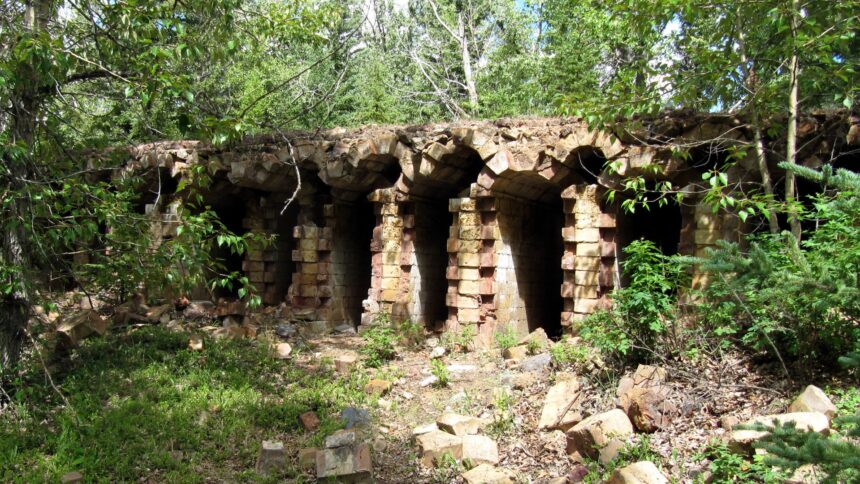
The arches are what people photograph at Lille, a row of dark brick openings set into broken ground, with trees rooted in the rubble in front of them. They look permanent, and yet they have already been taken apart once. According to the Canadian Register of Historic Places, the coke ovens were assembled in Belgium in 1904, tested there, dismantled, and put together again in the Crowsnest Pass, six kilometres northeast of Blairmore.
That is a long way to haul a furnace to a mining camp. West Canadian Collieries, the company running the mines, had fifty of them built, of a design called Bernard, and the Galt Museum’s catalogue entry for an old photograph of the battery describes them as the most advanced ovens of their day. The register adds that no others of the type are known in Canada outside Nova Scotia.
Key facts
- The Canadian Register of Historic Places records that the Village of Lille was formally recognized as a Provincial Historic Resource on January 18, 1978, and listed on the national register on February 26, 2009.
- The Canadian Register of Historic Places states that West Canadian Collieries had 50 Bernard-type coke ovens in service at Lille from 1904.
- The Canadian Register of Historic Places places the population of Lille at nearly 400 between 1907 and 1910, while a University of Lethbridge research document cites a 1911 census count of 303.
- The Canadian Register of Historic Places reports that the Lille mines closed in 1912 and that the townsite was abandoned by 1914.
- The Canadian Register of Historic Places reports that archaeological work at the site has recovered more than 4,500 pieces of cultural material.
The Town Around the Ovens Was Bigger Than the Ovens Suggest
The register counts up to 80 structures on about 130 hectares, among them houses, shops, a school, a hospital and a post office. The settlement began in 1901 as French Camp, and the name Lille came later, in honour of the French town where the company kept its headquarters. A University of Lethbridge document says that by 1906 the camp had a hospital, a four-room school and a hotel.
How many people lived there depends on which record is open. The register gives nearly 400 at the peak, and the Galt Museum’s account of the site says about 400. The university document, citing the 1911 census, gives 303. The dates sit a year or more apart and neither source explains the difference, so this column keeps the two figures apart.
The Record Gives Two Reasons the Mines Closed
The register says the mines closed in 1912 after labour unrest, rising production costs and declining coal quality pushed West Canadian Collieries toward better mines in the south, at Bellevue and Blairmore. The University of Lethbridge document names something else, a sharp fall in the global market for coke that same year. This column reports both and does not rank them.
Whichever carries more weight, the arithmetic is plain. By our count, eight years separate the assembly of the ovens in 1904 from the closing of the mines in 1912, or nine if the Galt Museum’s record of 1904 to 1913 is the one to follow. Machinery that was tested in Belgium before it was shipped here did not last a decade before the mines closed. That says nothing against the brickwork and a good deal about how quickly a coal company could walk away from a good plant.
The Ground Holds More Than the Arches Do
Archaeology teams worked at Lille in the 1970s and 1980s, according to the Galt Museum, and much of the digging went into the privies behind the houses and the garbage dump. The register ties the site’s high integrity to the fact that nobody resettled it after 1914. The Galt Museum’s account lists liniment bottles, a work boot, a tin water bottle, a child’s tea set, harmonica parts and a skate blade among the finds.
A skate blade says nothing about coke. It says that hockey and music were part of life at Lille, and that the most informative remains of the town are small ones.
A Protected Site Still Needs the Town Explained
Protection has done its job on the ground. The province recognized the site in 1978 and the national listing followed in 2009. What the written record has not done, at least in the pages this column opened, is give the town the same weight as the brickwork. The register lists the visible remains starting with the ovens and finishing with hydrants, a hotel foundation and cellar hollows.
We think anything a visitor reads should run the other way, because the ovens explain themselves and a townsite of up to 80 structures does not. We also think the 4,500 recovered pieces deserve a public catalogue. The register page we read does not say where they are held, and an online list would let anyone check the story the ovens suggest against what people actually used.
Beyond the arches stand a few fire hydrants in a townsite with no houses, and the ground is dented with cellar hollows.
Sources
- Canadian Register of Historic Places, Village of Lille, accessed October 3, 2026
- Galt Museum and Archives, article on the Lille archaeological site, April 2015, accessed October 3, 2026
- Galt Museum and Archives, collection record for the Lille Bernard coking ovens, accessed October 3, 2026
- University of Lethbridge research repository, Ghost Town of Lille, accessed October 3, 2026