

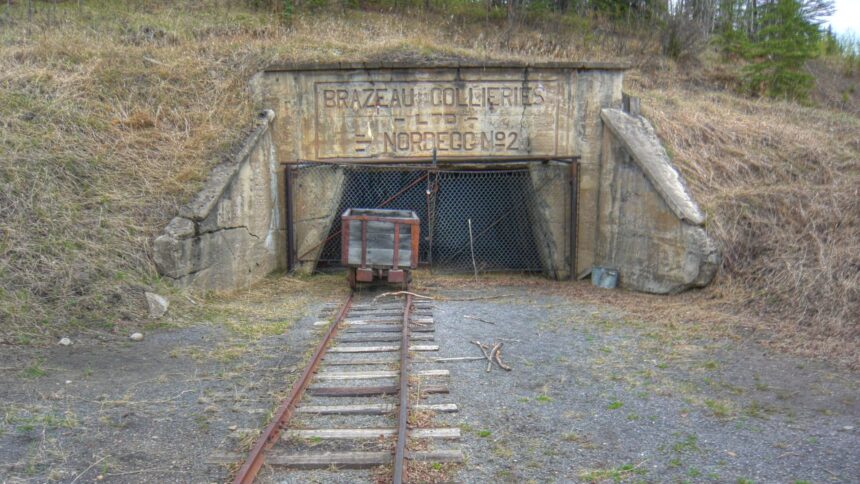
Each of the two mine portals at Nordegg wears a lettered panel over the opening. One reads Brazeau Collieries Ltd Nordegg No. 2 and the other carries No. 3, and below each panel a narrow track runs into the hillside. The mine those letters name closed in January 1955.
The newest big building on the site stood in service for about four years.
Key facts
- Brazeau Collieries began construction of its Nordegg minesite in 1911, about 80 kilometres west of Rocky Mountain House, according to the Canadian Register of Historic Places.
- The Canadian Register of Historic Places states that more than 100,000 tons of coal had been extracted by 1914, when the mine was processing 1,000 tons a day, and that it was the most productive in Alberta by 1923.
- The register records that a fire destroyed the mine’s processing facility in 1950 and that the replacement, built in 1950 and 1951, had a steel frame and sheet metal cladding.
- The register records that railways began converting to diesel locomotives in 1948 and that the mine closed in January 1955 after coal became uncompetitive with fuel oil.
- Alberta designated the 31-hectare site a Provincial Historic Resource on August 25, 1993, and Parks Canada records its designation as a National Historic Site of Canada on October 17, 2001.
The 1950 Fire Left the Company Rebuilding in Steel
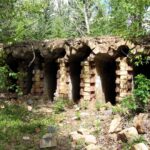
The minesite covers about 31 hectares of hillside. Its two slope mines open through concrete portals, and its support buildings are wood and brick in frame construction. The processing plant is the exception. When fire destroyed the earlier facility in 1950, the register says, the company replaced it with a bigger, newer and fireproof one, built in 1950 and 1951 on a steel frame with a metal skin.
Parks Canada describes what the machinery inside did to the coal. It unloaded it, cleaned it, pulverized it, mixed it and pressed it into briquettes. The register adds that the company borrowed heavily to pay for the rebuild, and it gives no figure.
The Mine Was Alberta’s Most Productive by 1923
The record that justified a rebuild was a good one. Work began in 1911, and by 1914 the mine had produced more than 100,000 tons and was handling 1,000 tons a day. By 1923, the register says, it was the most productive mine in the province.
Parks Canada says the operation was founded to fuel the Canadian Northern Railway and financed by Martin Nordegg and a group of German, Belgian and British investors under a 1909 agreement with the railway. That makes the railways both the reason for the mine and its market.
Diesel Locomotives Removed the Customer
The register says Canada’s railways began converting to diesel locomotives in 1948, and that the cost of hauling coal and the growing supply of fuel oil left coal uncompetitive. The mine closed in January 1955.
By our count, the rebuilt plant ran for about four years, from its completion in 1951 to the closure. The mine itself had been at work since 1911, which by our count is 44 years.
The Newest Building Is the One to Interpret First
Heritage sites tend to lead with the oldest structures, as if age measured value. At Nordegg the order should be reversed. The plant of 1950 and 1951 is the last large investment the record shows, and it carries the most useful lesson on the property, which is that a company can build with confidence and new steel for a market that is already leaving.
That does not make the plant a failure of engineering. The register values the hillside layout that carries coal from the portals through processing to the rail yard, and Parks Canada calls the surface plant the most complete of its kind in the region. The plant is a record of a decision, and the decision deserves a sign that states the dates plainly and lets the reader do the subtraction.
Stand in front of the panel marked No. 2 and look down the track. Everything the coal needed was built downhill, and the last piece of it went up two years after the railways began converting to diesel.