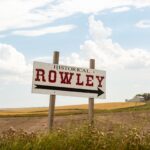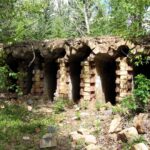


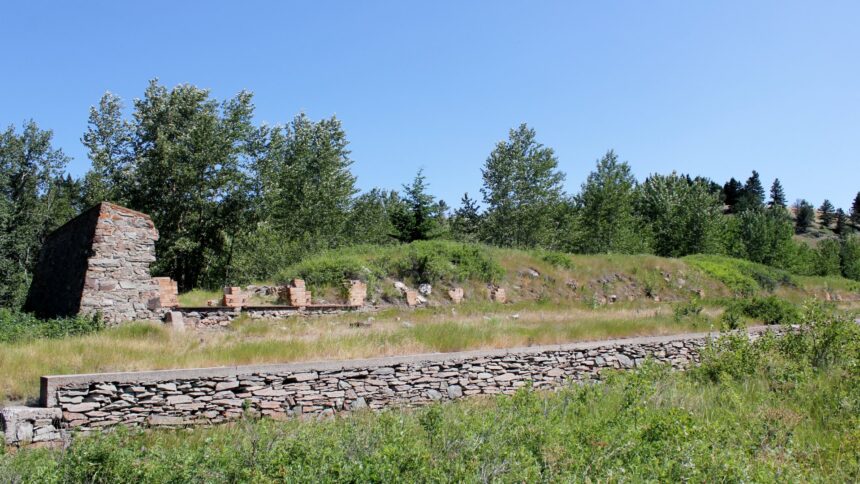
A row of 101 coking ovens lies along the ground near Burmis in the Crowsnest Pass, and the provincial register says only a small number of them were ever used. One published account puts the figure at five. Beside it a low stone retaining wall runs through the grass, and what is left of the works stands in pieces along it.
A long, costly row of ovens, then, and most of it never did the work it was built for.
Key facts
- Leitch Collieries opened in 1907 near Burmis, Alberta, and the site has been a Provincial Historic Resource since August 25, 1976, according to the Canadian Register of Historic Places.
- The Canadian Register of Historic Places records that coal was discovered at the site in 1906 and that the site has 101 coking ovens, of which only a small number were ever used.
- The Leitch Collieries Provincial Historic Site fact sheet states that the washery stood 27 metres high and that the tipple could handle between 1,000 and 2,000 tons of coal a day.
- The same fact sheet states that the sandstone powerhouse was completed in 1910 and supplied electricity to the surface operations and the town of Passburg.
- The Canadian Register of Historic Places says the company failed in 1916, while the site fact sheet says coal production ceased in 1915 and the company was liquidated by 1919.
The Ovens Went In Before the Coal Was Proved Poor
The company moved fast. Coal was found at the spot in 1906 and the colliery opened in 1907. The fact sheet says it was the one operator in the Pass with all-Canadian ownership and management. Its No. 2 Mine was developed in 1909 on a flat known as Police Flats, after the North West Mounted Police detachment that stood there from 1883 to 1901.
The surface works were big. A wooden washery rose 27 metres, and the tipple was rated at 1,000 to 2,000 tons a day. The Alberta Historic Places blog says 101 ovens were installed by 1910.
Then the coal met the fire. It proved poor for coking, and the blog says only five of the ovens were used.
The Powerhouse Outlived the Town It Lit
The powerhouse was finished in 1910. It fed power to the works and to Passburg, which the fact sheet places one kilometre to the west and describes as home to miners and their families. The register adds that the manager’s house, with local sandstone walls, survives, as does a sandstone quarry cut into the hillside above the east end of the ovens and the roadbed of a rail spur along the north edge of the site.
Passburg did not last. The blog says most of its buildings were relocated to Bellevue, another Crowsnest Pass mining community, so the houses left the site and the ovens stayed.
The Record Disagrees on When It Ended
The register says the colliery collapsed in 1916, buried in debt and short of markets, and it blames the 1911 general strike and the outbreak of war in 1914 in part. The fact sheet counts work stoppages in 1909 and 1911 and says coal production halted in 1915 over failed export contracts. It adds that a proposed $1,000,000 sale collapsed when the buyer died and that the company was forced to liquidate by 1919.
Those years do not match, and neither source reconciles them. Production may have stopped in one year and the company in another, but that is our reading and neither source says it. A visitor reading one document would leave with 1915 and a visitor reading the other with 1916.
A Failed Site Is Better Evidence Than a Successful One
Heritage work has a habit of dressing ruins as monuments to enterprise, and Leitch invites it. The row of ovens looks like ambition, and it was. The more useful point is plainer. A company put capital into equipment sized for a coal that would not do the job, and the surviving ovens are the receipt.
The interpretation should say so with the numbers. A sign that gives 101 ovens and the count of those used does more for a visitor than any paragraph about pioneer spirit, because it lets them measure the gap. Heritage that records only the successes teaches people that old things were well judged. The record here says otherwise.
Stand at the stone wall and look along the row. Most of what lies beyond it never burned.