

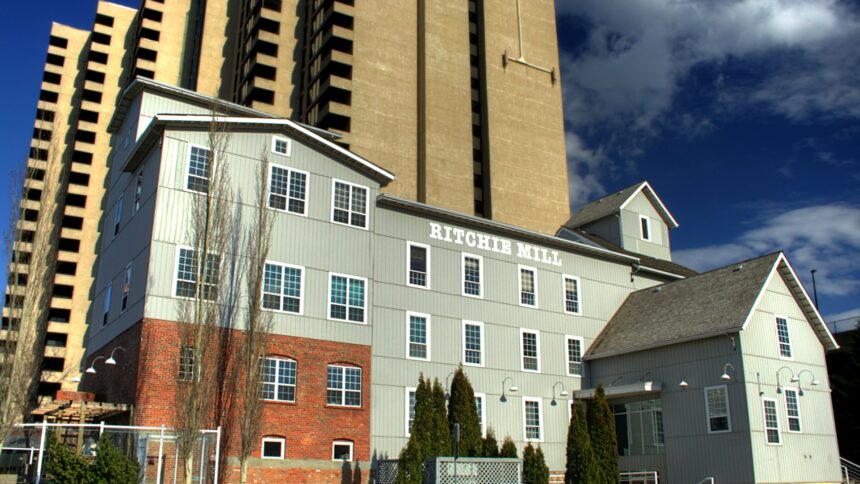
The roofline at 10170 Saskatchewan Drive changes every few metres. A three-storey rectangle gives way to a four-storey elevator with no windows in its walls, then to a partly brick building, then to a two-storey addition set at right angles to the rest. The Canadian Register of Historic Places describes each piece in flat language, and together the pieces make what it calls the oldest surviving flour mill in the province.
Robert Ritchie arrived in 1892 and, by the register’s account, built the original mill within his first year, with its windows set in a regular pattern. Elevators followed in 1895 and 1902. Flour production ended in 1948.
Key facts
- The Ritchie Mill (North West Mill and Feed Company) at 10170 Saskatchewan Drive, Edmonton, was recognized as a Provincial Historic Resource on May 3, 1979, according to the Canadian Register of Historic Places.
- The Edmonton Milling Company, listed at the same address, was recognized as a Municipal Historic Resource on September 9, 1997, according to the Canadian Register of Historic Places.
- The mill stood at the railway terminus the Canadian Register of Historic Places calls the End of Steel, following the arrival of the Calgary and Edmonton Railway in 1892.
- Robert Ritchie served as mayor of Strathcona in 1906, according to the Canadian Register of Historic Places entry for the Edmonton Milling Company.
Steel Rollers Replaced Stone Wheels at Ritchie’s Mill
The register rests its case for the building on the machinery inside it. Ritchie ground prairie wheat with steam-powered steel rollers where stone wheels had been the usual choice, and the register treats that as the reason the mill matters, ahead of its age. A local real estate history reports that the first mill turned out 75 barrels of flour a day, a figure we could not confirm in a primary record.
The End of Steel Chose the Site
The railway from Calgary arrived in 1892, and the mill stood at its terminus. The register links the building to the growth of Strathcona that followed the line, which is a plain statement of cause and place and needs no embroidery.
Ritchie was also an alderman, a school trustee and a justice of the peace before his 1906 term as mayor of Strathcona. Those offices explain why a miller’s name is remembered. They do not explain the building, which earns its protection from the work done inside it.
The later record is thinner and splits in two. The same real estate history says the mill was abandoned and threatened with demolition in the late 1980s, then refreshed as offices and a restaurant in time for its centennial in 1993. A 2017 development news item says only that the interior was converted to office and conference space in the early 1990s. The two accounts agree on the decade and differ on the tenants.
One Mill Sits in the Register Twice
The Canadian Register of Historic Places carries the mill under two names. One entry, Ritchie Mill (North West Mill and Feed Company), records the 1979 provincial designation and was listed on the register on August 3, 2006. The other, Edmonton Milling Company, records a municipal designation in 1997 and was listed on May 18, 2005. Both give the same address and describe the same stepped group of buildings in closely parallel terms. By our count, 18 years separate the two designations.
The Ritchie entry even lists Edmonton Milling Co. among its alternative names, which makes the split harder to explain. In the text we read, neither entry refers the reader to the other.
That is a record-keeping problem with a practical cost. A researcher who searches under one name finds one half of the file. The register should link the two entries, and the municipal one should say plainly that it describes the same buildings the province designated. A mill that outlived its own company name should not also outlive its paperwork.
Age is the weakest argument for this building, and the register does not lean on it. The claim is a machine that replaced a stone, in a railhead town that needed flour.
The stepped outline is still one object, a windowless elevator beside a three-storey rectangle from 1892, carried in the register under two names.
Sources
- Canadian Register of Historic Places, Ritchie Mill (North West Mill and Feed Company), listed August 3, 2006
- Canadian Register of Historic Places, Edmonton Milling Company, listed May 18, 2005
- Edmonton SkyriseCities, Oldest surviving flour mill in Alberta, October 2017
- River City Real Estate, Ritchie Mill history (reported, not primary)