


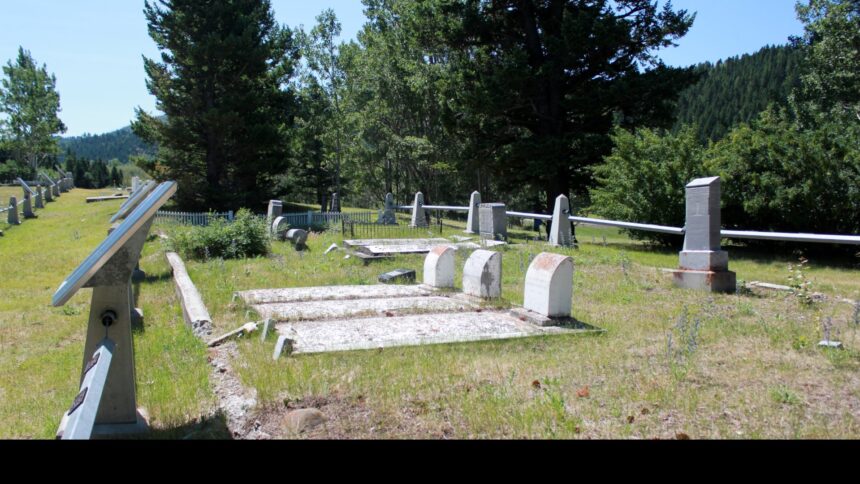
Anyone who enters Old Hillcrest Cemetery from the south climbs a concrete stile set into a long fence strung with steel cable, wire and rail. The Canadian Register of Historic Places describes both as features of the site, along with the grave markers inside.
The cemetery covers 1.45 hectares on the eastern slope of Turtle Mountain, in the Crowsnest Pass. On June 19, 1914, an explosion in the Hillcrest mine killed 189 men. Each source we opened calls it the worst mining disaster in Canada’s history, and each gives 189. Almost nothing else is stated the same way twice.
Key facts
- The Canadian Register of Historic Places records Old Hillcrest Cemetery as 1.45 hectares in the Crowsnest Pass, designated a Provincial Historic Resource on February 11, 1985.
- The Canadian Register of Historic Places states that 189 miners died in the Hillcrest mine explosion of June 19, 1914, and that 180 of them were buried in mass graves at the cemetery.
- The Canadian Register of Historic Places states that 235 workers went underground on the morning of the explosion and that 130 women were widowed.
- Travel Alberta states that a memorial was erected at the cemetery in 2000.
The Count of Men Underground Depends on the Page
The register says 235 workers descended into the mine that morning. Wikipedia’s text and a 2014 newspaper feature say 237, and the Wikipedia infobox gives 228. The figures change what the rescue means. By our arithmetic, 237 men underground less 189 dead leaves 48 survivors, which matches the rescued number in those two sources. The register’s 235 would leave 46.
The families follow the same pattern. The register records 130 widows and 400 fatherless children. Wikipedia and the newspaper feature give 90 widows and about 250 children. Those are not rounding differences. By our count, 130 is about 44% more than 90, in a town both sources put at about 1,000 people.
The Dead Lie in Mass Graves and the Record Cannot Say How Many
The register says 180 of the miners were buried in mass graves at the cemetery. The newspaper feature says most of the men lay in one of two mass graves, the only way a small community could cope. Travel Alberta and Wikipedia each refer to a single mass grave. The Commons files for the photograph chosen here are labelled for a west plot and an east plot.
The same arithmetic applies. The register’s 189 dead and 180 in mass graves leave nine men whose burial places the sources we opened do not give. Some may lie elsewhere, and none of the pages says so.
The Cause Is Still Reported as Probable
The register describes the likely cause as a spark from falling rock igniting a pocket of methane. Wikipedia says the methane ignition set off a coal dust explosion and that the first spark was never found. Both accounts agree on the gas and the dust. They differ on how confident anyone can be about the ignition, and the register is the more cautious of the two.
Alberta Should Publish One Verified Roll
A disaster this large should not have a crew size that moves between 228, 235 and 237. Wikipedia says the Government of Alberta held an inquiry in 1915. Alberta’s heritage staff, working from that inquiry and the burial records, should publish a single roll with the count underground, the names of the dead, their ages and the plot each man lies in.
That is archive work, and it is owed to the families who are still counted three ways. The memorial went up in 2000, according to Travel Alberta, and the record behind it has not caught up with the stone.
Inside the fence, the Commons record shows two plots, one west and one east, and the concrete stile at the south entrance is the way in.




.jpg)