

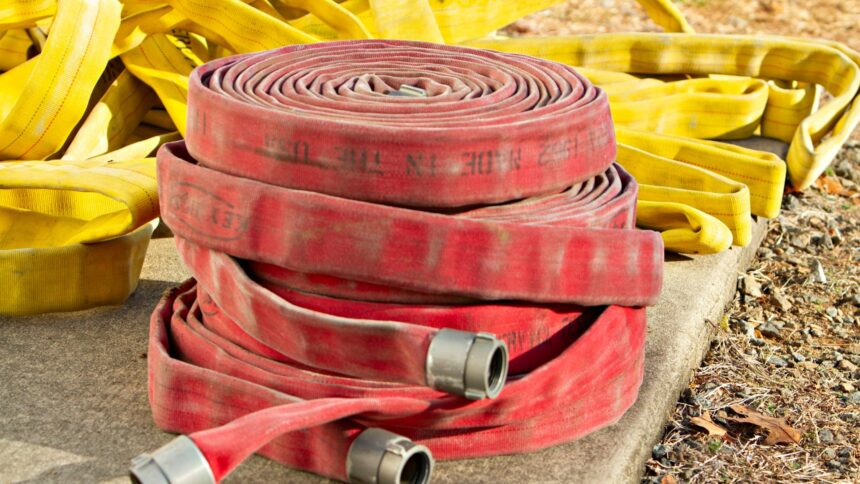
A square brick tower stands at the northeast corner of Calgary Fire Hall No. 1, 50 feet tall, with a domed, copper-covered cupola on top. Its job was plain. Firefighters hung their wet canvas hose inside it to dry.
The hall sits at 140 6 Avenue SE, turned on a diagonal to the street corner so that engines could leave toward either way, and it opened in 1911 with five bays across the front. The Canadian Register of Historic Places names Lang and Major as the architects and records that the building worked as a fire station until 1973.
Fire Prevention Week begins on Sunday, October 4, and ends on Saturday, October 10, under a proclamation signed on August 28 and published in the Canada Gazette on September 23. It is a fair week to read what this hall was built to do, because the machine it was built for had been in the department’s hands for about a year.
Key facts
- Calgary Fire Hall No. 1, at 140 6 Avenue SE, was built in 1911 and served as a fire station until 1973, according to the Canadian Register of Historic Places.
- Alberta designated the building a Provincial Historic Resource on March 11, 2009, according to the Canadian Register of Historic Places.
- The building has five front bays and a 50-foot hose tower with a domed roof, according to the City of Calgary’s Fire Hall 1 project page.
- The City of Calgary reports that its fire department kept 21 horses by 1911 and retired the last of them in 1933.
- Fire Prevention Week 2026 runs from October 4 to 10 under a proclamation published in the Canada Gazette, Part II, on September 23, 2026 (SI/2026-49).
The Hall Was Built for Trucks the City Had Barely Bought
Calgary did not have a motorized fire truck until 1910, according to a broadcaster’s history of the city’s horses, so the bays facing 6 Avenue were laid out for a fleet that hardly existed yet. The City of Calgary describes those five bays as built for motorized engines. The diagonal corner and the tall tower belonged to the same plan, a building arranged around how quickly a crew could leave and how quickly its hose could be made ready again.
The second floor held the firefighters’ living quarters. The Register reads the whole building as the point where Calgary moved from volunteer firefighting to a professional, mechanized service.
The Horses Kept Working for Twenty-Two More Years
The City counts 21 horses in the department by 1911 and says the last were retired in 1933. The Calgary Heritage Initiative sharpens the date, recording that Old Fire Hall No. 3 in Inglewood housed the city’s last horse-drawn engine when it was retired that year. By our count, 22 years had passed since Hall No. 1 opened, and more than two decades separate the first motor truck in 1910 from the last horse.
Chief James “Cappy” Smart, who took part in planning Hall No. 1 and led the department from it, also retired in 1933. The record does not tie the two events together, and neither should we. What it does show is a department running a stable and a motor pool at once, in a building drawn up for only one of them.
The 1886 Fire Is Why a Young City Paid for It
On November 7, 1886, a fire that began at the rear of a flour and feed store on what is now Ninth Avenue destroyed about 18 buildings, with losses the City puts at $103,200. Volunteers broke into a Canadian Pacific Railway freight shed to reach a chemical engine that had been impounded over unpaid freight charges, and they stopped the flames by pulling down a shop that had belonged to a former mayor. Nobody was killed or hurt. Officials afterward bought a $4,000 steam engine and pushed builders toward sandstone over wood.
Twenty-five years later the census counted about 43,700 people in Calgary, and the town that once had to force its way into a freight shed for a fire engine had a headquarters with a tower, a diagonal corner and a row of bays. That is what a city buys after it has watched a main street burn.
A Heritage Listing Protects the Shell and Use Pays for the Roof
Alberta designated the hall in 2009, 36 years after the department left. In between, a car rental company leased the building. The City’s project page dates the lease from 1989 to 2019, while Alberta Historic Places puts its start in 1983, so the sources disagree by six years on when it began. Either way, by our count the hall had spent at least 20 years under that tenant before any provincial designation existed.
The record suggests the building survived because someone paid to occupy five truck bays, and the paperwork came later. Nothing about its age makes it an easy fit now. A hose tower and five bays suit a narrow range of tenants, and the City’s own page says the work remains at the planning stage.
That page records that the City and cSPACE, an arts organization, signed a memorandum of understanding in April 2025 to plan an arts and culture hub across the hall and the neighbouring North-West Travellers building. It lists no funding figures and no construction date.
Planning is a sound first step, and it is also where old halls get into trouble. A designation stops a demolition permit. It does not pay for heat, roof repairs or insurance, and a brick building waiting on a plan is still being rained on. The City should publish a date for the first tenant, because the 1911 record points to use, more than designation, as what keeps a hall standing.
From 6 Avenue SE the tower is still the first thing the eye finds, 50 feet of brick with a copper-covered cupola, standing where wet canvas hose once hung.
Sources
- Canadian Register of Historic Places, Calgary Fire Hall No. 1 (accessed October 2, 2026)
- Canada Gazette Part II, Proclamation Designating Fire Prevention Week, SI/2026-49, September 23, 2026
- City of Calgary, Fire Hall 1 and North-West Travellers Building project page (accessed October 2, 2026)
- City of Calgary newsroom, The great fire of 1886 and the birth of sandstone buildings in Calgary (accessed October 2, 2026)
- Alberta Historic Places, Calgary Fire Hall No. 1, February 23, 2011
- Calgary Heritage Initiative, article on Old Fire Hall No. 3 (accessed October 2, 2026)
- CBC Calgary, Calgary history of horses (accessed October 2, 2026)
- Statistics Canada, 1911 census table (accessed October 2, 2026)