A semaphore arm is still mounted on the roof of the Meeting Creek station, up among the wood shingles, the exposed rafter tails and the two brick chimneys, where a train crew could read it long before anyone stepped off onto the platform. The Canadian Northern Railway built the one-and-a-half-storey depot on Railway Avenue in 1913, two years after it laid a line between Camrose and Stettler. The settlement wasn’t on that line. It sat five miles east of the new track, roughly 8 km by Alberta Tribune’s arithmetic, so the community packed up and moved to the rails.
The move is set down plainly in the province’s statement of significance for the station, which says the settlement relocated so it could be part of the new townsite. Staying put would have meant hauling every load of grain five miles to the siding.
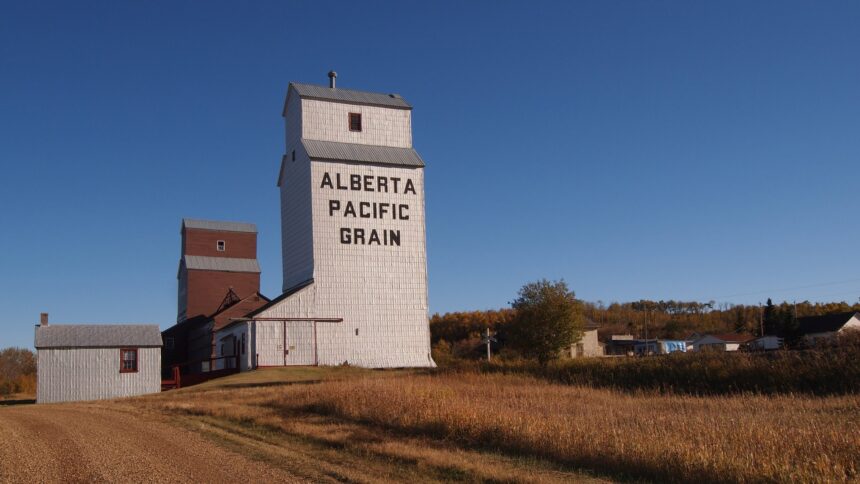
Beside the depot stands the Alberta Pacific Grain Company elevator, a wooden crib building with sloping shoulders, a cupola and a skin of pressed tin, built to hold 26,000 bushels. The provincial register entry for the elevator dates it to sometime between 1914 and 1917, while the Canadian Northern Society, which looks after it, gives 1917. Both buildings are Provincial Historic Resources, and both are still standing where the railway put them.
Key facts
- The Canadian Northern Railway Station at Meeting Creek was built in 1913 and designated a Provincial Historic Resource on January 30, 2008, according to the Canadian Register of Historic Places.
- The Alberta Pacific Grain Elevator Site Complex at Meeting Creek, with a storage capacity of 26,000 bushels, was designated a Provincial Historic Resource on October 19, 2001, according to the Canadian Register of Historic Places.
- The Canadian Northern Railway built a line between Camrose and Stettler in 1911, and the Meeting Creek settlement then lay five miles east of the new track and depot, according to the provincial statement of significance for the station.
- The Canadian Northern Society acquired the Meeting Creek depot from CN in 1986 and received the Alberta Pacific elevator as a donation in 1990, according to the society’s published site history.
One agent ran the whole station from a single building
The depot follows Plan 100-29, the most common pattern for the Canadian Northern’s third-class stations, drawn by Ralph Benjamin Pratt. Inside, one roof covered an office, a waiting room, a freight shed and the rooms where the agent and his family lived. According to the province’s historic places stewardship blog, the agent handled every passenger and every shipment in and out, grain included, and also worked as the district telegrapher.
Repeat that building along every new branch line and farm Alberta takes shape. In 1909 Premier Alexander Rutherford offered the big railway companies bond guarantees to extend track across the province, and the Canadian Northern was one of the companies that took the offer. Towns like Meeting Creek were the result. Camrose, Donalda and Bashaw were close enough to keep it small, but the railway still gave it three grain elevators. The station stayed open until the 1960s, when better highways made it surplus.
Alberta Tribune has followed the same pattern in the province’s vanishing wooden elevators and in St. Albert’s 1929 elevator, where the machinery also survives.
The Meeting Creek elevator still holds its working machinery
What makes the Alberta Pacific elevator worth the drive is what’s left inside. The register lists the elevator leg, the scales, the control wheel and levers, electric motors, belts and pulleys, wood bins and chutes, an air-pressurized hoist and the man-lift, all in place. It calls the building a rare example of an early elevator and ties it to grain handling from before the big co-operatives of the 1920s. The drive shed, the office and engine house, and a storage and fuel shed sit on the same 215 square metre lot.
Grain stopped moving through it in 1984. Vulcan, where a whole row of elevators came down to one, shows how that story can end.
Volunteers kept the station and elevator from being lost
The society’s own timeline reads like a rescue log. It took the depot from CN in 1986 in poor condition. The register says the station was extensively restored in 1988 to look the way it did between 1940 and 1950. The elevator came to the society in 1990, and when the railway through Meeting Creek was abandoned in 1997, Central Western Railway donated part of the main line and the elevator track so the buildings wouldn’t be stranded without the rails that explain them.
The rescue came from a volunteer society raising its own money, the same kind of unpaid work behind Alberta’s volunteer-built tourism network.
The grounds at Meeting Creek are open all year
The Canadian Northern Society says visitors can walk the site year-round, including a grassland trail that runs 2 km one way along the old right-of-way. The station and elevator interiors open during community events when volunteers are on hand, or by appointment at 780-672-3099. In November, call first.
Stand on the wooden platform and look up. The semaphore is still there over the track, with the tin-clad elevator rising behind it, both of them on the ground the railway chose in 1911 and the town followed it to.