

Key facts
- On July 22, 2024, wildfires forced the evacuation of about 25,000 residents, workers and visitors from Jasper National Park. On July 24, the fire reached the townsite.
- Of the town’s 1,113 structures, 358 were destroyed, about 30%. All critical infrastructure, including the hospital, schools and wastewater plant, was saved.
- The fire burned roughly 32,700 hectares. It was declared under control on September 7, 2024, and extinguished on April 1, 2025. Wildland firefighter Morgan Kitchen, 24, of Calgary, was killed.
- The Valley of the Five Lakes trail reopened in summer 2026 on a rebuilt trail, with a realigned section, improved surfaces and signage, and new rest areas.
- Cavell Road and Maligne Canyon remain closed through the 2026 season while Parks Canada assesses debris flow and landslide risk on the burned slopes.
The short answer
Two summers after the 2024 fire, Jasper’s recovery looks like two different things at once. In the townsite, it looks like construction fencing, insurance paperwork and a long, expensive rebuild. On the trails, it looks like something older and more certain: a burned forest doing exactly what burned forests do, greening up from the black. Both are real. Neither is the whole story.
This column is not a damage report. The damage was reported, exhaustively, in 2024. It is an account of what the second summer looks like, for a place that is still deciding what “back” means.
The valley
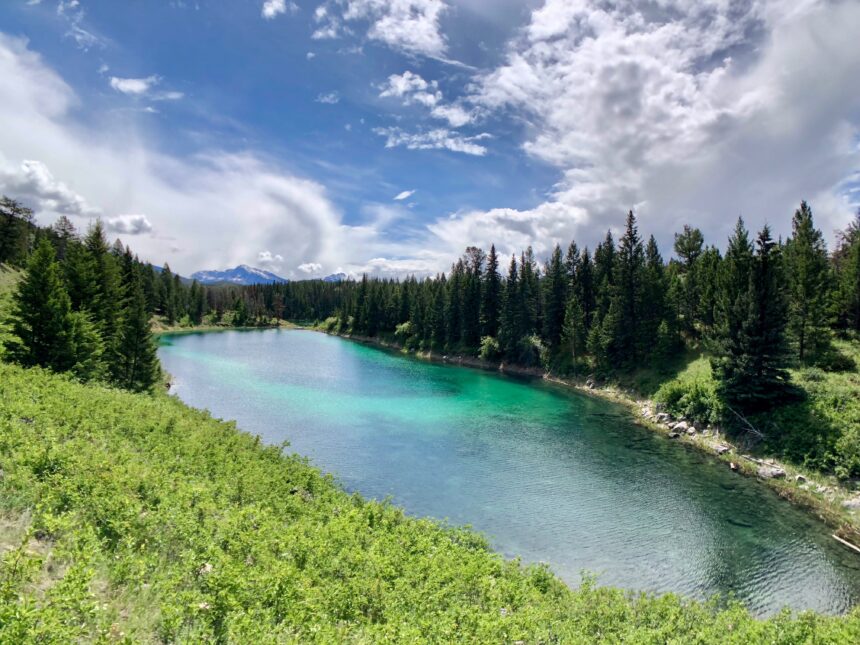
Start where the recovery is furthest along. The Valley of the Five Lakes has always been Jasper’s gentlest introduction: a 4.5-kilometre loop past five small lakes, each a slightly different shade of green, easy enough for children and grandparents. The fire burned through here, and the trail closed.
It reopened in the summer of 2026, and Parks Canada did not simply clear the old path. The trail was rebuilt with a realigned section, better surfaces, new signage and rest areas placed for comfort and accessibility. Walk it now and the first thing you notice is the light. Where the canopy burned, the sun reaches the forest floor, and the floor is green again. Fireweed, then shrubs, then the slow return of young trees. The lakes are the same colour they always were. The forest around them is younger.
There is a temptation to call this a rebirth, and the word is not wrong, but it is incomplete. What is happening in the valley is not a miracle. It is the ordinary, well-understood mechanics of a lodgepole pine forest, which has burned and regrown on roughly this cycle for millennia. The fire did not break the valley. It reset it.
What the fire took
The townsite is the harder part to write about, and it should be. On the night of July 22, 2024, about 25,000 people left Jasper in a matter of hours. Two days later the fire was in the town. When the damage assessment came back, the number was 358 of 1,113 structures destroyed, close to a third of the town, concentrated in the west end. Churches, homes, businesses, the hostel. The hospital, the schools, the fire hall and the wastewater plant were saved by the crews who stayed.
One firefighter did not come home. Morgan Kitchen, 24, from Calgary, was killed fighting the fire. His name belongs in any honest account of that summer, ahead of the statistics.
The financial scale is still settling. Insurance claims from the fire ran to about $880 million, making it one of the costliest natural disasters in Canadian history. Parks Canada lost 255 of its own infrastructure assets in the park, 132 of them a total loss. Rebuilding the townsite is measured in years, not seasons, and Parks Canada is providing interim housing into 2028 for displaced residents and the business community.
None of this is abstract for the people who live there. A column written from Calgary should not pretend otherwise, and it should not dress the loss up in pretty language about renewal. A third of a town burned. The renewal is real, but so is the grief, and they are happening in the same streets.
What reopening actually looks like
Here is the part visitors ask about, and the answer is better than the fear. Virtually all of Jasper’s trails have reopened. Along with the Valley of the Five Lakes, the Wabasso Lake and Curator trails reopened in summer 2026, and Trail 9 reopened with rerouted sections and rebuilt switchbacks. Maligne Lake is running, the Skytram is running, the town’s surviving hotels and restaurants are open.
Two notable exceptions remain, and they are instructive. Cavell Road and Maligne Canyon are closed through the 2026 season. The reason is not bureaucracy. With the trees and vegetation gone from the steep slopes above them, the risk of debris flows and landslides has risen sharply, and Parks Canada is still assessing how to make the areas safe. A burned slope above a road is a different engineering problem than a burned slope above a trail. The closures are the honest version of recovery: some places come back in two summers, and some places need longer.
The economics of coming back
There is a quieter recovery happening underneath the visible one. Jasper’s economy runs on visitors, and visitors need beds, meals and open trails. Every reopened trail is a small economic event. Every rebuilt hotel room is a larger one. The town that lost a third of its structures is rebuilding its capacity to host people at the same time as it rebuilds its capacity to house its own residents, and those two projects compete for the same workers, the same materials and the same housing.
This is the part of recovery that does not photograph well. It is permits and contractors and insurance adjusters. It is also the part that determines whether Jasper in 2030 is a town that survived a fire or a town defined by one. The early signs are the ones you would hope for: the trails filling in first, the townsite following, the critical infrastructure intact throughout.
The image to keep
Stand at the third lake in the Valley of the Five Lakes on a still evening, two summers after the fire. The peaks have not changed. The water has not changed. The forest around you is younger than the one that burned, thinner, letting in more sky. In ten years it will be thicker. In fifty, a hiker who never heard of the 2024 fire will walk this loop and see nothing but old forest.
That is what recovery really looks like. Not a return to what was, because that forest is gone and that town is changed. A restart, on the same ground, at the pace the ground sets. The valley got there first. The town is on its way.
Frequently asked questions
When did the Jasper wildfire happen?
On July 22, 2024, wildfires forced the evacuation of about 25,000 residents, workers and visitors from Jasper National Park. The fire reached the townsite on July 24. It burned roughly 32,700 hectares, was declared under control on September 7, 2024, and was extinguished on April 1, 2025.
How many buildings were destroyed in the Jasper fire?
Of the town’s 1,113 structures, 358 were destroyed, about 30%. All critical infrastructure was saved, including the hospital, schools and wastewater plant. Wildland firefighter Morgan Kitchen, 24, of Calgary, was killed.
What has reopened in Jasper since the fire?
The Valley of the Five Lakes trail reopened in summer 2026 on a rebuilt trail, with a realigned section, improved surfaces and signage, and new rest areas.
What is still closed in Jasper in 2026?
Cavell Road and Maligne Canyon remain closed through the 2026 season while Parks Canada assesses debris flow and landslide risk on the burned slopes.