

The stair treads inside Victoria School at 411 11 Avenue SE are slate, and the register that protects the building lists them beside the carved stone lettering over its doors as features worth keeping. The same record gives the autumn of 1918 a single clause. The school, built of Paskapoo sandstone in 1912 and 1913, was one of four Calgary school buildings that served as an emergency hospital when influenza reached the city.
It reached Calgary at 4 a.m. on October 2, 1918, on a troop train into the Canadian Pacific Railway station, and twelve sick soldiers were sent out to the army camp at Sarcee, by a Calgary newspaper retrospective. Five days later, on October 7, the city recorded its first death. That was the beginning of a long autumn in which a school built for the children of Victoria Park was handed over to the sick.
Key facts
- The Canadian Register of Historic Places records that Victoria Sandstone School, 411 11 Avenue SE in Calgary, was built in 1912 and 1913 and became a Municipal Historic Resource on November 15, 2004.
- The same register entry states that the building was one of four school buildings used as an emergency hospital during the influenza epidemic of 1918.
- The Alberta Medical Association’s Alberta Doctors’ Digest reports 38,308 influenza cases and 4,380 deaths recorded in Alberta, in a population of 500,000, during the 1918 and 1919 epidemic.
- The Alberta Doctors’ Digest dates the mask requirement outdoors to October 25, 1918, with courts closed on October 18 and non-essential stores closed on October 30.
- Alberta Culture reported on June 10, 2020 that the Provincial Archives of Alberta holds a 1918 public health scrapbook, Executive Council orders, court files and death certificates from the epidemic.
Calgary’s Health Officer Gave Orders Before the Law Caught Up
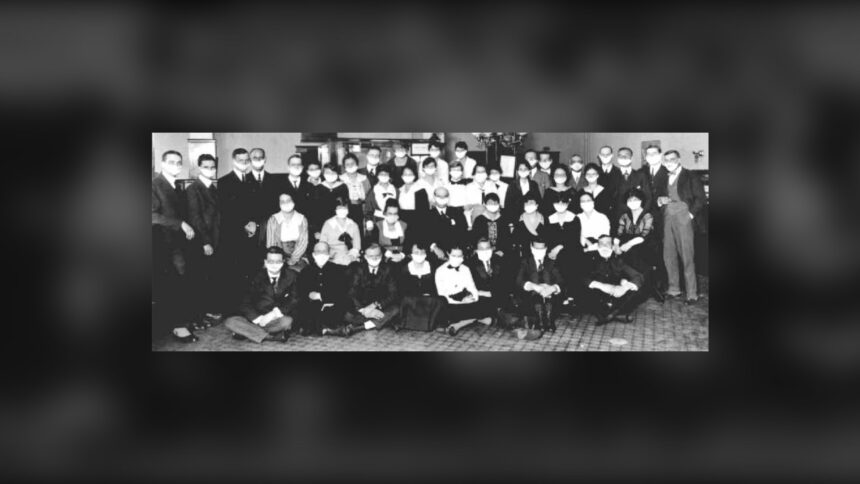
Dr. Cecil Mahood, Calgary’s medical health officer, was giving orders in October 1918 that the statutes had not yet caught up with. The province amended its Public Health Act on October 16, and the courts closed two days later. Masks were first required on trains and streetcars, with medical students riding the rails to check, according to the Alberta Doctors’ Digest, and the rule reached the sidewalk on October 25. Many people were fined. By October 30 every store that was not essential had shut.
The city did not agree with itself. On November 4 the city council voided Mahood’s orders, and the board of health stepped in and backed him. Two smaller details come from a retrospective on the same weeks. Masks sold for 10 cents each from nurses at the Memorial Park Library, and the fire chief, caught without one, is said to have answered that he could not give orders through it.
The Glenbow photograph that opens this page shows masked bank staff in Calgary in 1918. It is what the October order looked like on the far side of a counter.
Alberta’s Official Count Is Probably Low
The figure that survives is 4,380 deaths in Alberta out of 38,308 recorded cases. By our count that is about 0.9% of the province’s 500,000 people, and about 11.4% of those known to be ill. The retrospective puts the Calgary toll at 384 and says that number is likely understated, and the Alberta Doctors’ Digest notes that many at the time felt the provincial figures under-reported the cases.
A total that the sources themselves distrust is a floor. It leaves out households that never saw a doctor, and it says nothing about where the sick were kept.
One Clause Is Too Little Record for Four Hospitals
The Victoria School entry is one of the few public records that ties a standing Calgary building to the epidemic, and it does so in a single clause that does not name the other three schools. That same account names Colonel Walker School in Inglewood as an emergency hospital and describes Victoria as a convalescent ward. The detail exists, scattered through a news story, and has no home in the register that is meant to carry it.
Our position is that this is a small, fixable neglect. The Provincial Archives already holds the scrapbook, the orders and the court files. A municipality that recognized the building in 2004 could add the four schools and the dates they served to the entry, and the cost would be a few lines of text. A register that lists the treads and the railings can find room for the patients.
Over the doors the stone still reads VICTORIA SCHOOL, cut there before the epidemic and left alone by it.
Sources
- Canadian Register of Historic Places, Victoria Sandstone School record, accessed October 2, 2026
- Alberta Medical Association, Alberta Doctors’ Digest, “The 1918-19 Spanish Flu in Alberta,” May-June 2020
- Alberta Culture, Alberta’s Historic Places, “International Archives Week,” June 10, 2020
- CBC News, Calgary history and the Spanish flu, 2020
- CBC News, “100 years ago, a train carrying Spanish flu pulled into Calgary,” 2018