
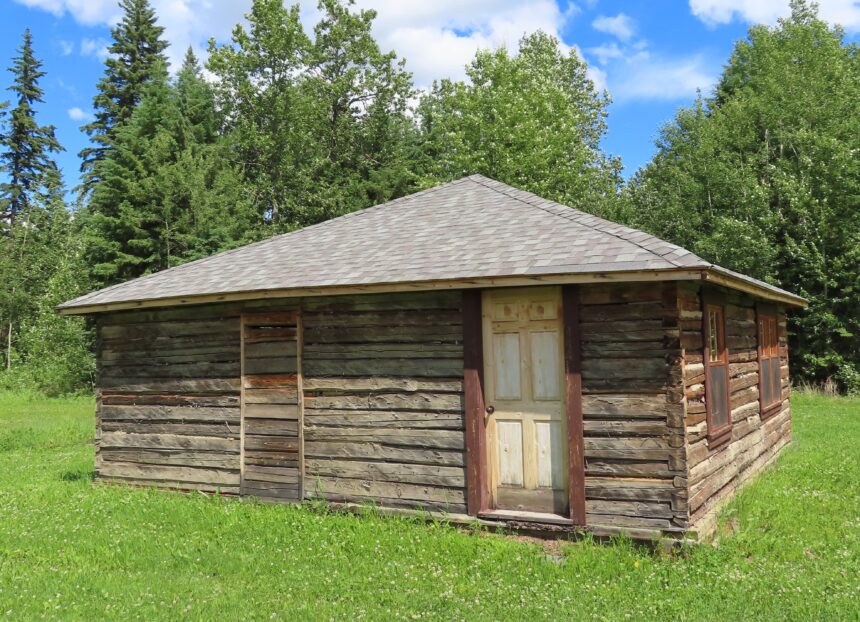
In 1910 Alberta had 1,501 school districts running 1,195 schools, most of them in the country, according to Alberta Historic Places. A century and more later Alberta Historic Places can name only a handful of those schoolhouses as restored. The ones that survived did not do so because they were old or pretty. They survived because somebody gave each one a job.
Key facts
- Alberta’s first one-room schoolhouse went up in Edmonton in 1881, and one teacher taught every grade in the room, with attendance ranging from a few pupils to almost 100, per Alberta Historic Places.
- Shilo School, east of Caroline, was built by its community in 1910 for $800, closed in 1952 when students were bused to Caroline, and now serves as a community centre.
- Verdun School near New Norway was built in 1902, served as a community hall and church as well as a school, and became a Provincial Historic Resource on October 26, 2000, according to the Canadian Register of Historic Places.
- William Peter Baergen’s book Pioneering with a Piece of Chalk covers the one-room country schools of Alberta from 1885 to 1982.
Districts built their schools before they could afford them
The buildings were modest by design and built by the people who would use them. Provincial rules asked for a well-drained site, about 15 square feet per student, 11-foot ceilings, porches and cloakrooms, and a bank of windows on the students’ left. When districts built poorly, the Department of Education bought standard plans, some drawn by the Provincial Architect’s office and some from a manufacturer, and the pattern shows up in Chailey School north of Manville. Shilo cost $800 and the land cost $2.00. That was the scale of the investment and the scale of the faith behind it.
The new system gave real gains. Under Premier William Aberhart, one-room schools declined after 1936 as the province phased out one-room schools in favour of multi-room, multi-teacher ones, which cut costs and standardized what a child learned. A pupil bused to a larger school generally got more than a single teacher could offer. The cost was the building, and the building was also the district’s hall.
The survivors found a second occupation
Shilo closed as a school in 1952 and is now a community centre. Verdun, originally New Berlin School, was renamed in 1918 during the anti-German feeling that followed the First World War, offered classes until 1952, and had already doubled as a hall and a church. Chailey, completed by fall 1910, kept the tall multi-paned windows, cedar shingles and brick chimney of the standard plan, and the Alberta Historic Places article counts the three as restored schools.
This is the part the heritage conversation gets backwards. It treats saving buildings as if the building were the point. A schoolhouse that becomes a community hall hasn’t been preserved as a monument to schooling. It has been kept alive as a place where people still gather, which is what it was all along. The same logic shows up in the Dorothy grain elevator, saved because it photographed well and in the museum at Etzikom.
Schoolhouses nobody uses are running out of time
There are still schoolhouses on Alberta farmland with no owner and no use, and their prospects are poor. The honest options are the ones the survivors show: an owner who will maintain it, a congregation, a municipality that will program it, or a family that will live in it. Failing that, the building needs documentation, with photographs, measurements, district records and teachers’ names, collected before the roof goes. The slow alternative is familiar. Paint goes, windows go, the walls lean, and one spring the building isn’t there.
Shilo School still stands east of Caroline, doing duty as a community centre.