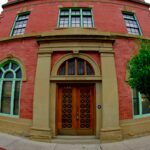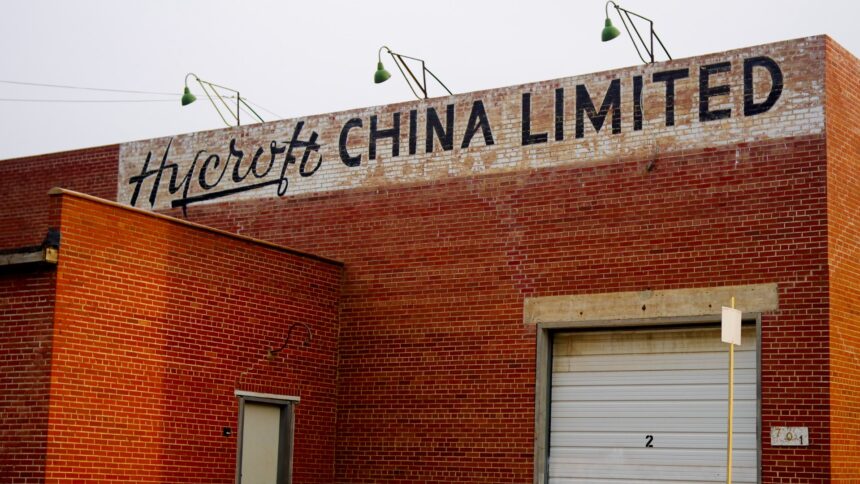
A photograph from September 2012 shows the words Hycroft China Limited stretched across red brick on Wood Street in Medicine Hat, with a row of green-shaded lamps on curved arms above the lettering and a white roll-up door below it. The Canadian Register of Historic Places says the plant that carried that name kept running until the late 1980s.
The building is a one-storey red-brick factory with a clerestory, glass block sidelights and curved walls in the Art Moderne manner. It went up in 1937 and 1938, and the register records a warehouse added in 1947.
Key facts
- The Canadian Register of Historic Places records the Hycroft China Ltd. Factory at 701-703 Wood Street, Medicine Hat, as built in 1937 and 1938.
- The Canadian Register of Historic Places states that Alberta designated the factory a Provincial Historic Resource on August 16, 1995.
- The Canadian Register of Historic Places describes a circular tunnel kiln more than 20 metres in diameter, which it calls the largest of its kind in Canada at the time.
- The Canadian Register of Historic Places gives the site as about 4.475 hectares, including the factory, a 1947 warehouse, gas works structures and a railway right of way.
The 1938 Plant Came With Radio Speakers and Water Fountains
Medalta, the heritage organization in the same city that tells the story of its clay industry, lists what went inside the new plant: a blue interior colour scheme, loudspeakers for radio broadcasts, soft drink coolers, water fountains and modern safety equipment. The register adds that clerestory windows let daylight into the building. Neither source offers a worker’s account of how any of it was used, so the list shows what the owner chose to install and nothing about what a shift felt like.
The Plant Changed Names and Owners After the War
The register says J. Harlan “Hop” Yuill founded the Medicine Hat Pottery Company in 1938. A Carleton University collections record says the plant made thin china, which kept it out of the army’s wartime utility ware orders. Marwell Construction of Vancouver bought it in 1955 and renamed it Hycroft China, according to the register. Harry Veiner, whom the register calls the city’s mayor, bought it next, and under him the line grew to include toilets and sinks beside the pottery and souvenirs.
The Sources Disagree on Dates by a Year
The register and Medalta put Veiner’s purchase in 1957. The Carleton record says 1956. The register says the plant closed in the late 1980s, while the Carleton record gives 1989 and adds that the company was dissolved in 1992 and that toilets arrived in 1960. A local newspaper’s heritage feature says Friends of Medalta acquired the factory in 1992. None of the accounts opened says where its year comes from, so each year is given with its source and the choice is left open.
The Kiln Deserves a Drawing Before the Next Flood
The register calls the circular tunnel kiln the largest of its kind in Canada when it was built and gives its diameter as more than 20 metres. Every account opened that repeats the superlative uses wording close to the register’s, and none cites a comparison. That does not make it wrong, but a claim of that size needs a number behind it, and a structure that big can be measured.
The fix is modest. The province designated the factory in 1995, and the register’s description of the kiln runs to a single sentence. The same newspaper feature says the site took damage in the 2013 flood and from vandals. A measured drawing and a set of interior photographs, made before any further loss, would give the next restorer something firmer than a superlative to work from.
Above the lettering, the lamps lean out on curved arms toward a name the company stopped using in the late 1980s.
For another Alberta industrial landmark, see the Atlas Coal Mine tipple at Drumheller.
Related from Alberta Tribune: Rossdale Power Plant Still Carries Its Building Dates In White Bands · How A Medicine Hat Pottery Filled Kitchens Across Canada