

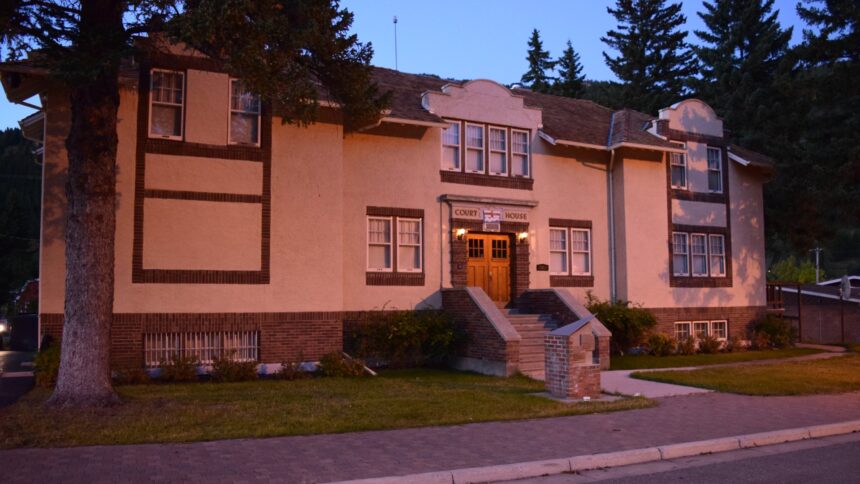
The courthouse in Blairmore is a two-storey building of buff stucco with brick framing the entrance, a hipped roof of clay tile and curved gables, and it stands at 13427 20 Avenue in the Crowsnest Pass. The Canadian Register of Historic Places says its designer drew on the missions of the American southwest. Nothing on the street side suggests a building put up to hold prisoners, yet the register records that it opened in 1923 with offices and barracks for the Alberta Provincial Police and holding cells for men and for women, all under one roof with the courtroom.
The Department of Public Works commissioned the building in 1922 to a design by R.P. Blakey. The register calls it the first courthouse in Alberta to include both police and court facilities. The reason was local. The register ties it to the bootlegging and smuggling that followed Prohibition in 1917, among other policing problems in the district.
Key facts
- Blairmore Courthouse at 13427 20 Avenue in the Municipality of Crowsnest Pass was commissioned in 1922, opened in 1923 and designed by R.P. Blakey of Alberta’s Department of Public Works, according to the Canadian Register of Historic Places.
- The Canadian Register of Historic Places calls Blairmore Courthouse the first courthouse in Alberta to include both police and court facilities.
- Alberta designated Blairmore Courthouse a Provincial Historic Resource on May 21, 1993, and the Canadian Register of Historic Places listed it on May 6, 2005.
- The Canadian Register of Historic Places records that Alberta Provincial Police constables arrived in the Crowsnest Pass in 1918 and that the force was disbanded in 1932.
The Cells Were Part of the Plan
Provinces built plenty of courthouses in the 1920s. What sets this one apart is the plan. It puts the police in the same building as the judge, which shortens the distance between an arrest and a hearing in a district with a liquor trade to police. That is our reading of the register’s description, and it is an administrative answer to a policing problem set into stucco and tile. The register’s claim of a first is its own, and we did not test it against other courthouses.
Courthouses.co says Blakey also designed courthouses at Medicine Hat, Taber and Vegreville. We found that in no other source. If it holds, Blairmore is the one with a mission facade over a barracks, which may make it the least typical of his work.
The Police Half of the Building Lost Its Tenant Quickly
The force the barracks were built for did not last. The register entry for the Alberta Provincial Police building in Coleman says the force was disbanded in 1932 and that the Royal Canadian Mounted Police again assumed police duties. By our count, that is nine years after Blairmore’s courthouse opened.
The register lists the original courtroom and staircase among the features to protect. The sources we opened say nothing about what became of the barracks wing and the cells after 1932, and nothing about how they are used now. That gap is itself worth noting, because it is the part of the building that made it unusual.
A Style Label Hides the Reason It Was Built
Our position is that the way this building is usually described does it a disservice. “Spanish-Colonial Revival” tells a reader what the stucco looks like and nothing about why the Crowsnest Pass needed a courthouse with a barracks inside it. The combined function is the distinctive fact, and it belongs at the front of any sign, any walking tour and any listing.
Designation in 1993 protected the fabric, and the register’s own statement is accurate on the function. The weakness is in the retelling. A building known by its style is easy to describe and hard to explain, and explanation is what keeps a building worth defending.
From the sidewalk, the stucco and clay tile give no sign of the cells inside.
Sources
- Canadian Register of Historic Places, Blairmore Courthouse, accessed October 2, 2026
- Canadian Register of Historic Places, Alberta Provincial Police Building, accessed October 2, 2026
- Heritage Guide, Blairmore Courthouse, accessed October 2, 2026
- Courthouses.co, Blairmore courthouse, accessed October 2, 2026