Bill C-264 lost 191 to 132 in the House of Commons on October 28, 2026, so the federal Oil Tanker Moratorium Act still governs British Columbia’s north coast. Two days earlier, Premier Danielle Smith and Minister of Energy and Minerals Brian Jean issued a joint statement backing the private member’s bill and pointing to a crude-by-rail export option through Prince Rupert. LEGISinfo records the result as Vote 186, negatived at second reading, with 8 members paired.
The bill, sponsored by Calgary Signal Hill MP David McKenzie and first read on March 11, 2026, had one operative idea, stated in its summary: it repeals the Oil Tanker Moratorium Act. It did not authorize a terminal, a rail contract or a pipeline. The plain answer to whether the north coast tanker ban still applies after the October 28 vote is yes, and the engineering questions behind the Prince Rupert idea are exactly where they were before the House sat.
Key facts
- Bill C-264, An Act to repeal certain restrictions on shipping, was defeated at second reading in the House of Commons on October 28, 2026, by a vote of 191 to 132, according to LEGISinfo.
- The Oil Tanker Moratorium Act, assented to on June 21, 2019, bars oil tankers carrying more than 12,500 metric tons of crude or persistent oil from mooring or anchoring at ports on British Columbia’s coast north of 50°53′ north latitude, according to the Act on the Justice Laws Website.
- A vessel convicted on indictment under the Oil Tanker Moratorium Act faces a fine of up to $5,000,000, according to section 25 of the Act.
- The Government of Alberta joint statement of October 26, 2026, says the tanker ban does not cover natural gas, natural gas liquids or other commodities.
- The Prince Rupert Port Authority says the Ridley Island Propane Export Terminal receives about 50 to 60 rail cars of propane a day over CN’s rail network.
What the Bill C-264 vote leaves in place at Prince Rupert
Section 4 of the Oil Tanker Moratorium Act works on the ship. An oil tanker carrying more than 12,500 metric tons of crude or persistent oil in bulk can’t moor or anchor at a port or marine installation inside the zone, can’t unload that oil there, and can’t load if loading would carry it past the threshold. The zone covers the coast north of 50°53′00″ north latitude and west of 126°38′36″ west longitude, which takes in Prince Rupert.
Scale is the point. Trans Mountain says the largest tankers calling at its Westridge terminal are Aframax class, 245 metres long with a maximum capacity of 120,000 tonnes, and that port restrictions generally hold them to about 80% of that. By Alberta Tribune’s arithmetic, 12,500 tonnes is about 10% of a full Aframax and about 13% of the roughly 96,000 tonnes a Westridge Aframax usually carries. Section 6 lets the federal minister exempt an identified tanker by order for community or industry resupply or in the public interest, a door sized for single vessels and not for an export trade.
How crude by rail to Prince Rupert would actually work
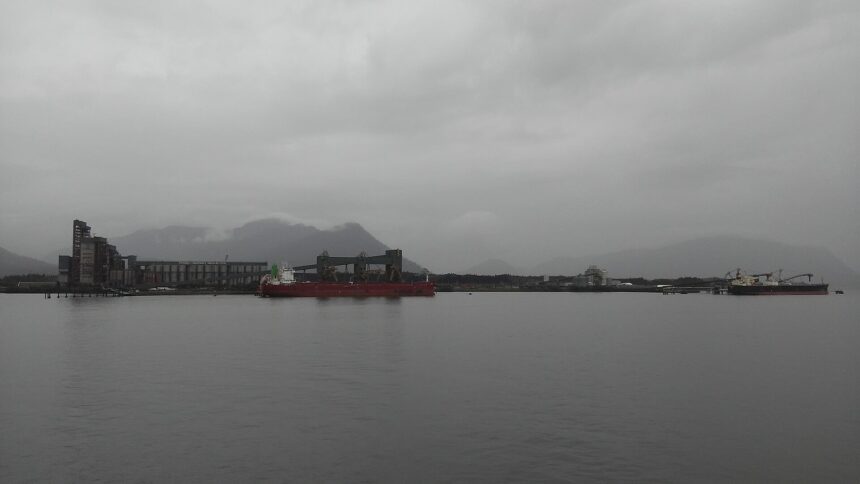
The port already runs a rail-to-ship energy chain, for propane. The Prince Rupert Port Authority describes it: about 50 to 60 rail cars a day reach AltaGas’s Ridley Island terminal over CN, the propane goes into pressurized storage, it’s chilled so it can be held and shipped at atmospheric pressure, and Very Large Gas Carriers take 20 to 30 cargoes a year from a facility rated at 1.2 million tonnes annually. Crude would need its own version of every link in that chain, from a rail unloading facility through tank storage to a marine berth with loading arms, plus spill response staged on the north coast.
The port’s energy page lists propane, liquefied petroleum gas and bulk liquids such as methanol and diesel, and no crude oil terminal. The geography is the attraction. The port lists a 35-metre main channel, a single-line connection to CN’s northern mainline and a saving of up to 60 hours’ sailing time against other Pacific Northwest ports, and Jean’s statement calls Prince Rupert “the shortest energy shipping route to Asia.” Shorter voyages matter because China now buys more Canadian seaborne crude than the United States does.
Why repealing the tanker ban would not build either route
Pacific Link is a separate file. The joint statement says the pipeline would ship from southern B.C. and was recently designated a project of national importance, and it does not depend on the north coast moratorium. Its own schedule is set by Pacific Link’s designation conditions, and its economics by the toll math behind the proposed west coast pipeline.
The Prince Rupert rail option would depend first on repeal and then on what no vote can supply. A shipper comparing rail with a pipeline needs a delivered cost per barrel from Alberta to Prince Rupert plus the tanker leg, a figure the province’s statement does not provide. A terminal is a long-lived asset, so lenders will want contracted volume before they commit, the same test that decides which pipeline gets built. Coastal protection is the condition the 2019 Act was written around, and any terminal proposal would have to set out spill response for the north coast in detail.
Trans Mountain, the one working outlet, ran at 94% utilization in the second quarter, which is the best argument for a second coast. The argument now has to wait for a different bill or a different Parliament. Until one arrives, the ceiling north of 50°53′ is 12,500 tonnes per tanker, and the maximum fine for a vessel that breaks it is $5,000,000.