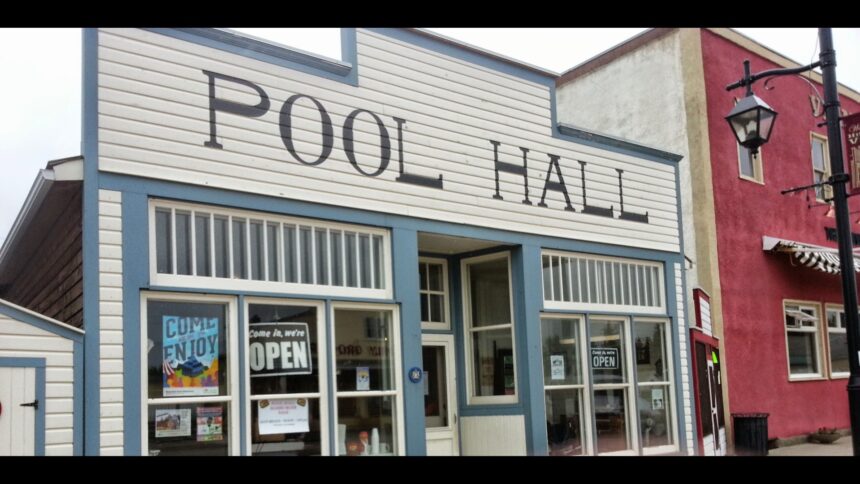
The Canadian Register of Historic Places entry for the Vilna Pool Hall and Barbershop inventories the contents down to a fly swatter, which turns up among the benches, ball sets, cues, advertising signs and barber furnishings the entry lists as part of what makes the place worth protecting.
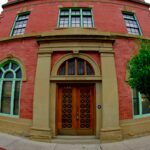
The building around those objects is a single-storey wood frame structure with a boomtown front, a low-pitched gable roof, horizontal sheathing outside and V-jointed boarding within. It is the oldest building in Vilna, a village in central Alberta, and it has the same false-front shape examined in the false front on main street. The register says it ran as a pool hall and barbershop until 1996, with candy and confectionery sales continuing into the 1960s.
Key facts
- The hall at 5028 50 Street, Vilna, has been a Provincial Historic Resource under Alberta’s Historical Resources Act since April 2, 2009, according to the register entry.
- The register gives 1920 to 1996 as the years it operated and counts four pool tables, two at 6 by 12 feet and two at 8 by 10 feet.
- Restoration architect David Murray says the foundation was replaced in 2003 and heating, electrical work and the facade followed in 2004.
- The Village of Vilna and Tourisme Alberta both credit the tables to Brunswick Balke Collender and Samuel May, and the village lists the hall as open Thursdays to Saturdays, 10 a.m. to 4 p.m.
The register gives two years for the same building
The register’s date field reads 1920. Its statement of significance says the building went up in 1921. A fire explains the gap. The village’s history page says Steve Pawluk built a two-storey pool and dance hall that burned in 1921 after prohibition-era fights, and that he rebuilt the same year as the one-storey building that stands now. The architect’s page tells it the same way. The register doesn’t mention a fire at all, so the date question is open in the paperwork even if the building’s own story is clear.
Two sources disagree on when the Tashuks arrived
The architect says John Tashuk bought the property around 1936. The village spells the name Taschuk and puts the purchase in 1933. Both agree his son Bill took over in 1947, and the village adds that Bill’s wife Lilly ran it with him. The architect has Bill retiring in 1997, when the Vilna Pool Hall Society acquired the building, while the register closes operation a year earlier. Counting from the earliest of those years to the latest, a calculation rather than a published figure, one family kept the doors open somewhere between 60 and 64 years.
The tables carry makers’ names the register leaves out
The register counts four tables and gives sizes without naming a maker. The village and Tourisme Alberta supply them: two Brunswick Balke Collender snooker tables and two Samuel May billiard tables, all of turn-of-the-century make. The sizes in the register and the descriptions in the listings don’t line up neatly, which is a good reason for the society to measure them once and write it down.
A pool hall that still opens is better kept than one behind glass
The register’s statement of heritage value calls the building a gathering place for the men of the surrounding district, and the architect adds that women were traditionally kept out, as were boys under 15, though the rule was often broken. Any interpretation of the room should say so plainly, because that’s who it was built for and who it wasn’t.
The society’s stated aim, in the architect’s words, is “a functioning, interactive pool hall museum,” and that’s the right one. A room that stays open keeps its meaning, while a table behind a rope keeps only its shape. Play will wear the cloth and the cues, and that wear is a fair price if each table’s maker, length and condition gets photographed and recorded once a year. Small-town main streets full of buildings this age could use the same habit, as how Alberta main streets still park the way wagons did suggests, and so could the Fort Macleod courthouse that outlasted its territorial peers.
The four tables, the barber’s chair and the fly swatter are all in the room at 5028 50 Street, and the village keeps the open days on its history page.