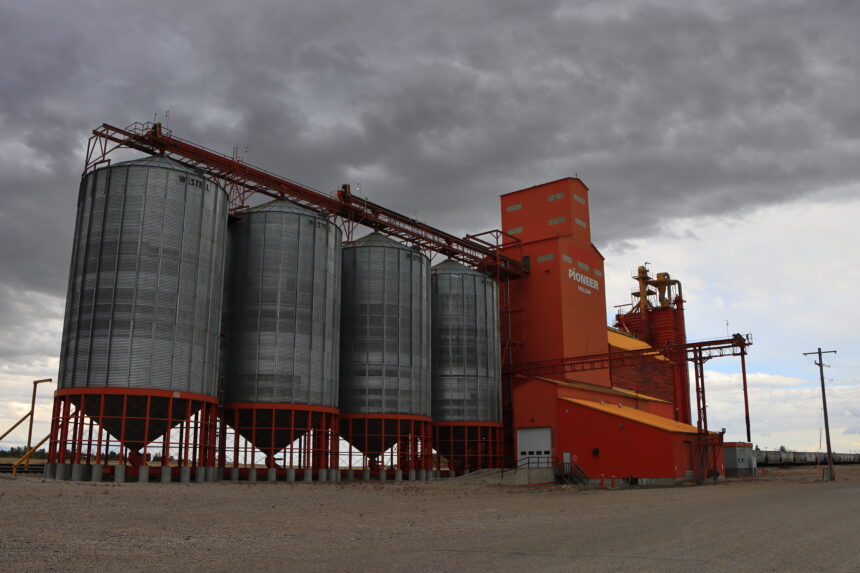
In 1924 a photograph of Vulcan shows a row of eight grain elevators standing along the tracks, according to the caption in an Alberta Historic Places record of the town’s skyline. The town later counted nine in what it called “9 in a line”, and today it has one. A Pioneer elevator with a wooden annex and four steel bins sits beside the rails, and two more stand outside town, the Alberta elevator inventory says. The distance between those two pictures is the argument of this column.
Key facts
- Vulcan billed its elevator row as “9 in a line”, and only one of the nine is left, per the town’s own local history page. The Alberta inventory also lists two more elevators outside town.
- Alberta’s wooden country elevators peaked at 1,781 in 1934. A count in 2017 found 110 still on railway rights-of-way, the Alberta Historic Places update reports.
- As of that 2018 update, 14 elevators were designated Provincial Historic Resources, and the oldest remaining is at Raley, dating to 1905.
- The province’s own brief history of the prairie icon is public and covers why the network shrank.
The network collapsed faster than anyone mourned it
It happened the way it happened everywhere on the prairies, slowly and then all at once. Trucks got bigger, and wooden elevators built for horse-drawn wagons couldn’t handle semis. Railways closed sidings. The grain companies built concrete and steel terminals sized for unit trains and let the country elevators go. An elevator that had paid for itself many times over turned into a liability on paper, expensive to insure and full of grain dust, and each town did the same sum.
To be fair to the present, the new system moves more grain with fewer buildings, and no one who farms would trade it back for a wagon and a scoop. That is a real gain, and the loss still has to be counted next to it. A surviving elevator in a small town is also a piece of the commercial tax base, and when one comes down the town carries that arithmetic for years.
Warner showed what happens without protection
In November 2014 two elevators were demolished from the row at Warner, which was then the longest in the province and one of only two rows left in Canada, the other being the restored one at Inglis, Manitoba. Warner’s row had no legal protection, and the village of about 385 people had no power to stop it. Those are the cases worth reading beside the last tower at Sharples and the Dorothy elevator, which Alberta saved because it photographed well.
Elevators survive when somebody gives them a job
Designation is one of the few tools that slows a demolition, and 14 designations against more than 1,700 buildings is a thin shield. The pattern in the record is that Alberta documents its demolitions better than it funds its rescues. The elevators that last tend to have work: a museum, a tea house, a community hall. The ones with work get repaired. The ones waiting on a grant get a demolition permit.
Vulcan is better known for the starship model and the Spock ears, as the story of its accidental Star Trek fame explains, and the elevator stands a short walk from all of it, mostly unvisited. It was never built to be pretty. It was built to load grain, and for a century it did.
A town that keeps its last elevator keeps the one thing on the horizon that says what the town was for.