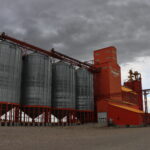

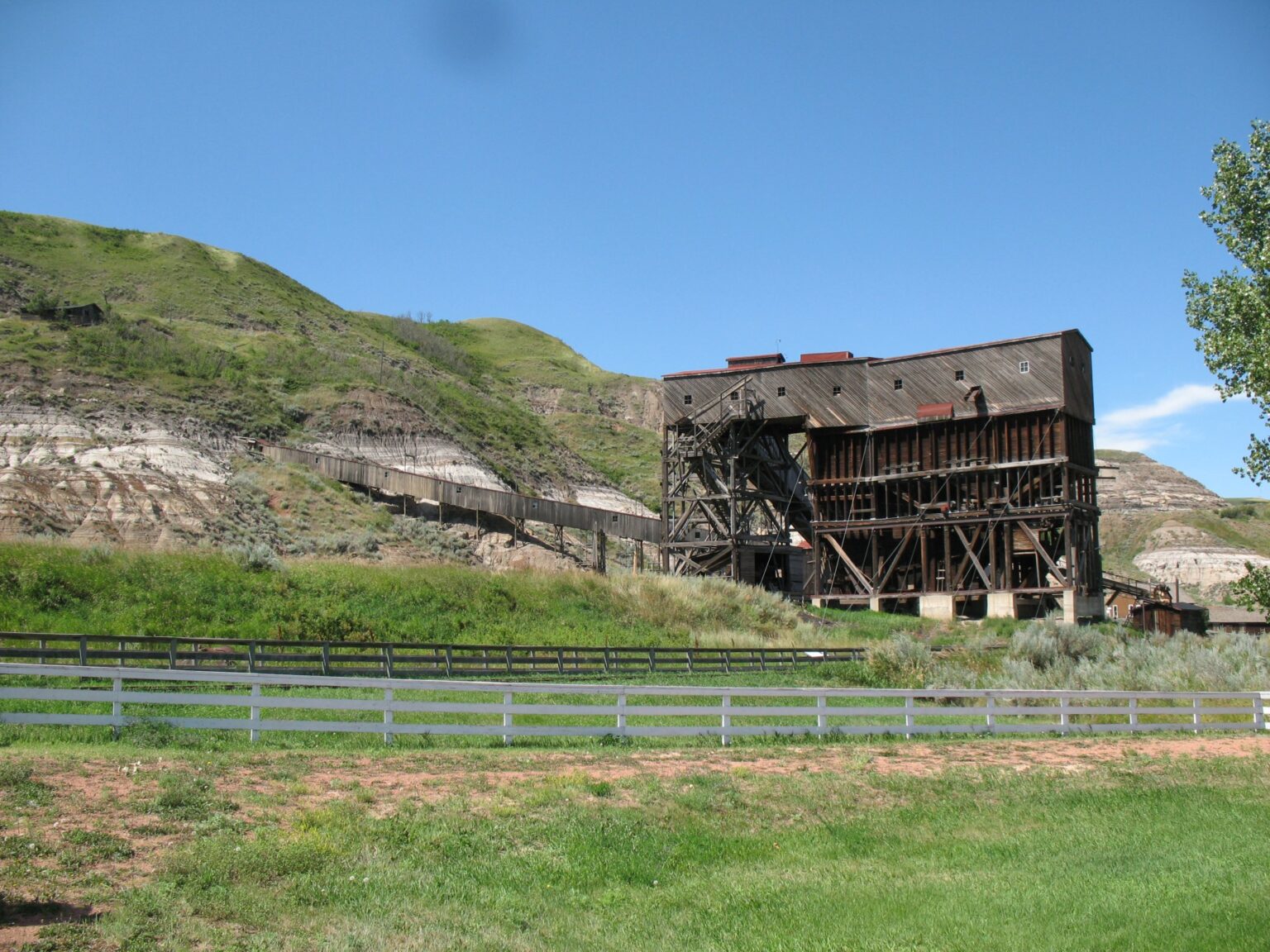

A few kilometres southeast of Drumheller, in the small community of East Coulee, a wooden tower seven storeys tall leans into the valley wind. It is a coal tipple, a machine for sorting and loading coal, and it is the last one of its kind left standing in Canada. There were once thousands of them. This is the one that did not come down.
The valley that ran on coal
It is easy to forget how much of early Alberta was a coal story. The Drumheller valley was one of the great coal districts of the country. Its seams lay nearly flat and close to the surface, which made them easier and safer to work than the steep, gas-heavy seams of the mountains. At the height of the boom the valley held 139 working mines.
The coal those mines produced was not for glamour or for export. It was for survival. Drumheller coal heated houses, fired kitchen stoves, and generated electricity across the prairies. It also fed the steam locomotives of the Canadian National and Canadian Pacific railways, which kept the country moving. For the first half of the twentieth century, a cold prairie winter and a Drumheller coal mine were closely related facts.
The mines built the towns. Drumheller and the string of small communities along the valley, East Coulee among them, grew up around the mine mouths and the rail spurs. Workers came from across Canada and from Britain, Europe, and beyond to mine the seams, and for a few decades the valley was as busy and as crowded as anywhere in the province.
The Atlas, and the tipple that survived
Of those 139 mines, the Atlas is the last one left, preserved rather than demolished. It is considered the most complete historic coal mine in Canada.
That survival was not inevitable. When a mine closed, the usual fate of its surface buildings was to be stripped for salvage or burned down for safety, and the tipples in particular, tall and wooden and no longer wanted, came down in their hundreds. The Atlas escaped mostly because a group of local people decided it should, and took on the long work of saving it.
Seven storeys of working machinery
The heart of the site is the tipple, built in 1937. A tipple is, in plain terms, a sorting machine. Raw coal came up out of the mine and went in the top, and the structure shook, screened, and graded it by size before tipping it into the railway cars waiting below. The Atlas tipple is built of wood, it stands more than seven storeys tall, and it is the largest wooden tipple still standing anywhere in North America. Every other one in Canada is gone.
A workplace, not a model
The Atlas is not a reconstruction. The mine office, the wash house, the lamp house, and the supply house still stand where the miners left them, and a battery-powered mine locomotive built before 1936 still runs. Walk the site and you are walking an actual industrial workplace, paused rather than rebuilt.
The hard side of the work
Coal mining was dangerous, and an honest heritage site does not pretend otherwise. Over the working life of the Atlas, thirteen people died on the job. The worst single day was June 24, 1941, when a gas explosion killed three men, and a fourth man died trying to reach them. It is a small number set against decades of operation, and it is also four families in one valley on one summer day. Both things are true, and the site keeps room for both.
How the industry ended
The Drumheller coal industry did not end in a disaster. It was retired by better technology. Natural gas reached prairie homes and did the work of heating without the dust, the deliveries, or the shovelling. The railways traded their steam locomotives for diesel and stopped buying coal by the trainload. Demand fell away, mine by mine, until the Atlas was very nearly the last one running. It finally closed in 1979.
The Atlas reopened as a historic site later in the 1980s, and it is now a National Historic Site of Canada. Visitors ride the old locomotive, climb the tipple, and walk a tunnel into the hillside. It is one of the few places in Alberta where the coal era is not a paragraph in a textbook but a building you can stand inside. The valley once ran on 139 mines. It is worth keeping the one that is left.