


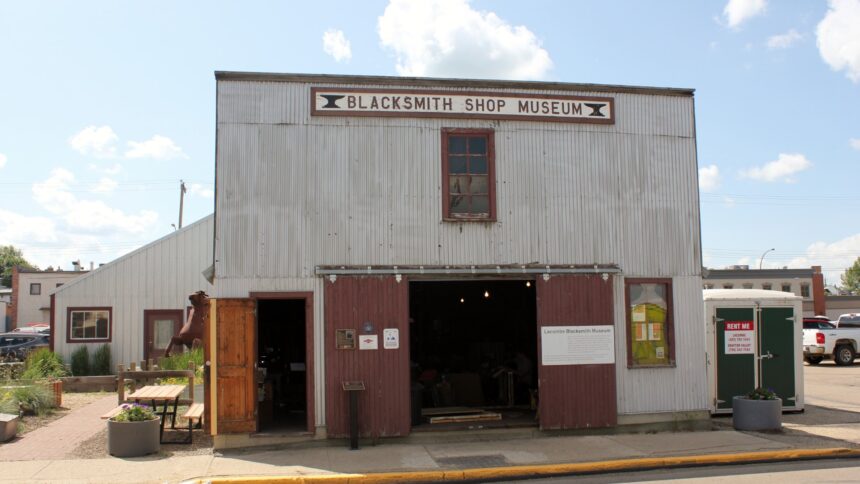
Somebody carved marks into the wooden walls of the Lacombe Blacksmith Shop, blacksmiths and customers both, and decades of forge soot have settled over them. The Canadian Register of Historic Places describes walls and ceiling beams darkened by smoke and heat, with carving and branding left by the smiths and the people who came to them. The sources we opened name none of those people. The wall is the only record.
The building is plain. It measures 7.6 metres by 12.8 metres, with a gable roof, corrugated sheet metal over the wood, and a boomtown front with a double-wide sliding door at its centre. It faces 49th Street, which the register says was once Glass Street. Lacombe Museums says A. F. Weddle opened the shop in 1902, the fourth blacksmith shop to open in town.
Key facts
- The Canadian Register of Historic Places records the Lacombe Blacksmith Shop as built between 1902 and 1907 and measuring 7.6 metres by 12.8 metres.
- The Canadian Register of Historic Places states that blacksmith work continued at the shop until at least 1939, followed by welding and general metalworking until 1993.
- Lacombe Museums states that the Lacombe and District Historical Society bought the shop in 1993 and opened it as a museum on July 16, 1994.
- Lacombe Museums states that the shop became a Provincial Historic Resource in 2011 and a Municipal Historic Resource in 2015.
Owners Changed Fast Before One Family Stayed
A 2015 release from Lacombe Museums dates construction to 1902 and 1903 and values the building at $1,325 in 1903. It also says the building went through a rapid succession of owners early on. The Wikipedia timeline, which cites museum and municipal sources, names them: Weddle, then the brothers Alfred and Stanley Watson from 1903, then John McNab from 1907, then McNab with John Reeves from 1926, then Reeves alone from 1927 to 1939. By our count that is four owners or ownership groups in 37 years.
The museum’s exhibit says Jules Selvais rented the shop from Reeves in 1939 and bought it three years later. His son Roger joined the business in the early 1950s. Lacombe Museums puts the Selvais family’s ownership at the longest of any, running until the historical society bought the building.
The Hammers Outlasted the Blacksmithing
Actual blacksmithing ended in the early 1950s, according to the museum, and many of the tools stayed. The register lists the original forge, two triphammers, anvils, vices and assorted hand tools still inside. The museum’s exhibit adds that the larger black hammer is believed to date from 1902, while the smaller red one was bought from Fred Dobirstein’s shop on Railway Street.
Jules and Roger Selvais added a welding shop in 1953, which the museum places on the west side. The register dates the addition to the mid-1950s and puts it at the rear. The front sliding doors had been sealed at some point and were later reinstated.
The Record Does Not Agree on When the Work Ended
The register says the building served as a welding and metalworking shop until 1993. The museum says Roger’s son Ronald kept commercial work going until 1987. The Wikipedia timeline ends Selvais ownership in 1992. The society’s purchase is 1993 on the museum’s site and 1991 in the 2015 release. These may mark different events, and none of the sources says which event each date marks.
The museum’s account of what followed is consistent. The society repaired the foundation, the walls and the roof, and the shop opened to the public on July 16, 1994, during the town’s Lacombe Days. The museum gives 2011 for the provincial designation, and Lacombe held a municipal designation ceremony on September 26, 2015.
The Soot Deserves More Protection Than the Superlative
The museum calls the shop the oldest blacksmith shop in Alberta on its original location. Another town can challenge that with an older date and a surviving shed. The walls cannot be challenged, because they are the evidence, and they are the part of the building a well-meant restoration could damage first.
Restoration work came in 1993 and again in 2019, when the museum says original windows were repaired and exterior woodwork repainted, and it listed roof, siding and triphammer repairs for 2021. Nothing we read says the interior will never be cleaned. The designation should say so. The carved and branded marks should also be photographed wall by wall and the images published, so the next person who wants to know who stood at that forge can start from the record and not from a guess.
Two triphammers still stand inside the shop, and above them the beams are dark with the smoke of fires lit under that roof.
Sources
- Canadian Register of Historic Places, Lacombe Blacksmith Shop
- Lacombe Museums, Blacksmith Shop Museum
- Lacombe Museums, Blacksmith Shop virtual exhibit
- Lacombe Museums, Restoring the Lacombe Blacksmith Shop
- Lacombe Museums, designation ceremony media release, September 26, 2015
- Wikipedia, Lacombe Blacksmith Shop Museum






.jpg)