

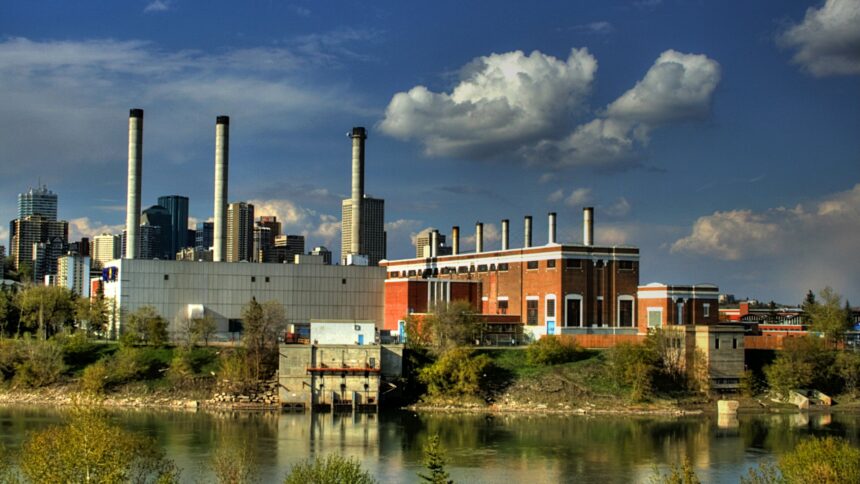
Along the roofline of the Low Pressure Plant at Rossdale, strong horizontal bands of white precast concrete carry the dates of each phase of construction, according to the Canadian Register of Historic Places. Seven stacks rise above them. Anyone looking up at the brick can read the plant’s growth off the masonry, the way a cornerstone gives a single year.
The site covers 16.97 hectares on the north bank of the North Saskatchewan River and holds three connected structures. The Low Pressure Plant includes a turbine house and a boiler house. Pumphouse No. 1 is a T-shaped reinforced concrete structure that reaches more than fifty feet below grade. The Administration Building is two storeys of brick with classical detailing. The register dates the work from 1931 to 1954.
Key facts
- Rossdale Power Plant at 10155 96 Avenue in Edmonton occupies 16.97 hectares and includes three connected structures, according to the Canadian Register of Historic Places.
- The Canadian Register of Historic Places dates construction of the existing structures from 1931 to 1954 and credits Maxwell Dewar with designing portions of the plant.
- Alberta designated Rossdale Power Plant a Provincial Historic Resource on October 17, 2001, and the Canadian Register of Historic Places listed it on September 7, 2006.
- The National Trust for Canada reports $4.5 million in immediate repairs and $87.3 million for upgrades and site development, a $3 million city allocation over ten years in 2013 and a further $6 million in 2020.
- The Canadian Register of Historic Places says Rossdale generated electricity until 1989, while the City of Edmonton says it stopped producing electricity in 2008.
The Plant Grew in Stages and Kept Its Look
Edmonton’s first electrical generating station moved to Rossdale in 1902, and the register treats the site as continuous generation from then. The Low Pressure Plant was built in phases. Heritage Guide counts six additions to it, and the City of Edmonton says the stack count rose from five in 1949 to seven in 1954. Dewar later became the city architect, and the city says he kept the design coherent as the plant grew.
The register’s own wording is that it is “the only power plant from this period of this scale remaining in Alberta.” That is a narrow claim, a matter of scale and period rather than of age.
Nobody Agrees on When the Machines Stopped
The register says generation continued until 1989. The City of Edmonton says the plant stopped producing electricity in 2008 and was decommissioned in 2011 and 2012. The description on the Commons photograph we use says it was decommissioned in 2009. These may be different events described with the same word, or they may be errors. We cannot reconcile them from the sources we opened, so the closing date stays a range, from 1989 on the register’s account to 2008 or later on the city’s.
A Stabilization Budget Is Not a Plan for the Building
The National Trust for Canada put Rossdale on its list of ten endangered places in 2013. It reports $4.5 million in immediate repairs and $87.3 million for upgrades and site development, and a city commitment of $3 million over ten years for stabilization. Roof and exterior wall work began in spring 2015, public tours opened in 2020, and the city approved a further $6 million that year for condition assessments and conservation planning.
By our count, the two commitments add up to $9 million, about 10.3% of the $87.3 million figure. Our position is that money of that size keeps rain off the brick and answers nothing else. A provincial designation protects fabric. It does not say what a 16.97 hectare industrial site is for, and every year that question stays open, the budget goes further toward holding the building still.
The white bands on the brick still read as a list of dates for what was built, and nothing on them says what the building is for.