

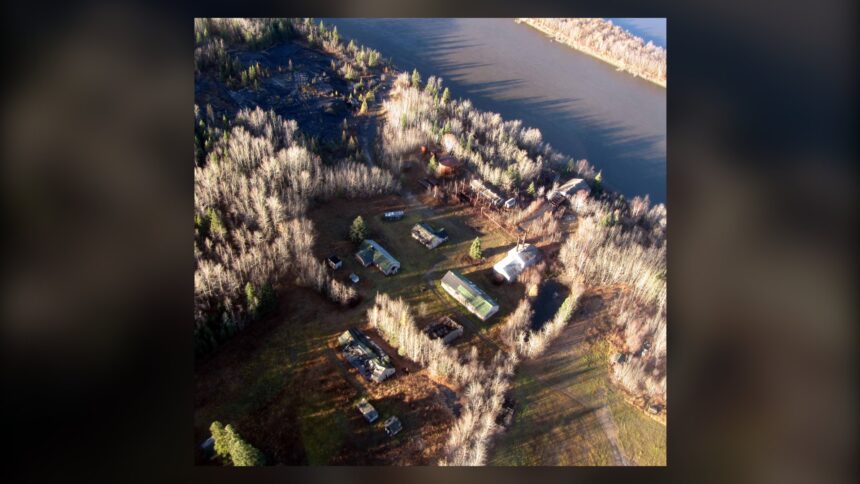
In one architect’s description of Bitumount, the steel-frame buildings of the government plant of the 1940s stand on concrete foundations in good condition. The older plant has collapsed, though much of its equipment is still in place. Both sit on the east bank of the Athabasca River, north of Fort McMurray.
Distance depends on who is measuring. The Canadian Register of Historic Places says about 89 kilometres from Fort McMurray, and the architect says about 80.
Key facts
- Bitumount lies on the east bank of the Athabasca River about 89 kilometres north of Fort McMurray, according to the Canadian Register of Historic Places.
- Robert Fitzsimmons received Canadian Patent 326747 for a bitumen recovery process in 1932, according to Alberta Culture’s Bitumount history.
- The Alberta government took control of the site in 1948 as a pilot plant, according to the Canadian Register of Historic Places.
- Alberta Culture’s Bitumount timeline dates the end of operations to 1958 and the historic designation of the site to 1974.
- The Canadian Register of Historic Places counts eight clusters of surviving buildings at Bitumount.
A Patent Came Before the Plant
The method was hot water separation. Karl Clark patented his version in 1929, according to Alberta Culture. Robert Fitzsimmons visited the sands and bought an oil lease in 1920, incorporated the International Bitumen Company in 1927, and built an initial separation plant at Bitumount in 1930. He received his own patent in 1932, and a refinery followed between 1936 and 1938. A plant designed for 200 barrels a day, Alberta Culture says, ran for only a short while.
None of this was steady. Alberta Culture notes that the company had stopped work in 1939 and was struck from the Alberta register by 1940.
A New Owner Arrived and the Province Took Over
Lloyd Champion, a Montreal financier, took control of the failing company, and Alberta Culture says it became Oil Sands Ltd. in 1943. The register dates Fitzsimmons’s sale to Champion to the same year. The sources then part on the loan. Alberta Culture’s timeline has Premier Ernest Manning announcing a $250,000 provincial loan in 1943, while its page on Champion dates a $250,000 provincial investment to December 1944. The government stepped in as costs climbed, and the register dates its control to 1948. Alberta Culture places Champion’s removal in November 1948 and the completion of the new plant in spring 1949.
A report by Sidney Blair in 1950 suggested the sands could prove profitable, and more than 100 delegates came to an oil sands conference at the University of Alberta in 1951. The plant itself, Alberta Culture says, “never sold a drop of oil.” Operations ended in 1958.
The Sources Give Three Reasons the Site Closed
The register says the site was abandoned in the late 1950s after establishing the economic viability of the oil sands, and credits the work with laying foundations for the Suncor and Syncrude plants. Alberta Culture says operations ceased once the government had shown that large-scale continuous separation was feasible. The architect offers a third reading, that serious investors were never found after the conventional oil discovery at Leduc in 1947. These explanations can sit together, but each source asserts only its own.
A Proving Ground Should Not Be Left to Fall Down
The architect says the site was designated a Provincial Historic Resource in 1974, a date Alberta Culture’s timeline shares. The same description says many of the wood buildings are in various states of disrepair and will benefit from conservation work as soon as possible. The architect gives no survey date, so the present condition needs checking on site.
This is the case for a firm position. A site that shows where the Athabasca oil sands were first worked at commercial scale has a stronger claim on stabilization money than a hundred roadside plaques. The steel plant will wait. The timber will not. Conservation work should follow the order in which the materials decay, and the record of what stood where should be fixed now, while the equipment is still there to be measured.
Steel frames stand on concrete footings on the river’s east bank, and beside them an older plant lies collapsed with its equipment still where it was left.
Sources
- Canadian Register of Historic Places, Bitumount Site (accessed Oct 2, 2026)
- Alberta Culture, Bitumount: The Plants (accessed Oct 2, 2026)
- Alberta Culture, Bitumount: International Bitumen Company Ltd. mine and plant (accessed Oct 2, 2026)
- Alberta Culture, Bitumount: Lloyd R. Champion (accessed Oct 2, 2026)
- David Murray Architect, Bitumount Historic Site (accessed Oct 2, 2026)