

For most of Canadian history, manufactured goods moved in one direction. They were made in the factories of Ontario and Quebec and shipped west to the prairies, where people bought them because there was nothing closer. Then a pottery in Medicine Hat did something that was not supposed to be possible. It started shipping the other way.
A city sitting on its own good luck
Medicine Hat had an advantage buried directly beneath it. The city sat on top of an enormous natural gas field, and in the early 1900s that gas was almost absurdly cheap. It heated the houses, lit the streets, and powered the workshops, and there was so much of it that the city had a province-wide reputation for being extravagant with the stuff.
When Rudyard Kipling passed through and was asked about the place, he handed it the line it has never since stopped repeating. Medicine Hat, he said, was the city with all hell for a basement. He meant the gas. The city took it as a compliment, which tells you a good deal about Medicine Hat.
For a pottery, that basement was a gift. Firing clay takes enormous and sustained heat, and heat is the single largest cost a pottery pays. Medicine Hat offered cheap fuel to make that heat, good clay deposits close at hand to shape, and a location directly on the Canadian Pacific main line to ship the finished goods. Nearly everything a pottery could want was in one place.
The birth of Medalta
The first attempt did not last. A firm called the Medicine Hat Pottery Company failed within a couple of years, and local investors tried again.
A name stitched together from a province
According to Wikipedia’s entry on Medalta Potteries, three partners started Medalta Stoneware in 1916 with 12 employees, and the reorganized company took the name Medalta Potteries in 1924. The name was a small piece of cleverness. Medalta was built from MEDicine Hat and ALTA, the old postal short form for Alberta.
Crockery for a country
What followed was a genuine prairie success story. Medalta made the heavy, useful, unglamorous things that a twentieth-century kitchen ran on. Crocks for pickling and storing. Butter churns. Mixing bowls. Beanpots. Water coolers. By 1924 the company was producing 75% of Canada’s stoneware. A prairie pottery was selling crockery to the country that had always sold to the prairie.
The work itself was hot, heavy, and skilled. Clay had to be dug, mixed, shaped, dried, glazed, and fired, and a pottery the size of Medalta needed a small town’s worth of hands to do it. For decades a Medicine Hat paycheque and a Medalta kiln were closely linked things, and the company became one of the steady anchors of the city’s working life.
The kilns that still stand
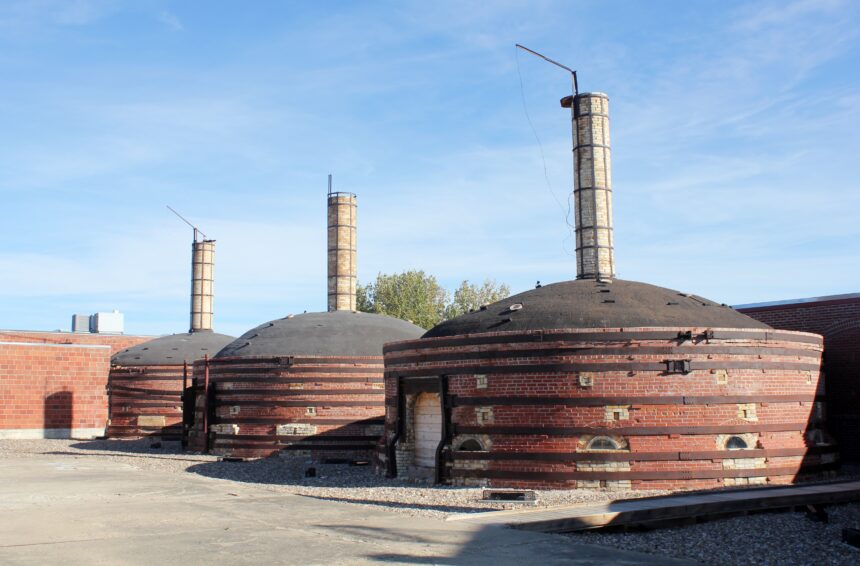
Medalta could not last forever. Tastes changed, lighter modern dishware took over, and the pottery closed in 1954. What it left behind was too good to lose. The site preserves a cluster of early industrial buildings and, at its heart, the great round brick beehive kilns where the clay was fired. Medalta was named a National Historic Site of Canada in 1985, according to the federal designation list for Alberta, and it now anchors the Historic Clay District in Medicine Hat, a working museum and pottery studio.
It is worth standing inside one of those cold beehive kilns and thinking about what once came out of them. A city that happened to be sitting on cheap fuel and good clay turned those two ordinary advantages into a company that put its crockery into kitchens from the Pacific to the Atlantic. Alberta has always been a province that turns what lies in the ground into something the rest of the country needs. Medalta did it with clay.