

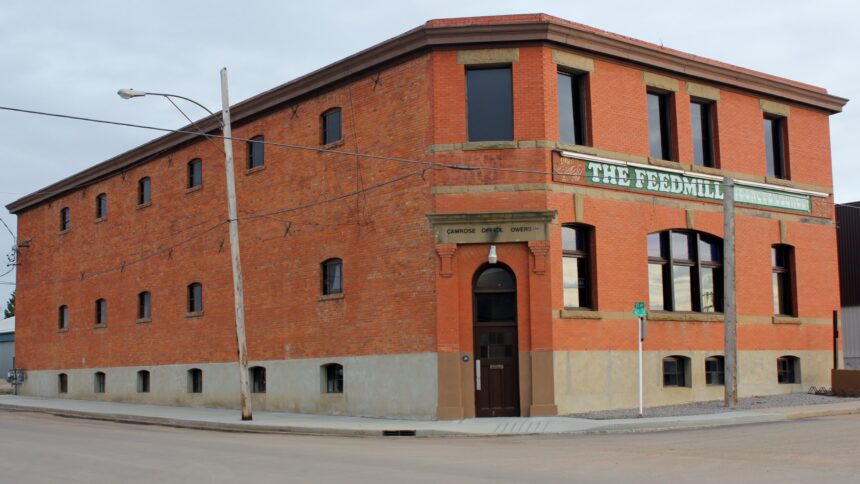
The corner of 4919 47 Street in Camrose is cut away at an angle, and the front door sits in the cut beneath a round-topped transom. Over it, a stone porch roof rests on stepped brick brackets. The walls are red brick with a second brick colour worked into the pattern, and the windows end in shallow curves. Nothing about the front suggests grain, grinding or chaff.
A sign across the upper storey reads The Feedmill, and most of the other names the register lists for the place also say mill. The register’s description of what the building was built to do says something different.
Key facts
- Georgeson and Co. Ltd., a Calgary grocery wholesaler, built the Camrose Feed Mill at 4919 47 Street in 1910, according to the Canadian Register of Historic Places.
- Alberta recognized the building as a Provincial Historic Resource on May 31, 1985, and the Canadian Register of Historic Places listed it on March 27, 2006.
- The Canadian Register of Historic Places describes a two-storey rectangular building with red brick facing and an interior of timber post-and-beam assembly with steel connectors.
- The register records that the building was later used as a liquor store, a seed cleaning plant and a restaurant.
- The register states that Camrose became a junction point for three railways in the early twentieth century, and the City of Camrose records that the community became a city on January 1, 1955.
A Calgary Wholesaler Built for a Railway Junction
By 1910 Camrose had railways coming at it from several directions. The register says the town became a junction for three lines, and it ties the building to the growth of wholesale trade there. Georgeson and Company was a Calgary grocery firm, and the register and the City of Camrose agree that it put up the brick warehouse in 1910.
A wholesaler wants a siding and a wide spread of farm customers, so the choice of Camrose is easy to read. That reading is ours, not the register’s.
The town had worn a few names on the way. The City says the hamlet began as Stoney Creek, then Sparling, and was the Village of Camrose by 1905. It adds that the present name may have come from a town in Wales, and calls that speculation.
The Record Gives the Trade as Grocery Wholesale
The register calls the builder a Calgary grocery wholesale firm. It says the building is a plain example of an Alberta warehouse of its time, and that it is one of the few survivors of the wholesale buildings that once stood in the town’s original warehouse district.
The sources do not line up on the name. The City of Camrose calls the building the Camrose Feed Mill when it describes the 1910 construction, and the Heritage Guide says it was originally a feed mill. We found no sentence in the register or the City page saying that a mill ever ran inside. We also found nothing that explains how the name settled in, and we will not guess at a route.
The Brick Has Outlasted Four Occupants
After the wholesaler, the register says, the building was sold and became a liquor store, then a seed cleaning plant, then a restaurant. That is four uses by our count, and the walls have carried every one of them.
Inside, the register describes exposed timber posts and beams joined with steel connectors. It is a working frame, and the register treats it as part of what makes the building worth keeping.
A Label Should Match the Record
A name that has lasted a long time is still not evidence. Heritage names are how most people learn what a building was, and a name that points at the wrong trade sends them away with the wrong picture. The grocery warehouse is the better story anyway. A mill would have been one local business. A wholesale house in a three-railway town belonged to a network that reached across the district.
The register already holds the correct description. A plaque at the door that gave the builder, the date and the trade as grocery wholesale would cost very little. It would also give the seed plant and the restaurant their proper place as later chapters, and it would let the restaurant sign stay where it is without anyone mistaking it for the record.
The door in the angled corner is the part the register describes. The sign above the windows is the part everyone reads.