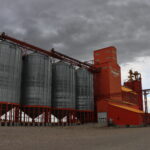

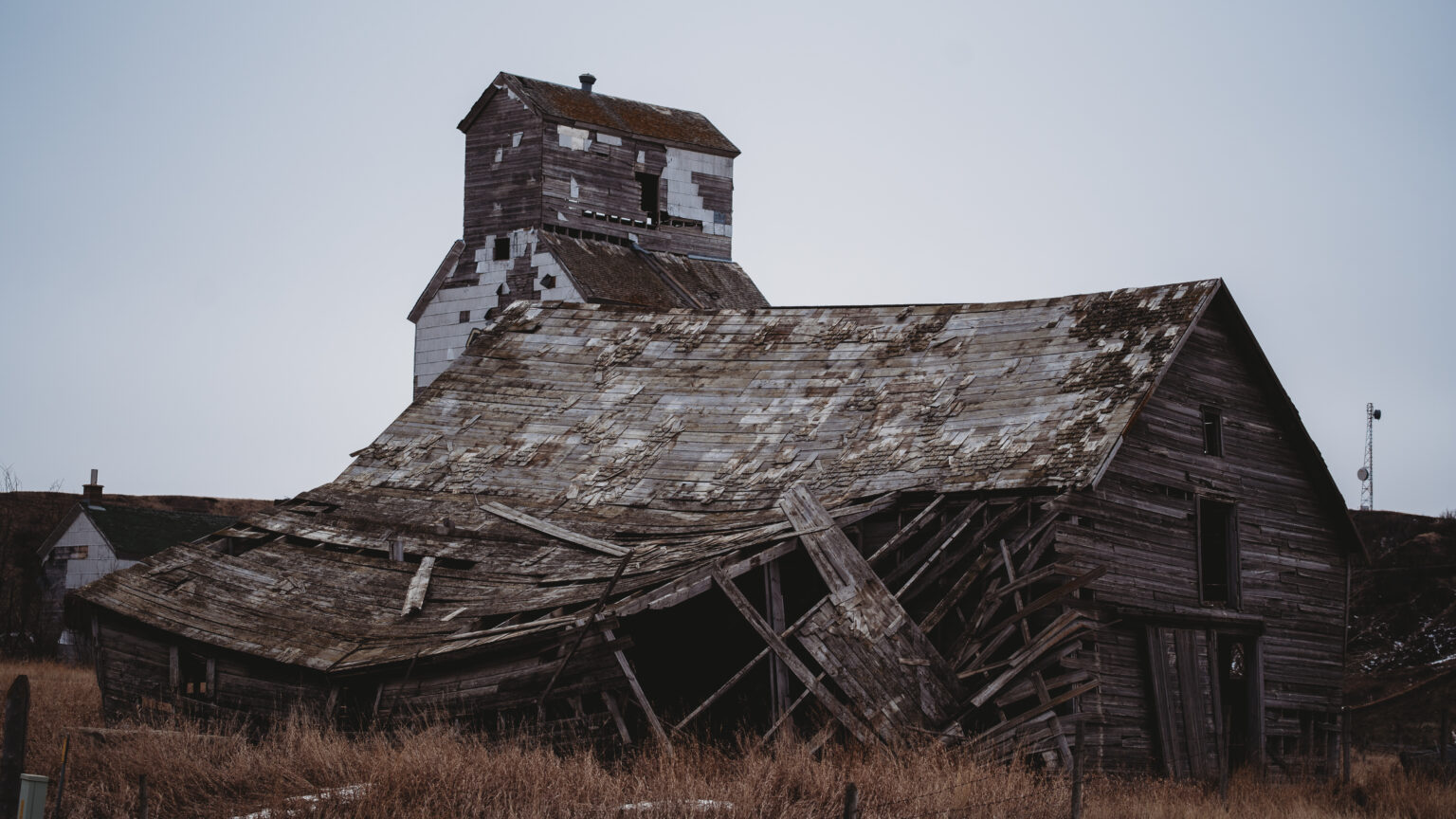

There is a wooden tower standing west of Drumheller that has watched over the Knee Hills Creek Valley for more than a hundred years, and any day now it will likely be gone. A spring 2026 demolition has been announced.
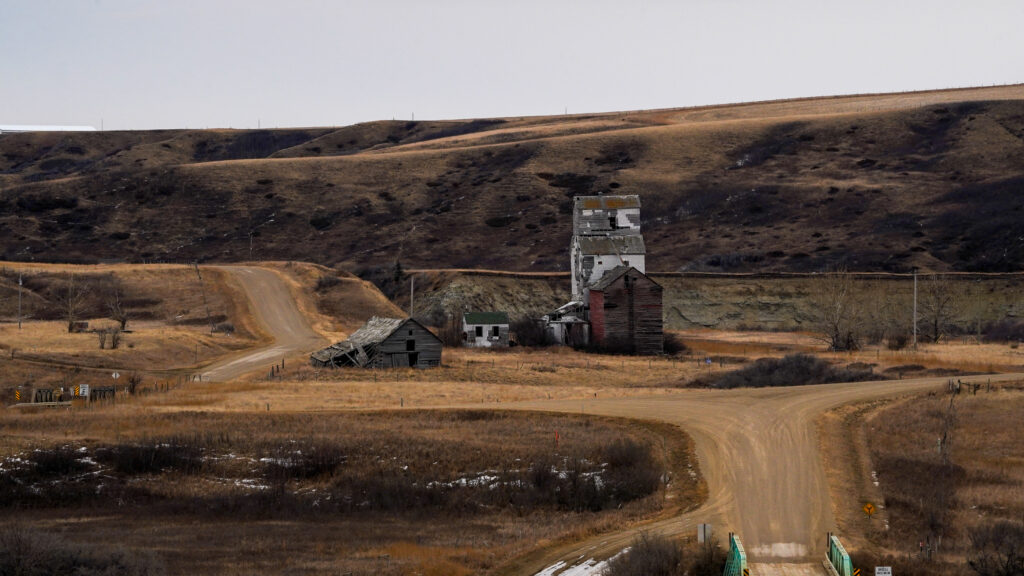
The grain elevator at Sharples was built in July 1923, the same year the Canadian Pacific Railway ran a spur line through the valley from Drumheller toward Carbon. Parrish and Heimbecker put it up on the siding, a 30,000-bushel structure roughly halfway between the two towns, overlooking one of the prettiest stretches of country in central Alberta. Sharples never became a town. It never incorporated. It was a crossroads, a rail stop, a place farmers drove their wagons to deliver the harvest. And yet that single tower became one of the most photographed grain elevators in the entire province.
Now Alberta Trail Net, the non-profit that was granted title to the site by CPR, says the building is too far gone to save. A 2012 condition assessment pegged the restoration cost in the hundreds of thousands of dollars, with the latest estimate at roughly $360,000. The organization builds recreational trails. It does not restore heritage buildings, and nobody has come forward with the money or the mandate to take it on. Demolition contractors are being contacted. The work is expected this spring.
A bigger place than the map ever showed
It is easy to wave this off. One old building, falling down, in a place that never amounted to a town, and nobody in Calgary or Edmonton has a reason to care about a wooden box on an abandoned rail line.
Because that wooden box is the whole story of how this province got built.
Sharples was busier than its size suggests. For a time it had two elevators, not one. The Alberta Pacific Grain Company added a second in 1927, later taken over by the Alberta Wheat Pool. The line that fed them carried coal as well as grain. By the 1940s the two elevators were moving more than 100,000 bushels of wheat a year, and a handful of small houses stood nearby for the people who worked there. The heritage record shows the Parrish and Heimbecker elevator alone handled more than 125,000 bushels in a single 1943 to 1944 season. This was a working hub, not a curiosity.
Machines made of wood
The tower still carries the marks of that work. It opened with a twelve-ton Fairbanks scale and a ten-horsepower engine. Two annexes went up in 1939 to add storage, and one of them is still standing. These were not decorative buildings. They were machines made of wood, and the people who ran them fed a continent.
Why a tower nobody lives near still matters
Grain companies once placed elevators about every six miles along the railway. That distance was not arbitrary. It was how far a horse could reasonably pull a loaded wagon and get home before dark. Each tower marked a community, or the promise of one. They were the first thing you saw rising off the flat, and for generations of Albertans, the name painted near the top told you exactly where you were. They were the punctuation marks of the prairie.
The last barn standing
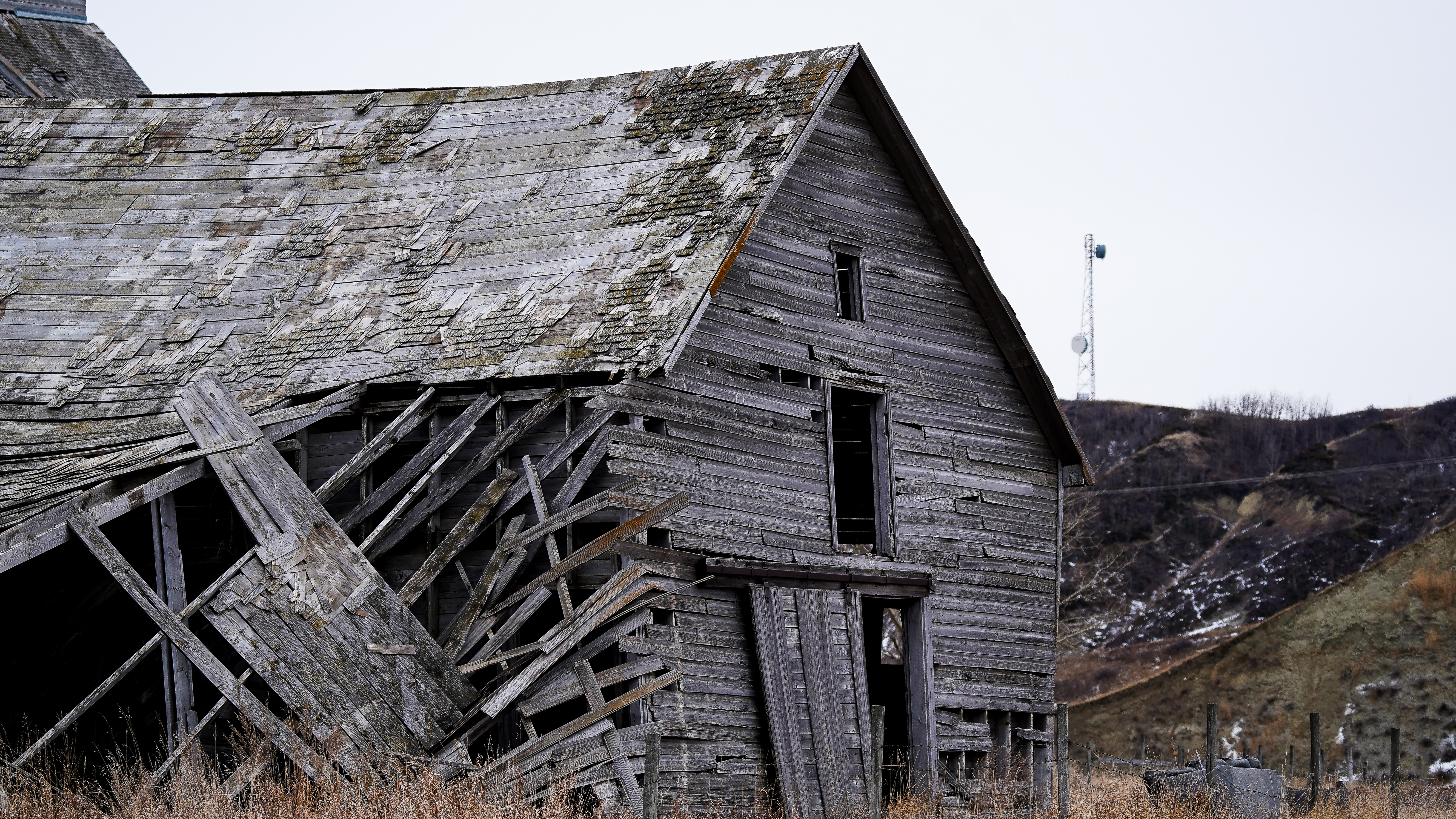
Sharples is rarer than almost any of them. It still has the original railroad barn beside it, a structure built to shelter and feed the horses farmers used to haul their grain. According to the people who have documented these buildings for decades, it is the only site in the province with both an original barn and its elevator still standing together. That is not a small thing. It is a near-complete picture of how an entire agricultural economy moved, in an age before grid roads and grain trucks. Lose the elevator and the barn, and you lose the only place left that shows the whole system in one frame.
Alberta has done this before, and the math is brutal
Alberta once had close to 1,700 wooden elevators. By one recent count there are only around 120 still standing, down from more than 5,000 across the prairies in the 1950s. The losses are not slowing in any comforting way. Estimates put the disappearance at ten to fifteen a year, gone for good. Some burned. Most came down, hauled off as a liability the moment the rail line closed and the bushels stopped coming. Just last month another historic elevator at Three Hills was demolished.
The Sharples elevator itself only survived this long because a local farmer kept using it for grain storage after the line closed in 1982. That is how a lot of these towers outlived their railways. Someone found a reason to keep the doors working. When the last reason goes, so does the building.
What Dorothy proved
There is a counter-example worth holding up. Down in the badlands at Dorothy, a 1928 elevator lost its roof to a windstorm in July 2015. It sat battered for years. But the community decided it was worth saving, raised money, and this past year it was restored into a full tourism draw. People pull off the highway to photograph it. The difference between Dorothy and Sharples is not the building. It is whether someone decided the building was worth the trouble.
What is actually being lost
A University of Calgary research team is now building digital twins of at-risk elevators, three-dimensional scans so future Albertans can at least see what these towers looked like. By the team’s account, the interest is coming from as far away as Europe. People on other continents understand that prairie heritage is unusual and worth studying. Albertans are the ones treating it as scrap.
A digital model is a fine record. It is not the real thing. You cannot stand inside a scan at dusk and feel the wind come off the valley. You cannot show your grandchildren the place their great-grandfather hauled wheat by horse and wagon and have it be true in front of them.
Sharples is a registered historic resource. The whole site sits on the Alberta Register of Historic Places. That designation did not save it, because designation without money or will is just a line in a database.
Demolition contractors are being lined up. And one of the last honest landmarks of how Alberta fed itself and built itself will be reduced to a pile of century-old lumber on a forgotten siding. The province will have the photographs. It will have the digital model. It will not have the tower, and it will not have the only barn that still stood beside one.
It deserved better. So did the valley it watched over.