

Key facts
- Parks Canada closed the Johnston Canyon trail network on May 2, 2026, until further notice, citing “on-going visitor safety operations.” Maximum penalty: $25,000.
- The order covers the Johnston Canyon trail, the Lower Falls, the Upper Falls, the Fire Road, and the P2 trail.
- Parks Canada lists the trail as 1.1 km one way to the Lower Falls, 2.4 km to the Upper Falls, and 5.5 km to the Ink Pots.
- A separate order bans all off-trail movement in the canyon from May 1 to November 15 each year, to protect the endangered black swift. Same maximum penalty: $25,000.
- Vehicle access to the Johnston Canyon area is maintained year-round via Castle Junction. The Bow Valley Parkway’s eastern 17 km runs vehicle-free for cyclists September 1 to October 6.
“Pursuant to Section 36(1) of the National Parks General Regulations, the following trail is closed to all traffic and travel.”
That is the Parks Canada closure order for Johnston Canyon. It took effect May 2, 2026. It runs until further notice.
The order covers the full network: the Johnston Canyon trail, the Lower Falls, the Upper Falls, the Fire Road, and the P2 trail. The stated reason: “To support on-going visitor safety operations.” The maximum penalty for crossing it: $25,000.
Twenty-five thousand dollars. For a hike.
What closed
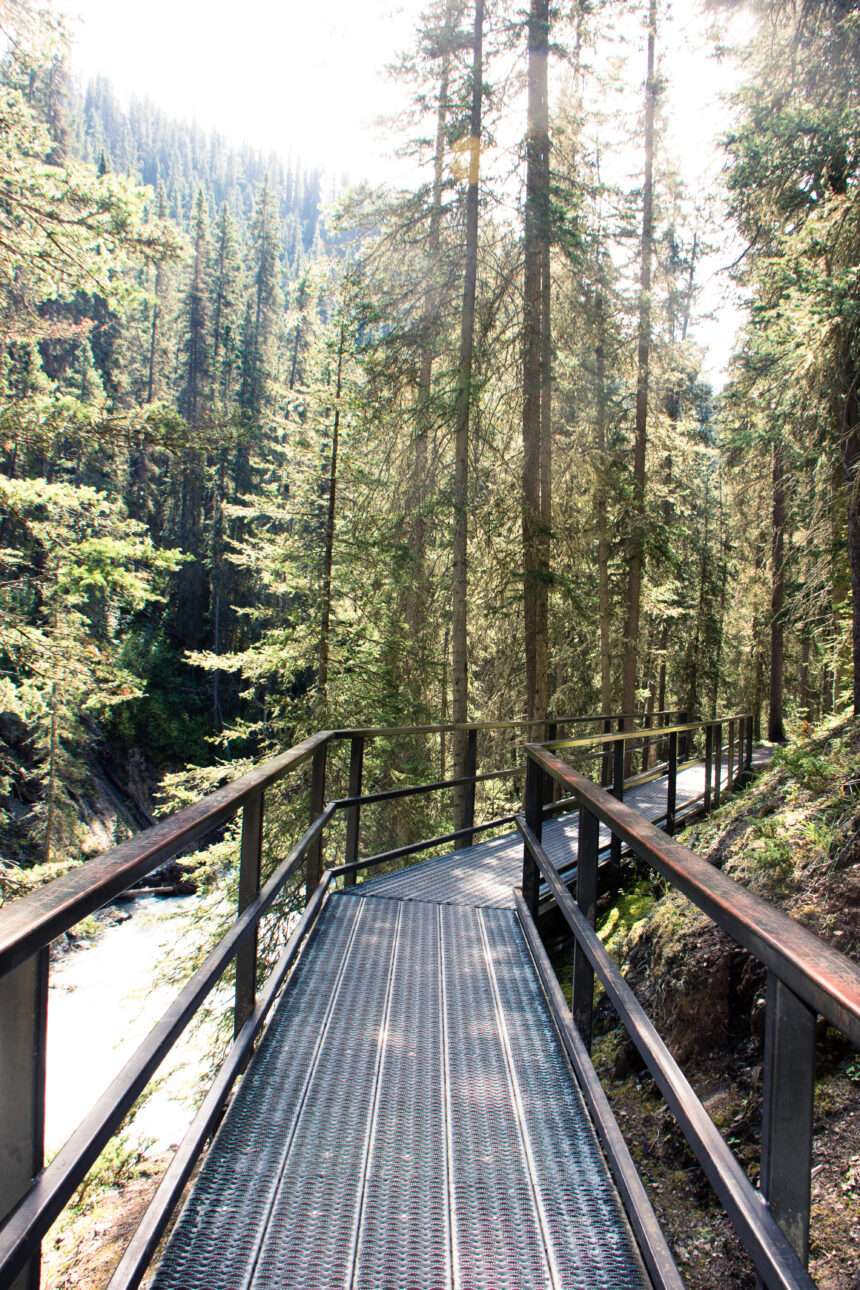
Johnston Canyon is the busiest trail in Banff National Park. The numbers explain why. Parks Canada lists it as 1.1 km one way to the Lower Falls, 2.4 km to the Upper Falls, and 5.5 km to the Ink Pots, with about 215 metres of climbing on the full route. Paved in places. Railed. A catwalk bolted to the canyon wall above the creek. It is the rare mountain walk a grandparent and a toddler can do together, which is exactly why the parking lot used to fill by nine.
Since May, the lot has been a different story. The tape is up. The signs are up. The canyon is closed.
Why it closed
Parks Canada’s public reason is five words: “on-going visitor safety operations.” The order does not elaborate, and that is normal. Closure orders rarely do.
The context is public, though. The canyon walls are also a restricted zone. A separate Parks Canada order bans all off-trail movement in the canyon from May 1 to November 15 each year, with the same $25,000 maximum penalty. The reason given there is specific: the black swift, a bird that nests on the canyon walls, has declined by half since the early 1970s and was listed as endangered in 2019.
The canyon, in other words, is a place where a very popular trail and a very sensitive wall occupy the same narrow space. The closure order protects the people. The off-trail order protects the birds. Both carry the same fine, which tells you how seriously Parks Canada takes both.
The pattern
This is not the canyon’s first shutdown. In 2022, Parks Canada closed the Upper Falls section for a railing replacement project, with the work running into late fall. The canyon is not a wilderness trail. It is infrastructure: catwalks, bridges, railings, viewing platforms, all of it bolted to a limestone wall above a creek. Infrastructure needs maintenance. Maintenance needs closures.
The difference this time is the reason. “Visitor safety operations” is broader than a railing project, and “until further notice” is longer than a season. The canyon will tell us what it needed when it reopens. Until then, the order is the whole story.
What it means for the valley
Johnston Canyon was the pressure valve. It absorbed the visitors who could not get parking at Lake Louise, the families who needed an easy walk, the tour buses that needed a guaranteed stop. With the valve closed, that pressure goes somewhere else.
It goes to the Lake Louise shoreline trail, which was already turning away 75% of vehicle traffic in summer 2025. It goes to the Tunnel Mountain and Hoodoos walks near the townsite. It goes to Canmore’s trails, which sit outside the park gates and outside Parks Canada’s management. The closure does not reduce demand. It redistributes it.
The Bow Valley Parkway complicates the picture. The parkway’s eastern 17 km runs vehicle-free for cyclists in the fall shoulder season, September 1 to October 6, under a pilot Parks Canada has extended to 2030. Vehicle access to Johnston Canyon itself is maintained year-round via Castle Junction. The road is open. The trail is not. Visitors arriving by car or bike will find the trailhead, the signs, and the tape.
The business end
The canyon was also an economic engine. Tour operators built itineraries around it: the guaranteed-easy walk, the guaranteed waterfall, the stop that never disappointed. The trailhead’s resort and coffee kiosk fed off the foot traffic. None of that appears in the closure order. Closure orders never mention the tills.
The operators will adapt. They always do. The itineraries will shift to the next-easiest walk, and the next-easiest walk will get busier, and Parks Canada will watch the counters move. That is the out-of-the-headlines story of every closure in a park running at record visitation: the people do not disappear. They relocate.
What to do instead
Check the bulletin before you go. Parks Canada’s closure page for Johnston Canyon is the single source of truth, and “until further notice” means the status can change without warning.
Do not duck the tape. The fine is $25,000, and the wardens write it. The off-trail order runs to November 15 regardless of the trail closure, so the canyon walls are doubly off limits.
Pick a substitute with the same profile: short, easy, dramatic. The Lake Louise shoreline. The canyon’s neighbours on the parkway. The Hoodoos trail above the Bow River. None of them is the catwalk. All of them are open.
The instruction
Banff’s busiest trail has been closed since May. It will reopen when Parks Canada says so, not when the summer crowds want it to. Check the bulletin. Respect the tape. The canyon has waited millions of years. It can wait a little longer.
Frequently asked questions
Why is Johnston Canyon closed?
Parks Canada closed the Johnston Canyon trail network on May 2, 2026, until further notice, citing on-going visitor safety operations. The closure remains listed as until further notice in Parks Canada bulletins.
What is the penalty for entering the closed Johnston Canyon area?
The maximum penalty is $25,000 under the Canada National Parks Act. A separate order bans all off-trail movement in the canyon from May 1 to November 15 each year to protect the endangered black swift, with the same $25,000 maximum penalty.
Which parts of Johnston Canyon are closed?
The order covers the Johnston Canyon trail, the Lower Falls, the Upper Falls, the Fire Road, and the P2 trail. Vehicle access to the Johnston Canyon area is maintained year-round via Castle Junction.
How long is the Johnston Canyon hike?
Parks Canada lists the trail as 1.1 km one way to the Lower Falls, 2.4 km to the Upper Falls, and 5.5 km to the Ink Pots.