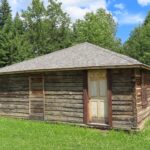


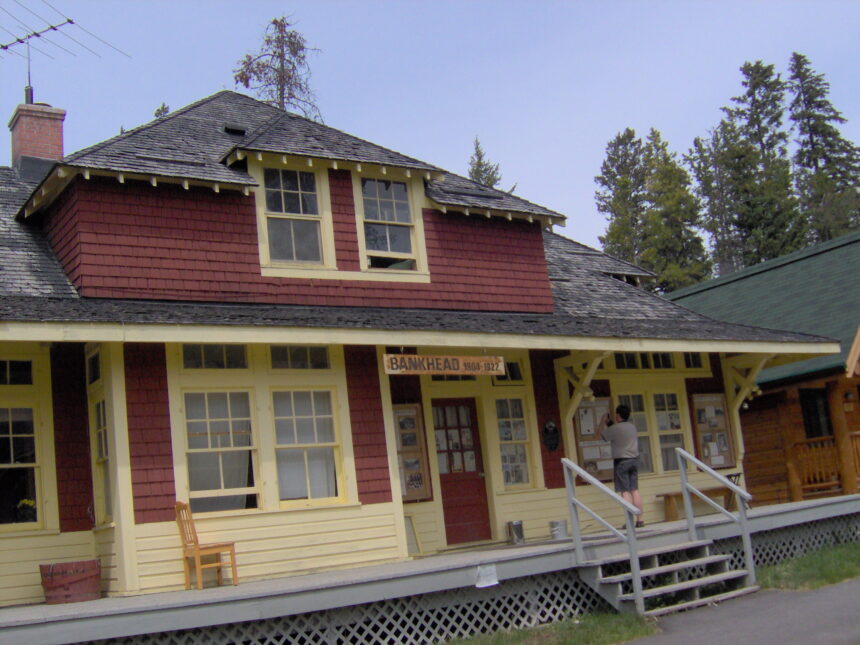
On Tunnel Mountain Road in Banff there is a small railway station with no railway beside it. It stands on the grounds of the HI Banff Alpine Centre, painted and kept up, and it was built for a coal town at the foot of Cascade Mountain that Parks Canada later cleared almost to the ground.
That town was Bankhead. For about twenty years it was a working industrial town inside the park, and the station is one of the few pieces of it still doing a job.
Key facts
- The Canadian Pacific Railway established the Bankhead coal mine on Cascade Mountain, in what is now Banff National Park, in 1903, according to Parks Canada.
- At its peak the Bankhead mine employed nearly 300 men underground and about 150 on the surface and produced nearly 200,000 tons of coal a year, according to Parks Canada.
- Underground work at Bankhead stopped during a strike that began in April 1922, and the mine entrance was sealed by June 1922, according to Parks Canada.
- Many of Bankhead’s buildings were moved to Banff and Canmore in 1926, according to the Glenbow Library and Archives collection at the University of Calgary.
A railway company dug a town into Cascade Mountain
Bankhead was a company place from the start. The Canadian Pacific opened the mine in 1903, and by the boom years the town had about a hundred private homes, a mine yard, a power house and a briquette plant. Underground, the main tunnels ran for about 55 km. Counting the ventilation and haulage passages, Parks Canada puts the total dug out of the mountain at more than 320 km, a network longer than the drive from Banff to Red Deer.
Some of the most lasting traces are the smallest. Parks Canada’s trail guide noted that rhubarb from the gardens of the town’s Chinese workers was still growing on the slack heaps decades after the last shift. A plant someone set out behind a company house outlived the company’s interest in the place.
A strike ended the mining and the park ended the town
In April 1922, Bankhead’s miners went out on strike again, part of a labour action that stopped much of North America’s coal production. All underground work halted. By June the mine entrance had been sealed, and the power house and briquette plant closed the following year. The mine never reopened.
A national park had no use for an empty industrial town. Under orders from the park administration, most of Bankhead’s structures were demolished, dismantled or relocated, and the Glenbow archival record dates the moves of many buildings to Banff and Canmore to 1926. The station was jacked off its foundations and taken away whole. In 1930 the National Parks Act banned new mining in the parks, which closed the question for good.
What was moved survives and what stayed is foundations
Bankhead belongs to a long Alberta habit of picking buildings up and carrying them to where the work was, the same habit that moved Champion’s buildings to the railway. The coal story has other survivors too, from the Atlas Coal Mine in the Drumheller valley to the Abbot Pass hut built from stone already on the pass.
At Bankhead itself, the 1.1 km Lower Bankhead interpretive loop off the Lake Minnewanka Road passes the old transformer building, an old mine train and the ruins of the mine works, with exhibits explained on Parks Canada signs. Then cross town. The station is on Tunnel Mountain Road, under its own roof, a few minutes’ drive from the place it was built to serve.