

Most Canadian cities tore down their historic main streets in the 1960s and 1970s. Edmonton is the rare exception. Old Strathcona, the historic core of what was an independent city on the south side of the North Saskatchewan River until the 1912 amalgamation with Edmonton, is the largest preserved heritage district in Alberta. The designation as a Provincial Historic Area came in 2007, but the preservation work goes back forty years before that.
What the district actually covers
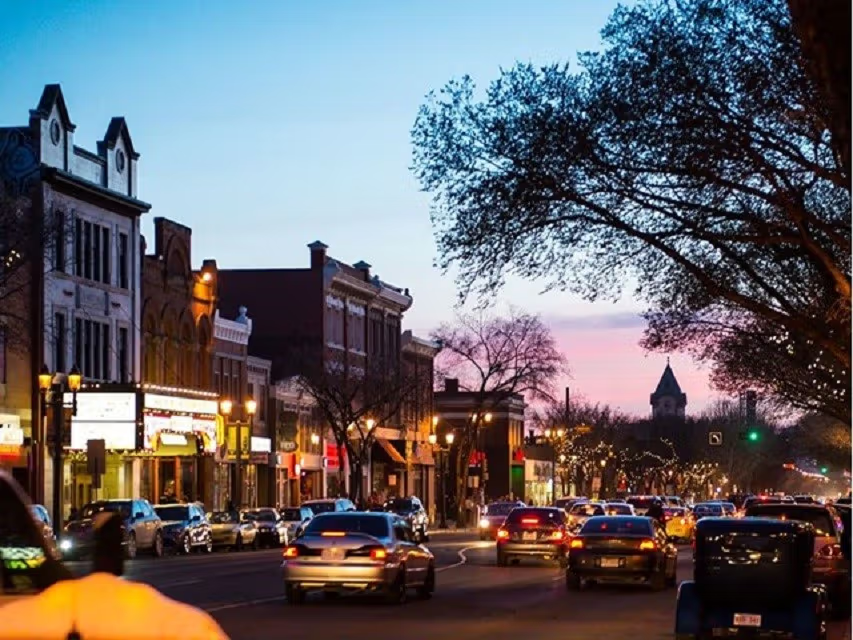
Old Strathcona stretches roughly from the High Level Bridge south to about 76 Avenue, and east-west from 99 Street to 109 Street. The core commercial strip is Whyte Avenue between 99 and 109. The district includes the historic Canadian Pacific Railway Strathcona Station from 1907, the Princess Theatre from 1914, the Strathcona Hotel from 1891, dozens of brick commercial buildings from the 1890s and early 1900s, and a substantial residential fabric of pre-1914 housing.
The district documents the boom era of Strathcona between 1891, when the CPR arrived at the south bank of the river, and 1912, when the city of Strathcona amalgamated with the city of Edmonton across the river. That twenty-one year window built most of what is still standing.
How the preservation actually happened
- The 1970s Old Strathcona Foundation, a community organisation, pushed back against early redevelopment proposals that would have replaced the strip with mid-rise commercial blocks.
- The City of Edmonton’s heritage department began documenting and protecting individual buildings through the 1980s and 1990s.
- The University of Alberta’s growth pressure was channelled away from the historic strip rather than through it.
- The Province of Alberta designated the whole district as a Provincial Historic Area on January 31, 2007.
The Provincial Historic Area designation is significant. It is one of only a few in the province. The designation protects the streetscape character and the broader urban form, not just individual buildings.
Why the timing matters
The 2007 designation came at the end of three decades of careful local work. The Edmonton city council and the Province both had to be persuaded that an active commercial neighbourhood was worth protecting as a heritage area rather than redeveloping for higher density. The community organisation, the local businesses, and the property owners pushed for the designation themselves.
The site is listed on the Canadian Register of Historic Places as Site ID 11853.
What the district teaches the rest of Alberta
The heritage buff opinion. Most Alberta cities have a handful of preserved heritage buildings but no preserved heritage districts. Calgary has Stephen Avenue. Lethbridge has a small downtown cluster. Medicine Hat has the clay industries area. None of them have the scale or coherence of Old Strathcona.
The reason Old Strathcona worked is that the local community organised forty years ago and kept organising. The Foundation, the Business Improvement Area, the neighbourhood associations, and the city all moved in the same direction over multiple decades. The result is one of the few places in the country where you can walk a continuous twelve-block stretch and see what an Edwardian-era prairie city actually looked like as a functioning commercial neighbourhood.
If you spend an afternoon there, the lesson is straightforward. Heritage protection at scale requires sustained local will and persistent institutional follow-through. Without those, even a great district gets nibbled away one teardown at a time. Old Strathcona is the proof that the alternative is possible. Worth a long walk along Whyte Avenue if you are in Edmonton.
Related reading from the series. Strathcona Hotel and the Edmonton building that has been open since 1891. The Edmonton 1881 School and the tiny log building that started public education.