

Alberta’s major projects inventory lists De Havilland Field in Wheatland County at 3,000 permanent operational jobs upon completion. For that figure to hold, three things have to be true. The campus has to be built in the phases the company describes, the aircraft lines inside it need orders deep enough to run for years, and the supply chain feeding them has to stay largely Canadian.
On the evidence available this week, the first and third conditions look sound. The second is where the number will be won or lost, and it deserves a closer look on the same day Ottawa took an observer’s seat in a foreign fighter program.
Key facts
- De Havilland Aircraft of Canada Limited broke ground on De Havilland Field in Wheatland County, Alberta, on May 15, 2026, according to the company.
- The Government of Alberta major projects inventory lists De Havilland Field as a 1,500-acre site under construction, scheduled from 2026 to 2028, with its first building opening in spring 2028 and 3,000 permanent operational jobs on completion.
- The same provincial listing ties the project to a $1.6 billion contract for 24 DHC-515 firefighting aircraft for six European Union countries.
- De Havilland Canada states that its supply chain is 80% Canadian-based.
The optimistic case for Wheatland County is strong
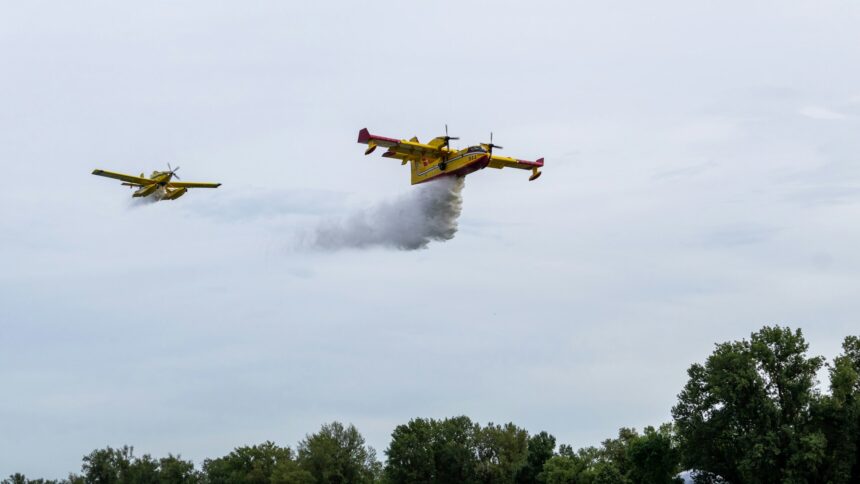
Start with the best version of the argument, because it is a good one. The DHC-515 is the successor to the Canadair water bomber, a type that fire agencies across the northern hemisphere have been flying for decades and that went out of production years ago. Demand for a replacement does not need to be invented. Fire seasons are generating it every summer, and European governments have already signed for 24 aircraft.
Alberta has put its own money behind the line as well. The province ordered five DHC-515 aircraft in February 2026, a purchase reported at $400 million, which means the plant’s home jurisdiction is also one of its customers. The company adds the Twin Otter and the Dash 8-400 to the product family planned for the site, and it says 80% of its supply chain is already Canadian. A final assembly plant draws machinists, avionics technicians and composite specialists, and those workers draw supplier shops the way a new interchange draws gas stations and warehouses.
The optimists are right that this is real industry, with signed orders, a site and a schedule. This one has shovels in the ground.
What the job figure depends on
Now consider the constraints. The first phase, as described at the groundbreaking, covers parts manufacturing, aerostructures and a global distribution hub. The runway comes in later phases. The first building is scheduled for spring 2028, and the 3,000-job figure describes the finished campus.
The order book on public record is 24 European aircraft plus Alberta’s five, which by our arithmetic is 29 DHC-515s. That is a solid start for a specialized aircraft, and it is also a figure that a production line working at a steady rate could clear within a few years. A campus sized for thousands of permanent jobs needs a pipeline of orders that runs well past the first delivery schedule, the way a precast plant needs contracts booked beyond the current pour.
This is where the federal picture matters. Canada’s own aerial firefighting capacity, federal procurement of utility aircraft and allied purchases of firefighting fleets are all places where a Canadian-built product could be priced first. Ottawa spends its aircraft attention on fighter programs designed elsewhere, and a domestic manufacturer building exactly the type of aircraft the country will need more of every summer gets its biggest orders from Europe. Demand from buyers at home is the variable that decides how fast the job count climbs.
The province deserves credit for placing an order early. De Havilland Field’s diversification case was made when the site was chosen. The remaining test is volume.
What would prove the forecast right
A prediction worth checking should carry a date and a condition. Here is one. If the first building at De Havilland Field opens in spring 2028 as the provincial inventory lists, and the DHC-515 order book has grown beyond the 29 aircraft on public record this summer, the site will be employing workers in the thousands before the end of 2030. If the order book is still at 29 when that first building opens, expect employment to arrive in phases measured in hundreds, and expect the 3,000 figure to slide toward the middle of the next decade.