

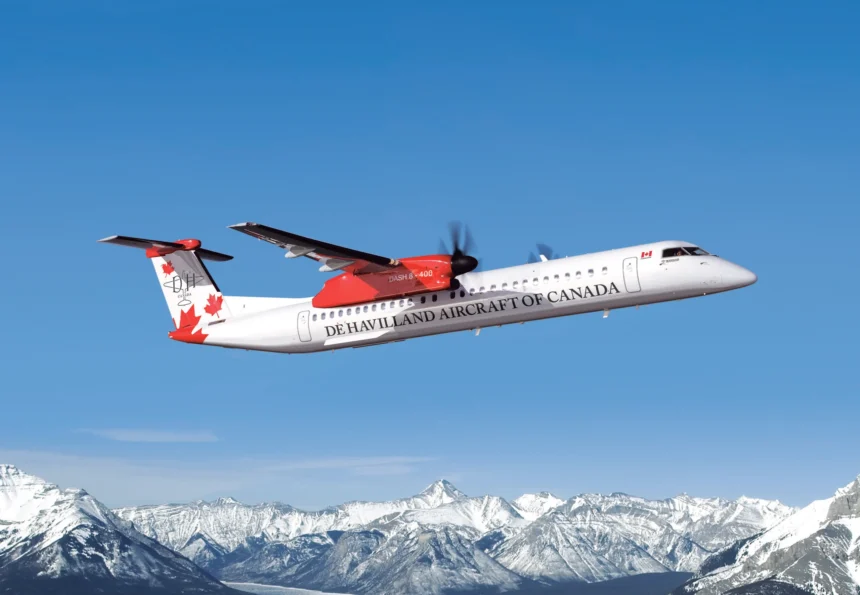
Eleven kilometres west of Strathmore, in a Wheatland County field that grew canola last season, Canada’s storied aircraft maker just broke ground on its future. De Havilland Field, launched officially on May 15, will be a 1,500-acre aerospace hub, an aircraft assembly plant joined by a runway, a parts manufacturing and distribution centre, and a maintenance, repair and overhaul operation. At full build employment is projected at up to 3,000 once complete, anchoring the largest private aviation investment this province has ever landed.
The order book is not theoretical either. Final assembly is planned for the DHC-515 waterbomber, the Twin Otter and the Dash 8-400, aircraft the world actually buys, and Alberta’s government has ordered five of the waterbombers, a $400 million commitment that doubles as wildfire capacity the province needs regardless.
Diversification With Rivets in It
Alberta has heard the word diversification from a thousand podiums, usually attached to a panel, a strategy document or a grant program that evaporates on contact with reality. This is the other kind. A factory. Trades jobs, engineering jobs, supply chain contracts, machining and avionics work, anchored to land and equipment that cannot relocate on a news cycle. The kind of payroll that survives a commodity downturn because firefighting aircraft and regional turboprops sell on their own market logic.
It also compounds what the province already does well. The aviation cluster joins the data centre pipeline and a manufacturing base that has been quietly broadening for a decade. None of it replaces energy, and none of it needs to. Diversification done right adds legs to the stool instead of sawing one off to balance the others.
Why the Company Chose Here
Aerospace manufacturers can site a plant anywhere on the continent, and the location calculus is unsentimental. Land that is available and affordable. A workforce with industrial trades depth. A provincial government that processes approvals on business timelines. Proximity to flight test airspace and a logistics corridor. Wheatland County won on the fundamentals Alberta keeps winning on whenever the contest is decided by economics rather than politics.
There is a national defence angle too. Ottawa’s commitments on defence industrial capacity will require sovereign aerospace manufacturing, and a country that intends to fight wildfires, patrol an Arctic and supply allied fleets needs exactly the aircraft this site will build. The work might as well land in a province that shows up ready.
Not another slogan. Not another framework. A runway, a factory and three thousand paycheques rising out of a prairie field. That is what real economic growth looks like, and Alberta should build the next ten projects exactly this way.
Should Alberta push harder into aerospace and defence manufacturing? Tell us below.