

Spencer Fraser, founder of Landing Zones Canada in Medicine Hat, describes his aircraft as “basically a very expensive boomerang.” It is a good line, and it contains the entire business case in four words. For a boomerang to beat a throwaway, it has to return frequently and cheaply enough that the cost of each return trip falls below the price of the disposable thing it replaces.
Ottawa has now put $1,161,500 of repayable money behind the idea that it can. The comparison deserves to be done honestly, sensor against sensor, before anyone treats a loan as a verdict.
Key facts
- Prairies Economic Development Canada announced a repayable investment of $1,161,500 in Landing Zones Canada of Medicine Hat on Mar 2, 2026, under the Regional Artificial Intelligence Initiative, for its GITPO remotely piloted aircraft system and an expected 12 jobs.
- The United States National Weather Service states that around 76,000 radiosondes are flown every year within its upper air network of 92 stations.
- Airbus announced on Jul 22, 2026 that it is investing in Landing Zones and will hold a seat on the company’s board, as part of a strategic partnership with Airbus Defence and Space.
- The 37th ASTech Awards list their finalist showcase for Sep 18, 2026 at Ross Glen Hall in Calgary and their awards gala for Nov 6, 2026 at the Westin Edmonton.
What a single-use radiosonde actually costs the system
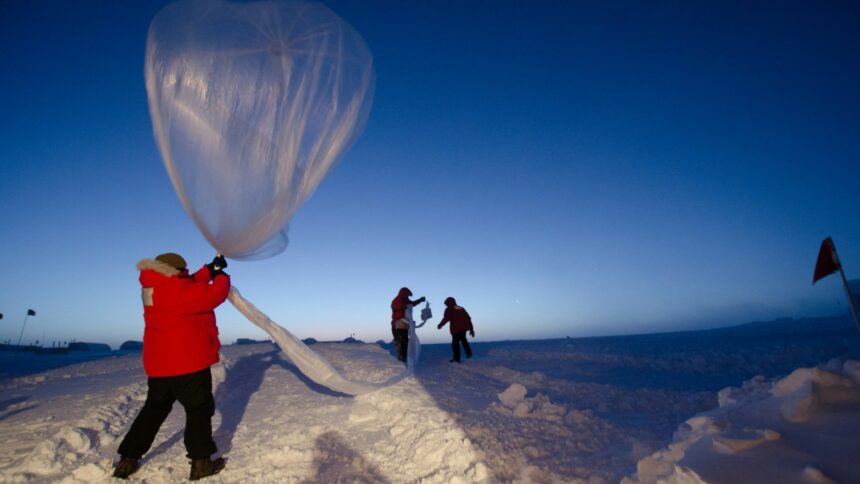
The thing being replaced is the radiosonde, a small instrument package that rides a weather balloon into the upper atmosphere, radios back temperature, humidity and pressure on the way up, and is never recovered in normal operation. When the balloon bursts, the package falls wherever the wind has carried it. The federal announcement quoted the company’s own figure of over 600,000 launched annually across the globe, and the company argues these packages are the largest source of electronic waste from weather monitoring.
A nearer benchmark comes from south of the border, where the numbers are published. The National Weather Service says about 76,000 radiosondes fly every year across its network. By our arithmetic, that is roughly 826 per station per year, a little over two a day, which matches the standard twice-daily launch schedule. Every one of those is a finished electronic product used once for about two hours.
That is the supply chain a reusable aircraft is trying to break into, and it is a supply chain built entirely on consumption. A weather office buys sondes the way a restaurant buys napkins, by the case and without thinking about it.
Why a reusable drone has to win on handling costs
The optimistic case is strong, and I think the optimists are partly right. The company says one airframe can be used hundreds of times. Take a station on a twice-daily schedule, which burns through about 730 sondes a year, and assume an airframe good for 300 flights. On that assumption, which is ours, the station would need between two and three airframes a year in place of more than 700 disposables. Even if each airframe costs many times more than a single sonde, there is a lot of room in that ratio.
The ratio is where the pitch ends and the operating cost begins. A radiosonde is cheap because nobody has to go get it. A reusable aircraft has to fly itself to a landing site, be collected, inspected, recharged and fitted to a fresh balloon, and every one of those steps is labour that the throwaway never needed. At a staffed station on a fixed schedule that handling may be trivial. At a remote northern station where launches are already automated, it could erase the savings. The comparison gets settled in the hangar.
Landing Zones also has company. Meteomatics, a Swiss firm, has built a foam glider that carries a radiosonde to about 30 km and flies it back for recovery, and it reported roughly 60 test launches with the Swiss federal weather office in the summer of 2024. Two independent teams arriving at the same design is a sign the physics works. It also means the contest will be decided on price and on who signs the first weather contract.
Where Landing Zones Canada makes money first
Here the defence side matters more than the weather side. The Airbus partnership announced in July covers threat emulation, battlefield simulation and advanced glide targets for live training, with Landing Zones acting as the Canadian representative for Airbus Defence and Space Services. That is a customer base with training budgets, an appetite for high-altitude targets and no expectation that the target comes home cheap. The weather market pays for reuse. The defence market pays for performance, and it pays sooner.
The weather contract is the slower road. When the loan was announced in March, a federal pilot was said to be in development, and a pilot is still a long way from a standing order that replaces a consumable line in a departmental budget. Procurement moves at the speed of the slowest signature, and no amount of engineering in Medicine Hat changes that. This is a city that has sold its own gas for 125 years, and a second industry built on flight hours would suit it well, but only if the orders arrive in the right sequence.
By the end of 2027, the company’s largest paying customer will be a defence training buyer rather than a weather service, and the only thing that would prove this wrong is a signed federal weather contract for reusable sondes, beyond a pilot, before the Nov 6 ASTech gala in Edmonton.