

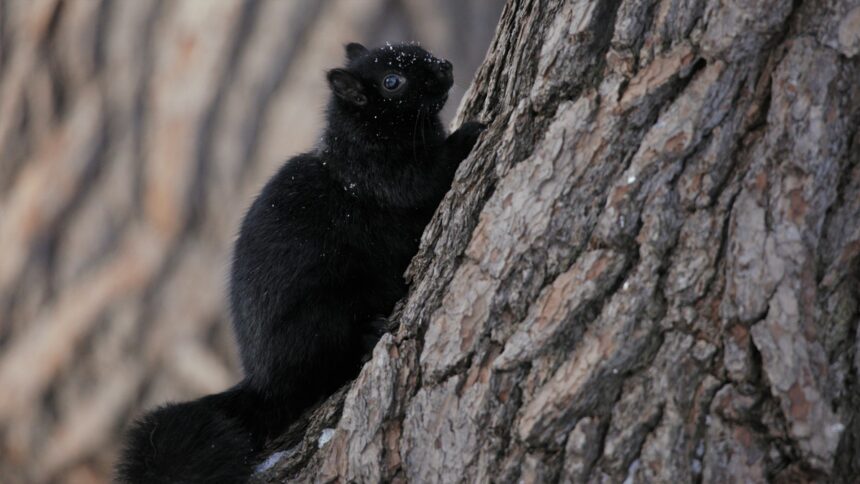
The University of Calgary Archives describes Thomas R. Baines as the “first zookeeper and curator of the Calgary Zoo,” appointed in 1929 and serving thirty-five years. That is the documented part. The undocumented part, which is the part everybody in this city knows, is that Baines once traded a pair of lion cubs to a zoo in Toronto for a handful of squirrels with an unusual coat, and that every black squirrel now crossing a Calgary fence is descended from them. It is a wonderful story. There is no paper anywhere behind it.
Key facts
- University of Calgary Archives records Thomas R. Baines, 1901 to 1994, as the first zookeeper and curator of the Calgary Zoo, appointed in 1929 and retiring in 1964.
- The eastern grey squirrel is native to eastern North America and is an introduced species in Alberta.
- Innes and Lavigne reported in the Canadian Journal of Zoology in 1979 that black morph eastern grey squirrels lose roughly 18% less heat at temperatures below minus 10 degrees Celsius, with a metabolic rate roughly 20% lower than grey morphs.
- Cosentino and Gibbs, publishing in Scientific Reports in 2022, examined coat colour across 43 North American cities and attributed the urban to rural melanism gradient mainly to reduced predation pressure in cities rather than to temperature.
- No published estimate of Calgary’s eastern grey squirrel population could be located in municipal, academic or conservation sources.
Three details in the legend do not survive a calendar
Begin with the decade. The story is always set in the 1920s, and Baines was not hired until 1929, which leaves a window of about fourteen months for a man to arrive, establish himself and begin conducting international livestock diplomacy on his own initiative. Not impossible. Not likely either.
Then the counterparty. The Toronto Zoo did not exist until 1974. The institution in Toronto at the relevant time was the Riverdale Zoo, whose grounds are now a working farm where schoolchildren meet goats. Half a century of Calgarians have been telling one another about a trade with an organization that would not be founded for another forty-five years, which is the sort of detail that survives precisely because nobody enjoys checking a story they like.
And then the lion cubs themselves, which trace to a single naturalist recounting the tale on the radio in 2021. That is an honest secondary account of a local tradition, and it is not a ledger entry. The zoo’s own records contain no acquisition note, no correspondence and no shipping manifest that anybody has produced. An institution that can date its first curator to the year cannot date the animal that became the city’s unofficial mascot, which is a fair summary of how municipal memory works.
The number everybody quotes does not exist
There is a figure of 100,000 squirrels attached to this story in most retellings. It has no source. Not the city, not a university, not a naturalist organization, not a survey of any kind. Somebody once needed a number, produced one, and the number has been earning a living ever since without ever holding a job.
What is documented is better anyway. Work published in 1979 measured black morph eastern greys losing about 18% less heat below minus 10 degrees, on a metabolic rate about 20% lower than their grey cousins. That is a real, quantified cold-weather advantage, and anybody who has stood at a bus stop in Calgary in January will find it immediately persuasive.
Persuasive, and mostly beside the point. A 2022 study across 43 North American cities found that the reason black squirrels concentrate in cities has less to do with cold than with hawks. Urban predators are scarcer, the conspicuous dark coat stops being a liability, and melanism persists where nothing much is hunting it. The cold helps at the northern edge of the range. The city is what does the heavy lifting.
What the zoo actually accomplished
Strip out the unverifiable parts and something more useful remains. A curator at a small prairie zoo, working with almost no budget in the years around the Depression, acquired an animal that was not native, could not be contained, and has since colonized every park, alley and attic in the city. Modern institutions spend years on impact frameworks trying to achieve a fraction of that reach and publish annual reports about it.
The lesson usually drawn from this is that Calgary should verify its charming stories before repeating them, and it should, and it will not, and on balance that is survivable. Alberta wildlife stories are held to a looser standard than Alberta budgets and always have been.
Though it is worth noticing which part turned out to be true. The unverifiable legend gave this city an origin story it enjoys. The peer-reviewed literature gave it a population that is thriving because Calgary got rid of the hawks. Only one of those is an achievement anybody planned.