


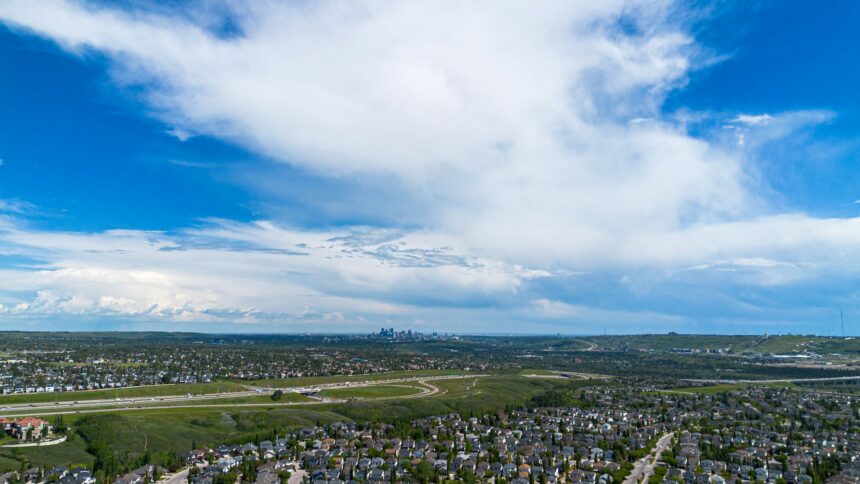
In the summer of 2000 Alberta crossed three million people for the first time; Statistics Canada put the province at 3,004,198 on July 1 of that year. The fourth million arrived in the estimate for October 1, 2013, a little more than thirteen years later. The fifth came in the estimate for July 1, 2025, less than twelve years after that, and on September 23 the agency put Alberta at 5,101,050 as of July 1, 2026.
The headline that went with the number was a flattering one. Alberta grew 1.5% over the year, the fastest rate of any province, while the country as a whole grew by roughly 0.5%. Both statements are true. The number underneath them tells a more useful story, and it is the one worth keeping in mind before anyone decides the pressure is off.
Key facts
- Statistics Canada estimates Alberta’s population at 5,101,050 on July 1, 2026, in quarterly population estimates released September 23, 2026.
- Alberta’s population grew 1.5% in the twelve months to July 1, 2026, the fastest rate among Canada’s provinces, according to Statistics Canada’s estimates of September 23, 2026.
- The Government of Alberta reported on September 23, 2026, that Alberta recorded the strongest net interprovincial migration inflow of any province in the second quarter of 2026, while net outflows of non-permanent residents held down international migration.
- Statistics Canada’s quarterly series, as republished on the Government of Alberta Economic Dashboard, records Alberta at 3,004,198 people on July 1, 2000 and 4,008,421 on October 1, 2013.
Alberta added fewer people this year even while it led every province
By our own arithmetic from the Statistics Canada series, Alberta added 76,419 people in the year to July 1, 2026. In the year before that it added 122,836, and in the year to July 1, 2024 it added 213,763, the peak of the recent surge. This year’s gain is about 38% smaller than last year’s and roughly a third of the peak; those percentages are ours, and so is every figure in this paragraph.
The reasons are partly national. The province’s own summary says Alberta continued to draw more people from other provinces than any other province did in the second quarter, and that departures of non-permanent residents held international migration down. Ottawa’s tighter limits on temporary residents are felt everywhere; they are felt here too, even in a province that remains the first choice of Canadians who move.
Leading the country is not the same as growing quickly. It means the others slowed further.
A slower year is the right time to build for the next fast one
Anyone who has lived through a few of this province’s cycles learns to distrust the comfort of a slowing number. In each boom the complaint is the same, that the schools, the interchanges, the hospital wings and the water lines were planned for the population of five years earlier; in each lull the urgency drains away, and the capital plans are trimmed to the pace of the moment. Then the next wave arrives, and the province is once again building for a crowd that is already standing in the doorway.
The arithmetic of the next million makes the point better than any warning. At this year’s pace of 76,419 people a year, Alberta would reach six million in a little under twelve years. At the pace of 2023-24 it would take about four years and two months. Those are our calculations, and neither is a forecast; they are two bookends, and the province has lived at both of them within the last three years.
The same thought applies to housing, where the monthly figures have swung hard enough this year to fill a column of their own on August starts. A pause in arrivals is the only time a province can catch up without also running to keep pace, and pauses in Alberta have never lasted long.
What 5.1 million people will ask of the province next
The question most Albertans are asking is whether housing, roads, schools and health care can expand fast enough for a province of more than five million. The honest answer is that they can only expand fast enough if they are expanded early, and early in this province means now, while the arrivals are a little fewer.
The mistake Alberta has made before is to read a slower year as a solved problem. It is a reprieve, and a reprieve is worth exactly what is built during it.
A province that builds only when it is crowded will always be building for the year that has already passed.
Frequently asked questions
What is Alberta’s population in 2026?
Statistics Canada estimates Alberta’s population at 5,101,050 on July 1, 2026, in quarterly population estimates released September 23, 2026.
Is Alberta still the fastest-growing province?
Yes. Alberta grew 1.5% in the twelve months to July 1, 2026, the fastest rate among Canada’s provinces, while the country as a whole grew by roughly 0.5%. New Brunswick and Saskatchewan were next at 1.0% each.
How much did Alberta’s growth slow this year?
Alberta added 76,419 people in the year to July 1, 2026. In the year before that it added 122,836, and in the year to July 1, 2024 it added 213,763, the peak of the recent surge. This year’s gain is about 38% smaller than last year’s and roughly a third of the peak.
Why is Alberta’s population growth slowing?
The reasons are partly national. The province’s own summary says Alberta continued to draw more people from other provinces than any other province did in the second quarter, recording the strongest net interprovincial migration inflow of any province. But departures of non-permanent residents held international migration down. Ottawa’s tighter limits on temporary residents are felt everywhere, including here.
When did Alberta cross each million-person mark?
Statistics Canada put the province at 3,004,198 on July 1, 2000 and 4,008,421 on October 1, 2013. The fifth million arrived in the estimate for July 1, 2025, and the count reached 5,101,050 a year later.