

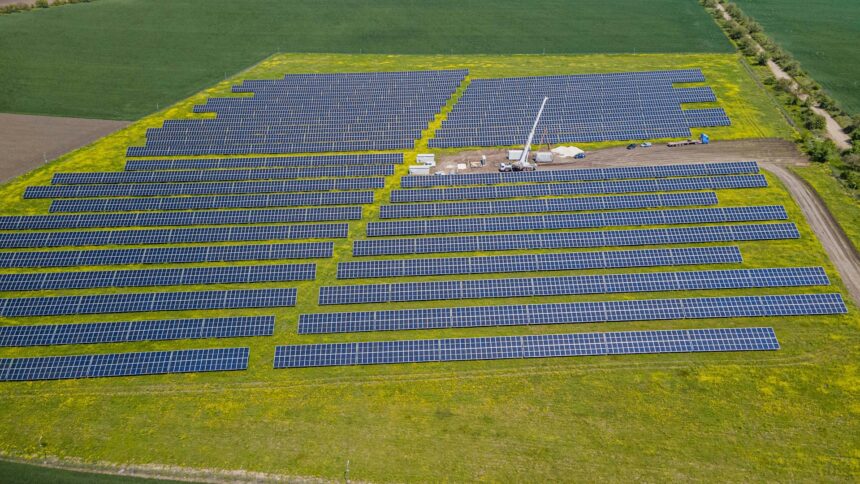
Every province in this country makes a case for itself, and the case costs nothing to make. Five acres in a municipally owned industrial park at Innisfail, an hour north of Calgary, now hold direct air capture equipment running on solar power, with a well that puts carbon dioxide two kilometres under the ground. Somebody paid for that. Money came from a fund Bill Gates started and from a provincial fund fed by industrial emitters, and the rest came from investors who could have placed it anywhere on this continent. It landed in central Alberta. A press release is written in an afternoon and forgotten by supper. Concrete is a decision nobody takes back.
Key facts
- Deep Sky’s announcement of 7 August 2024 set the Innisfail facility at 3,000 tonnes of carbon dioxide removed a year, with eight direct air capture technologies named at announcement and room for up to 10.
- Breakthrough Energy Catalyst granted Deep Sky US$40 million on 18 December 2024 toward the Innisfail build, according to Deep Sky’s announcement of that grant, which put the company’s total funding at $130 million.
- Emissions Reduction Alberta’s media release of 25 June 2025 records a $5 million provincial contribution from the Technology Innovation and Emissions Reduction fund toward a Deep Sky project valued at $58 million.
- The Government of Alberta Major Projects listing for the Carbon Removal Innovation and Commercialization Centre at Innisfail gives an estimated cost of $50 million on a 2024 to 2025 schedule.
- Deep Sky reported on 29 June 2026 that its Innisfail facility had delivered North America’s first certified direct air capture removal credits, verified under the Isometric protocol and sold to Microsoft and Royal Bank of Canada.
What the money at Innisfail actually bought
The design puts up to 10 different direct air capture technologies on one site, running side by side on the same power and into the same well. Eight were named when the project was announced on 7 August 2024. That is unusual. Most first-of-a-kind plants back a single technology and hope, because backing several at once means paying for the ones that fail. Deep Sky paid for the comparison, which a company can only afford where land is cheap, power is available and the rock underneath will take what you put into it.
The numbers attached to the site do not all agree, and that is worth saying plainly rather than smoothing over. Emissions Reduction Alberta put the project at $58 million in its release of 25 June 2025. The provincial Major Projects listing carries $50 million. Both are public documents and neither is a receipt. By our arithmetic the $5 million of provincial money is roughly 9% of the larger figure, which leaves about 91% of the build carried by people who answer to shareholders rather than to voters.
The job figures are projections and deserve to be read as projections. Eighty positions during construction, 15 once the plant is running. Deep Sky’s own material projects more than $110 million into the Innisfail community over 10 years, while the Emissions Reduction Alberta release puts the local benefit near $100 million over the same period. Those are forecasts made by parties with reasons to forecast well. What is not a forecast is the equipment on the pad, the solar supply sized at up to 4 megawatts, the injection well, the certified tonnes with buyers’ names on them.
Commissioning began in the summer of 2025. The first tonnes went underground after that, and on 29 June 2026 the company reported the first certified direct air capture credits in North America, bought by Microsoft and by Royal Bank of Canada. Alex Petre, the chief executive, said leadership in the field would be “earned through execution”. People say that sort of thing constantly. The difference here is a delivery record sitting behind the sentence.
Why the capital came here and not somewhere else
Deep Sky is not an Alberta company by origin. Its other projects sit at Becancour and Thetford Mines in Quebec, its larger second facility is going into Manitoba, and Investissement Quebec holds a seat on its board. A company with that history put its first operating plant in central Alberta anyway. It did so because the province supplied the two things the project could not manufacture for itself. Pore space that an industry has been drilling and describing for decades. A permitting path for putting carbon dioxide back into that pore space, written before anyone from this company came looking.
There is a habit in this country of treating a town like Innisfail as somewhere things pass through on the way to a serious place. The habit is wrong, and it is expensive for the people who hold it. The equipment did not go to a research park attached to a university. It went onto an industrial lot the town owns, beside the sort of workforce that has been raising steel and running compressors in central Alberta for two generations. Those skills were already in the area. The company says the milestones came on schedule and on budget, and that claim is easier to believe when the trades do not have to be flown in.
None of this settles anything about climate policy, and I have no interest in arguing that question here. The point is narrower and harder to wriggle out of. A government can tell investors its rules are stable and its geology is good, and the telling is free, and the phrase gets repeated at summit after summit until it means nothing at all. A company that has spent its own money and put its name on certified tonnes has made the same statement in the only language that clears. There is a ledger entry behind it.
Farm country has always judged people by what they do in a wet spring rather than by what they say at the counter afterward, and the rule holds for money as surely as it holds for neighbours, because talk is free and available in unlimited quantity while capital is scarce and has to choose one place over another every single time it moves. Alberta has been told for years that it needs to sell itself better. What happened on those five acres suggests the selling was never the problem. The rock was here and the rules were already written, and a company from two provinces over looked at both and started digging.
A place is what people are willing to build on it.