


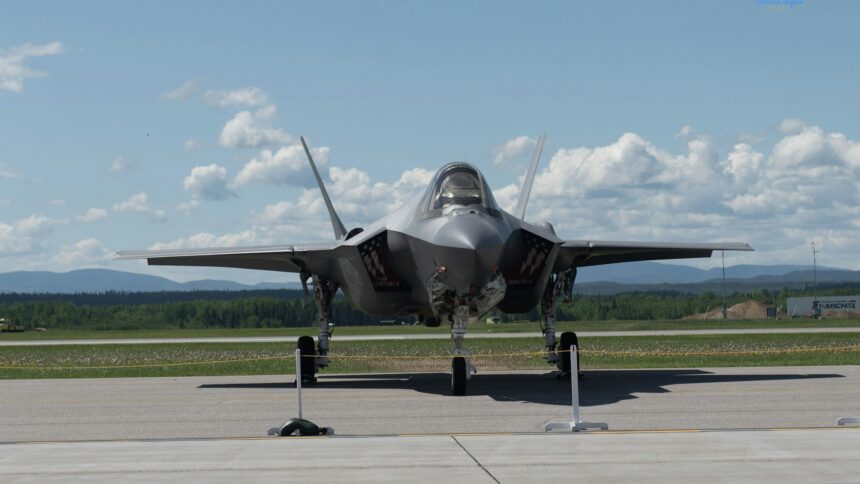
A technician at 4 Wing Cold Lake walks around a CF-18 with a flashlight.
The jet came into Canadian service in the 1980s. Some of the pilots flying it were not born yet.
Today Ottawa signed up for the next fighter. Sort of. Canada is now the first observer nation in the Global Combat Air Programme, the British, Italian and Japanese project to build a sixth generation jet. Observer. That is the word in the statement.
Key facts
- The Department of National Defence published a joint statement with Italy, Japan and the United Kingdom on July 21, 2026 confirming Canada as an observer to the Global Combat Air Programme.
- The United Kingdom Ministry of Defence stated in July 2026 that Canada will have “no decision-making role” as a Global Combat Air Programme observer.
- The United Kingdom, Italy and Japan launched the Global Combat Air Programme in December 2022 with a target of a new fighter in service by 2035.
- The Department of National Defence announced on January 9, 2023 that Canada had finalized an agreement for 88 F-35A fighters, and in March 2025 the federal government ordered a review of that purchase.
What observer status actually buys Canada
Here is what an observer gets, in the partners’ own words. Insight. Understanding. A look at the governance and the industrial framework.
Here is what an observer does not get. A vote. The British defence ministry said so plainly. No decision-making role.
That is a seat in the stands. Nice seats, maybe. Good view of the ice. You still don’t touch the puck.
And Canada took that seat while it is still reviewing the jets it already ordered. Ottawa confirmed 16 F-35s. The plan for the other 72 has been under review for more than a year. No end date published.
How long Canada has been shopping for this jet
Count it out on your fingers.
Ottawa announced the F-35 in 2010. Froze it in 2012. Ran a competition. Picked the F-35 again in 2022. Signed in 2023. Ordered a review in 2025. Now it is looking at the plane after that one.
Sixteen years, by our count. Somewhere in there Ottawa bought second-hand Hornets from Australia to keep the lights on.
A farmer who shopped for a combine that long would be cutting his crop with a scythe.
To be fair to the hedge, there is a case for it. Watching both an American program and a British, Italian and Japanese one costs little. The intelligence is useful. If the review ends with a decision, any decision, keeping a foot in both doors might look smart later.
But not deciding has a cost. Allies plan around what Canada can actually fly. Industry can’t tool up for a maybe. And the old jets don’t care about the review schedule.
Why Cold Lake and Alberta have a stake
The fighters live here. 4 Wing Cold Lake is one of the two main fighter bases in the country, and the town around it runs on that base. Every year of drift is another year of keeping old airframes flying out of an Alberta hangar.
Then there is the factory work. Every fighter program comes with promises of industrial benefits, contracts that are supposed to land in Canadian shops. A country that can’t decide what it is buying can’t steer where the work goes, either. Alberta has an aerospace sector with real skin in this, and De Havilland Field is going up east of Calgary right now.
The GCAP partners want their jet flying by 2035. Nine years. That sounds like a long time until you remember this country took sixteen to not quite finish buying the last one, and the technician in Cold Lake is still out there with his flashlight, checking a jet that should have been retired years ago.
Ottawa bought a ticket to watch.