

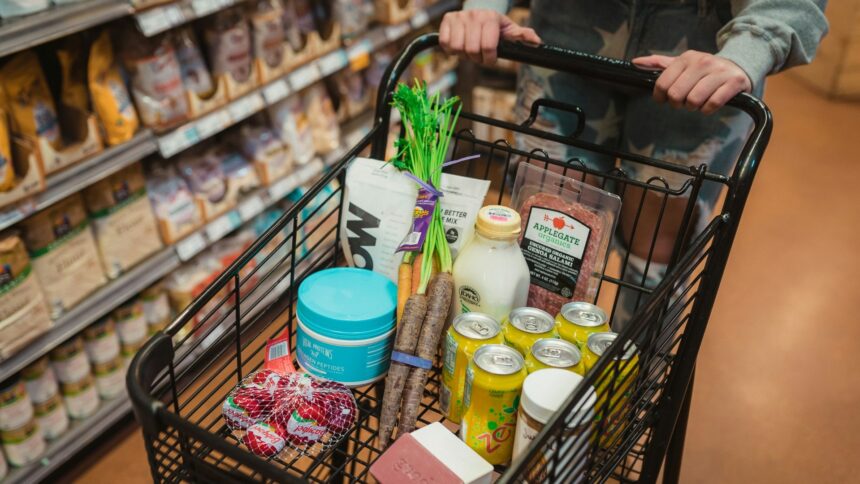
“Price growth for food purchased from stores continued to slow in August.”
Statistics Canada put that sentence in its Sept. 14 release on the Consumer Price Index, and it has the cadence of a homily in which the flood is measured by how gently the rain now falls. Groceries still cost 2.8% more than a year earlier. The growth slowed, and the prices grew.
Alberta’s own line in the tables tells the story in plainer figures. The province’s all-items index, which Statistics Canada sets at 100 for 2002, stood at 179.8 in July and 179.2 in August, a monthly drop of 0.3%. It had climbed 7.2 points from August 2025 to July. August handed back 0.6 of them, by our arithmetic one twelfth of the rise, and left Alberta prices 3.8% above where they stood a year before.
Key facts
- Statistics Canada’s all-items Consumer Price Index for Alberta, based at 2002=100, was 179.2 in August 2026 against 179.8 in July 2026, a monthly decline of 0.3%, in table 18-10-0004-01 as republished by the Alberta Economic Dashboard.
- Alberta’s all-items index stood at 172.6 in both July 2025 and August 2025, which puts August 2026 3.8% higher over 12 months in Statistics Canada table 18-10-0004-01.
- Canada’s all-items Consumer Price Index rose 3.0% in the 12 months to August 2026, matching July, Statistics Canada reported on Sept. 14, 2026.
- The Bank of Canada’s inflation-control agreement, renewed in December 2021 for the five years to the end of 2026, sets a 2% target at the midpoint of a 1% to 3% range.
Why a lower monthly reading still leaves Alberta prices higher
The 12-month rate is the figure that travels, and in Alberta it eased from 4.2% in July to 3.8% in August, by our arithmetic from the index. Last year contributed nothing to that improvement. The provincial index read 172.6 in July 2025 and 172.6 again in August 2025, so the entire slowdown in the annual rate comes from this year’s 0.6-point dip. One month did all the work, and one month is all it was.
In household terms, by our arithmetic, a basket that cost $100 at Alberta prices in August 2025 cost about $104.17 in July 2026 and about $103.82 in August. The better month saved roughly $0.35 on that basket. The other $3.82 stayed exactly where the year had put it.
Alberta still runs ahead of the national figure of 3.0%. Working from the same table, Ontario’s index rose 2.4% over the year and British Columbia’s 3.0%, while five provinces, four of them Atlantic plus Manitoba, ran hotter than Alberta. Statistics Canada noted that annual price growth sped up in six provinces in August. Alberta went the other way, which earns it a polite nod from the gallery and no refund at the box office. The household ledger, the same one behind the summer’s credit delinquency figures, runs on the level, and the level barely moved.
What the word relief is doing in an inflation report
Official prose about prices is a theatre in which the rate plays the lead and the price level never gets a line. A falling rate is billed as relief, the stalls applaud, and the ticket still costs 3.8% more than last season. An agency reports the speed of prices, and a household pays for the distance travelled.
Relief, in the sense a household means it, would be the price level walking back to where it stood last August. At August’s pace of 0.6 points a month, Alberta would need eleven more months like it to get there, by our arithmetic, a full year of falling prices to undo a year of rising ones.
The Bank of Canada’s agreement with Ottawa asks it to hold inflation at 2%, inside a range whose floor is 1%. A year of falling prices sits well below that floor, and the whole machinery of monetary policy is built to stop one arriving.
The relief Albertans are waiting for, in other words, is the one outcome the Bank of Canada is formally charged with preventing.
Frequently asked questions
What was Alberta’s inflation rate in August 2026?
Statistics Canada’s all-items Consumer Price Index for Alberta, based at 2002 = 100, was 179.2 in August 2026 against 179.8 in July 2026, a monthly decline of 0.3%. Over the 12 months to August, Alberta prices were 3.8% higher, down from a 4.2% annual rate in July. The index read 172.6 in both July and August 2025, so the entire improvement in the annual rate came from this one month’s dip.
If the index fell 0.3% in a month, why are prices still 3.8% higher than last year?
The monthly reading measures one month’s movement, while the 12-month rate measures where prices stand against a year ago. By the Tribune’s arithmetic, a basket that cost $100 at Alberta prices in August 2025 cost about $104.17 in July 2026 and about $103.82 in August, so the better month saved roughly $0.35 on that basket while the other $3.82 stayed put. August handed back 0.6 of the 7.2 index points Alberta had gained over the year, or one twelfth of the climb.
How did Alberta’s inflation compare with the rest of Canada in August?
Alberta’s 3.8% annual rate ran ahead of the national figure of 3.0% and ahead of Ontario’s 2.4% and British Columbia’s 3.0%. Five provinces, four of them Atlantic plus Manitoba, ran hotter than Alberta. Statistics Canada noted that annual price growth sped up in six provinces in August, while Alberta’s rate eased, and groceries still cost 2.8% more than a year earlier.
What is the Bank of Canada’s inflation target?
The Bank of Canada’s inflation-control agreement, renewed in December 2021 for the five years to the end of 2026, asks the bank to hold inflation at 2%, the midpoint of a 1% to 3% range. Relief in the household sense would mean the price level walking back to where it stood last August, and at August’s pace of 0.6 points a month, Alberta would need eleven more months like it to get there. A full year of falling prices sits well below the Bank’s 1% floor, and the whole machinery of monetary policy is built to stop one arriving.