

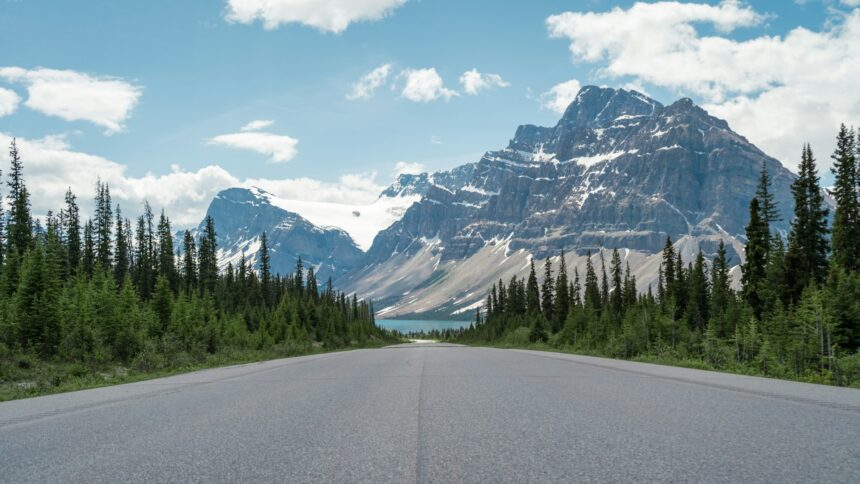
The pavement at Bow Pass sits 2,067 metres above sea level, the highest point on the Icefields Parkway, and on a July afternoon it holds enough heat that you can feel it through the soles of your boots. It is ordinary asphalt, two lanes and a painted centre line, and nearly everybody who crosses it is looking up at the peaks rather than down at the road that carried them there.
That road has a longer memory than most. Parks Canada’s own history of the route says construction began in 1931, in the Depression, and that about 600 men worked on it over roughly a decade. Each crew had one tractor. Horses pulled the graders and the plows, and the same federal account says most of the work was done by hand, across country that still feels unforgiving from inside a heated car.
All 230 kilometres of it.
Key facts
- Parks Canada records that construction of the road between Lake Louise and Jasper began in 1931 and that about 600 men worked on it over roughly ten years.
- Parks Canada gives the length of the Icefields Parkway as 230 kilometres, with its highest point at Bow Pass, 2,067 metres above sea level.
- According to Parks Canada, the route was finished in 1940 as a single-track gravel road, and the paved and realigned Icefields Parkway officially opened in 1961.
- Parks Canada’s history of the route states that each construction crew had one tractor and that horses pulled the graders and plows.
The Icefields Parkway was built by men the Depression had put out of work
The men who went up the valleys in 1931 were relief workers. They had no jobs where they came from, and the federal government had money for work in the national parks, so the work came to them in the form of a road through two of those parks, from Lake Louise north to Jasper. The pay was barely pay at all. The Association of Professional Engineers and Geoscientists of Alberta, which has written up the road’s history for its own members, puts the relief wage at $5 a month plus food and shelter, with foremen earning $60.
The historian Bill Waiser, who wrote the standard account of the relief camps in Canada’s national parks, describes bunkhouses of tarpaper with no insulation, in valleys where the snow comes early and leaves late. He also records one detail that says more about that winter than any budget line could. In November 1932, at the Jasper end of the work, two men cut a deck of cards to decide which of them would wear the one set of underwear and the one pair of socks they had between them.
One of them won the cut.
The gravel road of 1940 and the parkway of 1961 are two different roads
The first road was finished in 1940 as a single-track gravel route, and as the decade went on heavier machinery took over more of the work that horses and picks had started. It was a road you drove carefully and slowly, in summer, and for years afterward it was not kept open through the winter at all.
What most of us drive today is the second road. By 1961 the route had been rebuilt, paved and realigned, and the modern parkway was officially opened that year. Realigned is the important word there, because it means the highway does not always run where the relief crews first cut it. That is the way of old roads in this province, the way an abandoned rail grade in east-central Alberta still runs straight across a pasture long after the last train, and anyone who has walked one knows the feeling of standing on something that used to matter a great deal.
The crews who cut the first road are remembered mostly as a number
The mountains along this road are well looked after. The glaciers are measured, the viewpoints are signed and a great deal of care goes into telling visitors what they are looking at, which is exactly as it should be. The same visitors might stop at a ski hill near Banff to see a chairlift first built in 1948, or climb from Lake Louise to a tea house that has poured since 1905, and in both places somebody has kept the story.
The men who built the road that gets people to all of it are harder to find. The federal history of the route gives them a number, 600, and a sentence about horses and hand tools. Nearly everything else we know about their winters comes from a few historians who went looking in the files, and from the engineers who later rebuilt what they started. That is not anybody’s fault in particular. It is what happens to work that was done by people nobody thought to photograph, and it is the kind of forgetting that a little effort would still put right.
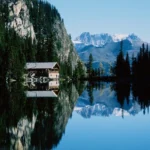
So the next time you pull over at Bow Pass, with the lake below you the colour of a gas flame and the icefield somewhere up ahead, look for a moment at the grey line of the road itself as it runs north through the spruce, first scratched out of this valley by men with shovels who were paid $5 a month to be somewhere, anywhere, that had work.
Frequently asked questions
When was the Icefields Parkway built?
Parks Canada records that construction of the road between Lake Louise and Jasper began in 1931, in the Depression. After roughly ten years of work it was finished in 1940 as a single-track gravel road. The paved and realigned Icefields Parkway officially opened in 1961.
Who built the Icefields Parkway?
About 600 relief workers, men the Depression had put out of work, recruited by the federal government for work in the national parks. Parks Canada’s own history of the route says most of the work was done by hand: each crew had one tractor, and horses pulled the graders and the plows.
What were the Icefields Parkway relief workers paid?
The Association of Professional Engineers and Geoscientists of Alberta puts the relief wage at $5 a month plus food and shelter, with foremen earning $60. Historian Bill Waiser, who wrote the standard account of the relief camps in Canada’s national parks, describes bunkhouses of tarpaper with no insulation, in valleys where the snow comes early and leaves late.
How long is the Icefields Parkway and what is its highest point?
Parks Canada gives the length as 230 kilometres, running from Lake Louise to Jasper. The highest point is Bow Pass at 2,067 metres above sea level.