
For most of its history before 1947, Alberta was a farming province that happened to have some oil. The farms were the main event. The oil was a sideline, promising on paper and disappointing in the field. Then, on the afternoon of February 13, 1947, a well in a frozen field near Leduc rearranged the order of things for good.
A company running out of holes
The company drilling that well was Imperial Oil, and by the mid-1940s Imperial was close to giving up on western Canada. The search for a major oil field had been long, expensive, and almost entirely fruitless. By the time the Leduc crew set up, the company had drilled 133 dry holes without a real success. The industry had a blunt term for a well that found nothing. It was a dry hole, and Imperial had drilled a small forest of them.
Leduc No. 1 was not expected to be different. It was one of a small group of wells the company had agreed to drill as a final effort before turning its attention elsewhere. The crew on the rig knew it. The site sat well away from any previous drilling, on ground most experts had no particular faith in. It was a last chance.
Each of those 133 dry holes was a crew, a rig and weeks of hard work, spent to prove only that the oil was somewhere else. A lesser company, or a less stubborn one, would have walked away long before the Leduc crew ever raised a derrick. Imperial drilled one more time anyway.
The afternoon of February 13, 1947
What happened next became one of the most retold days in Alberta history.
A crowd, and a breakdown
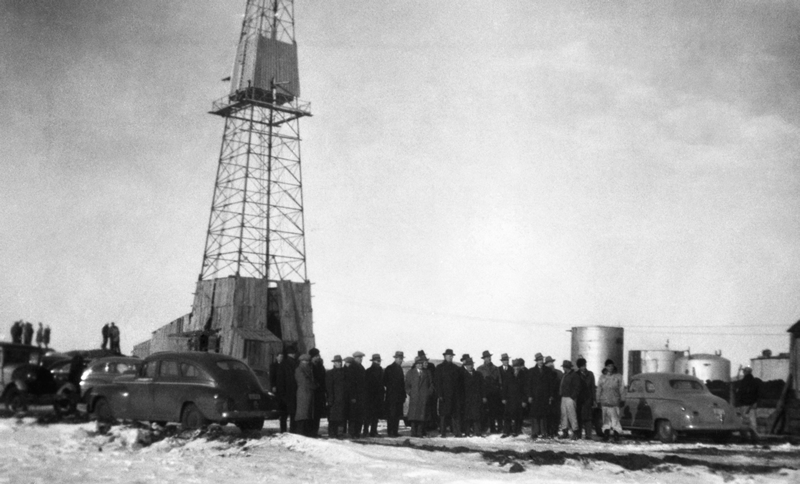
Word had spread that Imperial intended to bring the well in, and a crowd of around 500 gathered at the site. There were farmers and Edmonton families, reporters, company executives, and government officials, all standing in a February field waiting for oil. Then the equipment broke down. The crew spent most of the day on repairs while the crowd stamped its feet against the cold, and some of the spectators, certain they were about to watch one more failure, gave up and drove home.
The well comes in
They left too early. Late in the afternoon the well was finally ready. At about 3:55, Alberta’s Minister of Lands and Mines turned the valve, the flare line was lit, and a column of flame and black smoke climbed out of the prairie. After 133 disappointments, Imperial Oil had its field. The drilling crew was led by a superintendent named Vernon Hunter, a man so accustomed to failure that his own nickname, earned the hard way, was Dry Hole Hunter. The name stopped fitting that afternoon.
The province that Leduc built
Leduc No. 1 was not the largest oil well in the world, and it was not even the largest in the field it opened. Its importance lay in what it proved. It showed exactly where Alberta’s deep oil was hiding, and it set off a search that turned up field after field across the province. An earlier generation had seen a smaller boom at Turner Valley. Leduc was the one that changed the province’s character for good.
The boom remade the map. Edmonton, the closest city, became the service and refining hub for a new industry almost overnight. New towns appeared around the wells. Pipelines reached out across the province and beyond it. Within a generation the question in Alberta was no longer whether the oil was there, but how quickly it could be moved to the people who wanted it.
From sideline to main event
The shift came fast. In the years that followed, oil and gas overtook agriculture as the engine of the Alberta economy, and the discoveries that began at Leduc helped turn Canada into an oil exporter. The farm did not disappear, and Alberta remains a serious agricultural province. But after February 1947, it was no longer the only story the province told about itself.
The well itself was retired long ago, and the site near Devon is now a museum, marked by a derrick standing over the spot. It is a modest place for a piece of ground that closed one chapter of Alberta and opened another. The oil era that followed began with a last-chance well and a cold afternoon when part of the crowd had already gone home.