

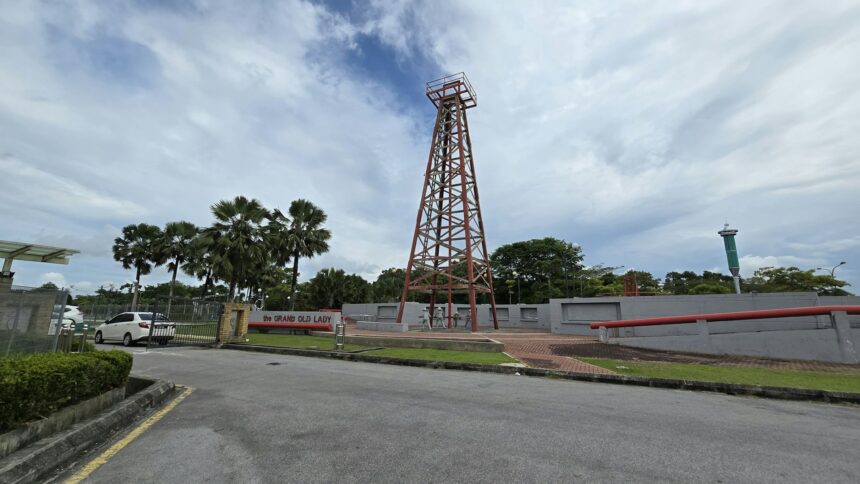
In May 1914, a well called Dingman No. 1 came in at Turner Valley, southwest of Calgary, and brought up wet natural gas rich enough in liquids to be used as gasoline. Thirty-three years would pass before Imperial Oil’s Leduc No. 1 came in on February 13, 1947, the date most Albertans are taught as the start of everything. The distance between those two dates is the most useful number in the province’s energy history, and it is almost never quoted.
Thirty-three years is longer than most careers. It is longer than the interval between the first strike at Turner Valley and the end of the war in 1945. Few of the men who put money into the 1914 well collected on what it announced; the plant burned, the company was sold, and the larger prize went to a later generation drilling farther north.
Key facts
- Dingman No. 1 came in at Turner Valley on May 14, 1914, heralding the discovery of the first major natural gas and oil field in Alberta, according to The Canadian Encyclopedia.
- The Turner Valley Gas Plant, which grew out of the 1914 discovery, holds both provincial and national historic site designations, according to The Canadian Encyclopedia.
- Imperial Oil’s Leduc No. 1 came in on February 13, 1947, and by the end of 1947 about 30 wells in the Leduc field produced 3,500 barrels of oil a day, according to The Canadian Encyclopedia.
What the 1914 investors actually got for their money
The venture began with W. Stewart Herron, a rancher convinced there was gas under the foothills. He had the conviction and some of the capital. He lacked the drilling knowledge, so he recruited Archibald Dingman, an experienced driller from Pennsylvania, whose crew found wet gas at roughly 800 metres. Among the Calgary men who backed the venture were James Lougheed and R. B. Bennett, the second of whom would later serve as prime minister. They were not speculators in the modern sense. They were Calgary men putting Calgary money into a hole in the ground on the strength of a conviction.
The ledger on that bet reads badly for the original partners. The strike set off Alberta’s first oil boom, a burst of share buying and company formation in Calgary. Six years after the discovery, in 1920, fire destroyed the plant, and Imperial Oil bought the company and folded it into a new subsidiary, Royalite Oil Company. The field went on to produce for decades under other owners. The people who opened it were paid mostly in having been first.
That is how most industries are built, and it is worth saying plainly because it is so easy to forget. The dramatic well gets the plaque. The expensive, patient, frequently unprofitable decades before it get a footnote. Leduc confirmed what Turner Valley had shown was possible; it did not invent the idea that Alberta sat on something valuable.
Why a 33 year gap should shape how Alberta judges patience today
Set 1914 beside the present and the measuring stick does its work. A driller in 1914 accepted that a discovery might take a generation to pay, and the capital that backed him accepted it too. The province now has a record of Turner Valley’s importance in the first oil boom that built modern Alberta, and every year the lesson of that record gets shorter in the retelling.
The lesson is about time. Projects of national size still take years to approve and longer to build, and the patience asked of investors has not shrunk since 1914; only the patience of the public conversation has. A proposal like the pipeline application now sitting on Ottawa’s desk is judged in news cycles of a few days. The Turner Valley partners were judged by the ground, over three decades, and the ground was the fairer judge.
By the end of 1947, the Leduc field was producing 3,500 barrels a day from about 30 wells. By our arithmetic, that is roughly 117 barrels a day per well, a modest figure by any later standard, and it was enough to turn the province. The first 33 years were the down payment on it.
A province that remembers only its gushers will keep underpricing the decades that make them. Turner Valley was a long apprenticeship, and the apprentices were not the ones who got rich.
Memory that runs back only as far as the last good year is the most expensive thing a province can own.