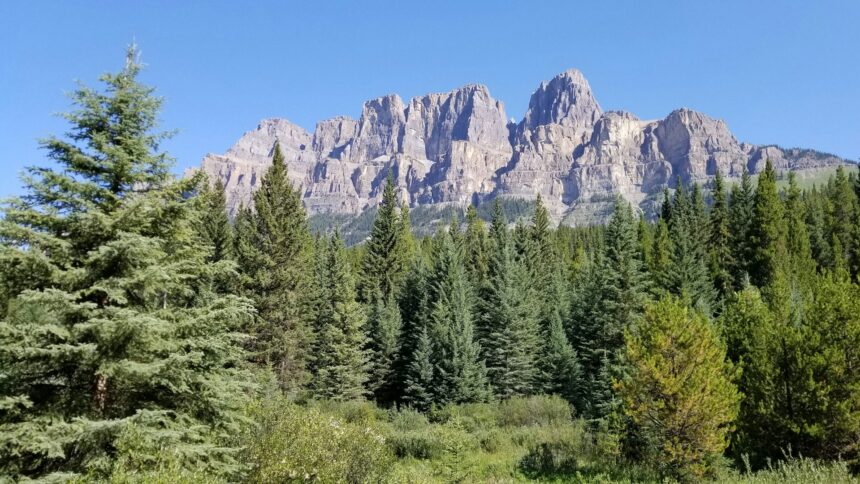
An informational plaque is all that marks Silver City today. It stands at the base of Castle Mountain in Banff National Park’s Bow Valley, 18 miles west of Banff according to the Whyte Museum of the Canadian Rockies, which is about 29 kilometres by the Tribune’s conversion.
A mining town of well over 2,000 people stood there for about two years, and no silver was ever mined in it.
Key facts
- Silver City stood at the base of Castle Mountain, 18 miles (about 29 kilometres, the Tribune’s conversion) west of Banff, according to the Whyte Museum of the Canadian Rockies.
- John Healy returned to the site in 1882 and named it Copper Mine, and the Whyte Museum records that no silver was ever mined there.
- The railway reached the site in November 1883. The Whyte Museum puts the town at over 3,000 residents with at least five mines operating at once, while Alberta Historic Places puts it at over 2,000.
- The Whyte Museum records that the town ground to a halt by the end of 1885, after fraud at the Homestake Mine and ore that did not pay.
- The Whyte Museum records that Joe Smith remained the only permanent resident until 1937, when blindness forced him to leave, and that Parks Canada later burned the remaining structures.
The name promised silver and the valley held copper
The Whyte Museum traces the town to 1882, when John Healy came back to a site where testing had shown high copper and lead content and called it Copper Mine. The name changed to Silver City at some point, and nobody has a settled account of why. The ore was copper and lead.
At its peak Silver City was several times the size of Calgary
The railway reached the site in November 1883, and the town filled quickly with hotels, pool halls and stores, with at least five mines working at once. Sources disagree on the size. The Whyte Museum says over 3,000 residents, Alberta Historic Places over 2,000, and each figure is given here to its own source. Calgary, by comparison, had about 400 people early in 1884, according to the Calgary Heritage Initiative, and was proclaimed an incorporated town on November 27, 1884.
Even the low figure is five times that, by the Tribune’s arithmetic. A camp in the Bow Valley outweighed the settlement that became the largest city in southern Alberta.
Fraud and thin ore ended it in about two years
The Whyte Museum dates the collapse to 1885, when the owners of the Homestake Mine allegedly planted gold dust on their claim to deceive shareholders. The town had run from November 1883 to the end of 1885, roughly two years by the Tribune’s count, which is too short for most places to build anything meant to stay.
Joe Smith stayed on until 1937
One man did not leave. The Whyte Museum records Joe Smith as the sole permanent resident until 1937, when blindness forced him to move away. Parks Canada then burned the structures that remained, and an informational plaque is what the museum lists at the site now.
Castle Mountain still stands over the place, and the plaque is still there beneath it.
Updated October 7, 2026. Limited Joe Smith’s account to the record (sole permanent resident until 1937) and removed unsourced claims about the dismantling of the town, its lack of a school and church, and Calgary’s 1884 population.
Related from Alberta Tribune: The Banff Cave Where Canada’s National Parks Were Born · Banff’s Railway Pagoda Museum Still Displays Specimens the 1914 Way · Coleman’s Police Barracks Still Stands Where Constable Lawson Fell in 1922