

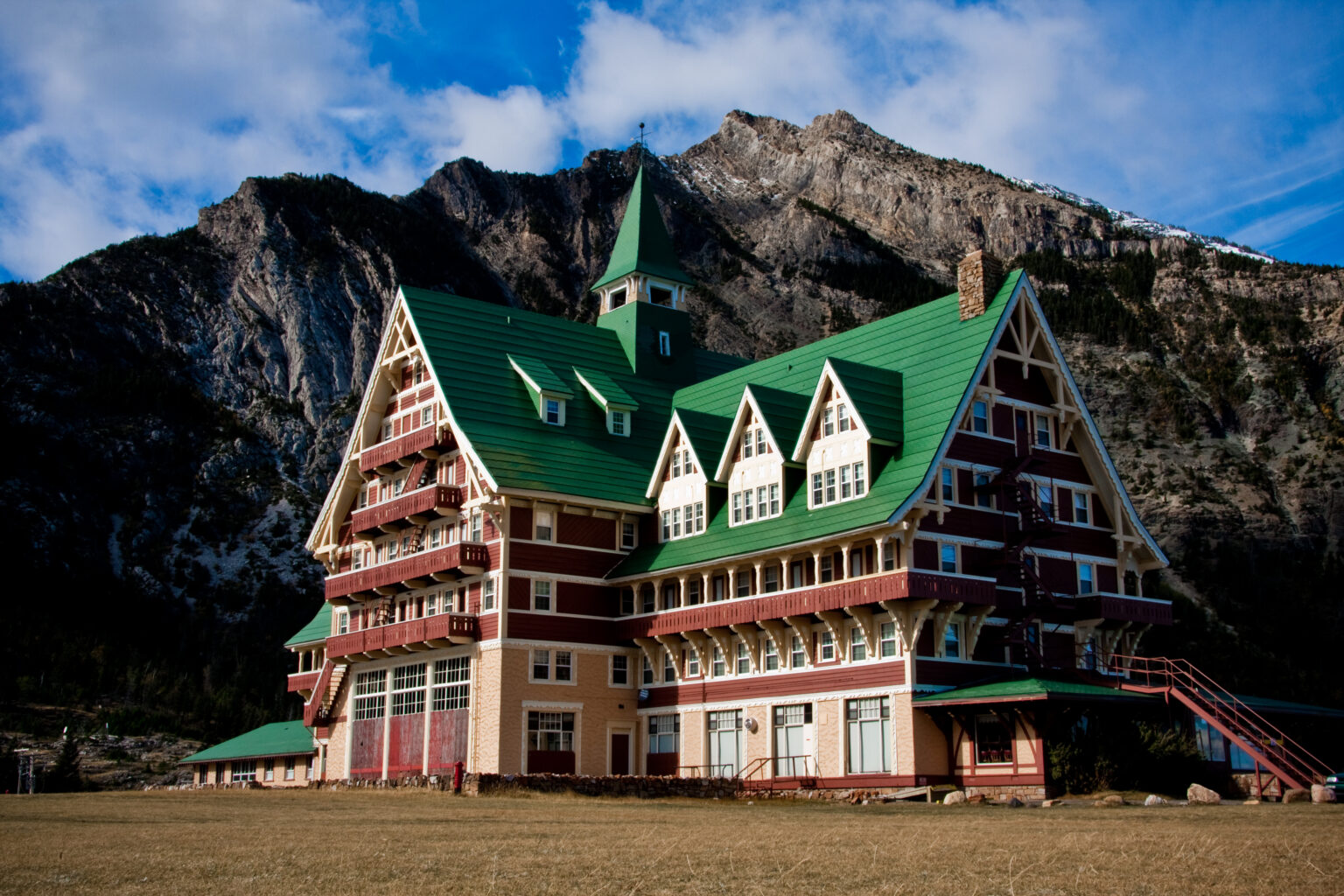
There is a hotel in Waterton Lakes National Park that should not, by any sensible reading of the weather, be standing where it stands. The Prince of Wales Hotel sits alone on a bare knoll above Upper Waterton Lake, directly in the path of some of the strongest sustained winds in Canada. The people who built it in the 1920s knew the hill was windy. They did not yet know how windy. The hill was about to teach them.
An American railway with a Canadian plan
The Prince of Wales is unusual among the great hotels of the Canadian Rockies for one simple reason. It was not built by a Canadian railway. It was built by the Great Northern Railway, an American company, and it remains the only one of Canada’s grand railway hotels put up by a firm based in the United States.
The man behind it was Louis Hill, president of the Great Northern and the son of the railway baron James J. Hill. Hill had picked out the dramatic hilltop above the lake as early as 1913. His reasoning was blunt and effective. The Great Northern already drew tourists to Glacier National Park, just across the border in Montana (Glacier National Park), and Hill wanted a reason to send them a little farther north into Canada. Prohibition gave him one. Through the 1920s the United States was officially dry and Canada was considerably less so, and a grand hotel on the Canadian side, with a dining room and a view, was an easy sell to American travellers.
The hotel that was named as bait
The name was a marketing decision, and not a subtle one.
A prince who never came
The hotel was named for the Prince of Wales, the future King Edward VIII, in a fairly transparent hope that the flattery would persuade him to stay there during his 1927 tour of Canada. It did not work. The prince had his own Alberta property, a ranch in the foothills, and he stayed there instead. The hotel kept the royal name regardless. It has carried the name of a guest who never checked in for nearly a century, and it has done very well by it.
The winter the wind fought back
Construction ran through 1926 and 1927, and it collided with one of the harshest winters the site had ever recorded.
Off the foundation, twice
On December 10, 1926, hurricane-force winds struck the half-built hotel and shoved its wings off the foundation. The crew managed to winch the sections back into line. Roughly three months later the wind returned and pushed the now fully framed building out of position again. The foreman made a hard call. Rather than risk tearing the structure apart by hauling it back, he chose to leave it slightly out of plumb. The Prince of Wales has a faint, deliberate lean to this day, and it was the wind, not the architect, that designed it.
Cabled to the ground
The builders took the lesson seriously. To keep the finished hotel where they had put it, they anchored the building to the hill with heavy cables, run down from the loft, through the structure, and into the ground itself. The Prince of Wales is, in a real sense, tied down. Guests who feel the building move gently on a gusty night are not imagining it. The hotel was engineered to give a little and hold.
The lean is still there
The Prince of Wales opened in July 1927, seven storeys of steep roofs and balconies standing against the mountains, and it became one of the most photographed buildings in the country. It was named a National Historic Site of Canada in 1992.
The hotel was built in a steep-roofed alpine manner, the sort of thing a traveller might expect in Switzerland, and it was placed so that nearly every window frames the lake and the peaks beyond. Hill wanted a building that looked like it belonged to the mountains around it, and he got one.
An American railway looked at the windiest hill in Waterton and put a luxury hotel on top of it. When the wind knocked the building sideways, the builders cabled it down and finished the job. Stand on the knoll in a westerly and the lean is still there, along with the cables that hold it.