

On 15 April 1966 the Legislative Assembly of Alberta passed An Act to Establish the Glenbow-Alberta Institute, and the province took ownership of a private collection that one Calgary lawyer had spent the previous eleven years assembling. Eric Lafferty Harvie built it through the Glenbow Foundation, which he set up in 1955. The Act closed out his part of the work. It opened everyone else’s, and that part is still open, with the Stephen Avenue building shut and the reopening targeted for 2027.
Two things happened in 1966 and only one of them ended. Harvie stopped being responsible for the collection. Alberta started, and has not stopped.
Key facts
- Eric Lafferty Harvie acquired freehold mineral rights in some 496,000 acres in Alberta in 1943 from the receivers of British Dominions Land Settlement Corporation and Anglo-Western Oils Ltd, per the judgment in Western Leaseholds Ltd v Minister of National Revenue, [1958] CTC 257.
- The Legislative Assembly of Alberta passed An Act to Establish the Glenbow-Alberta Institute, Statutes of Alberta 1966, chapter 35, on 15 April 1966, a date recorded in Hugh Dempsey’s memoir from University of Calgary Press.
- Glenbow held 250,000 artworks and cultural objects, of which 3% were on public display at any one time before the 2021 closure, per the Department of Canadian Heritage news release of 10 January 2025.
- The University of Calgary announced on 15 November 2018 that Glenbow’s library and archives, described in that announcement as provincially owned, would move to the Taylor Family Digital Library under a 99-year arrangement.
- The Glenbow-Alberta Institute’s annual general assembly materials of 27 September 2024 state that the Devonian Foundation appoints two of the corporation’s governors.
Harvie held the mineral rights four years before Leduc No. 1 came in
The usual telling compresses the order of events. Oil is found and a museum follows. A reported judgment in a 1958 tax case sets it out differently and in sequence. It records that in 1943 Harvie, then a Calgary barrister, “acquired the freehold mineral rights in some 496,000 acres in the province of Alberta” from the receivers of British Dominions Land Settlement Corporation and Anglo-Western Oils Ltd. By our arithmetic that is roughly 2,007 square kilometres. He bought from receivers, which is to say he bought out of somebody else’s failure, and the two companies formed to hold the rights were incorporated in April 1944.
Leduc No. 1 came in on 13 February 1947. Redwater followed in 1948, though Glenbow’s own published account of its founder dates that strike to 1949. Other accounts put the purchase in 1944, or split it between the summer of 1941 and 1943, so the judgment is the document to trust here. Four years separate the deed from the first well. The fortune arrived because the paper was already in the drawer, and the collecting arrived because the fortune did.
The 1966 Act moved ownership and left a standing obligation behind
Eleven years after starting the Foundation, Harvie let the whole of it go. What the Act did was plain enough. It brought the Glenbow-Alberta Institute into existence and moved the Foundation’s shares and holdings into it, under a board of governors seated partly by government and partly by the family. Hugh Dempsey, who worked inside the place for decades and later published a memoir with University of Calgary Press, recorded both the terms and the date of passage.
Sixty years on, that structure is still load-bearing. The corporation’s annual general assembly materials, dated 27 September 2024, still carry the name Glenbow-Alberta Institute, and still record that the Devonian Foundation, which grew out of the family foundation Harvie started, appoints two of the governors. A statute from 1966 reads like history and works like a standing instruction somebody has to follow every year.
Keeping the collection has meant moving it and closing the doors
Keeping has meant work with dates on it. In November 2018 the University of Calgary and Glenbow announced that the library and archives would move into the Taylor Family Digital Library under an arrangement running 99 years. The announcement stated that “the collections include provincially owned archives currently held by Glenbow,” which is the 1966 transfer speaking in its own voice fifty-two years later. The move began in March 2019.
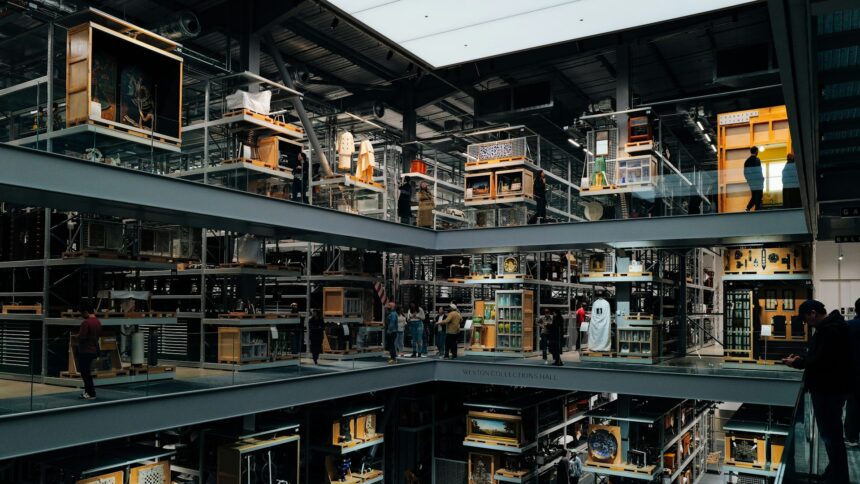
The building closed in August 2021. The federal heritage department, announcing a contribution on 10 January 2025, described a holding of 250,000 artworks and cultural objects and noted that 3% of that holding was on public display at any one time before the closure. The 2024 assembly materials report more than 100,000 items lifted out of wooden storage units and settled into new steel ones. By our count the doors have now been shut for five years.
The renovated building will carry the name JR Shaw Centre for Arts and Culture, while Glenbow keeps its own. Naming a building is the fastest part of this arrangement to change; the part Harvie could not do for anybody was the sixty years of storage and conservation that follow a signature.
Harvie died on 11 January 1975, nine years after the signature. By our arithmetic the obligation he created has run about six and a half times longer than he lived to watch it. A collector works inside one lifetime and can finish. An institution is asked to work outside every lifetime in the room.
Notice what he did not do. He did not hand over the crates and trust to goodwill. He moved the shares and wrote the family into the governance, then left a statute to carry the rest. He had been called to the Alberta bar on 13 July 1915, and he wrote the gift the way a lawyer writes one.
Anyone who wants to know what Alberta agreed to in 1966 should read chapter 35 rather than the plaque; the plaque finishes, and chapter 35 does not.