

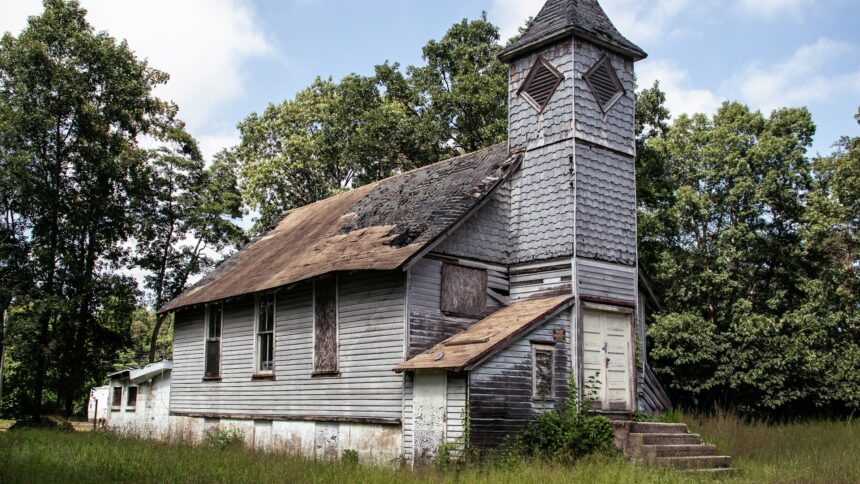
In September 1974 the church at Boian was declared a historic site. On 6 June 2023, forty-eight years on by our arithmetic, the building burned to the ground in a single afternoon. The designation had done the job it was written to do, which was to attach a legal condition to what an owner could alter, move or pull down; it had never pretended to have a word to say about dry timber and a spark. Alberta had the paperwork right. The building is gone all the same.
A building is a ledger kept in wood. Every beam in it records a decision that somebody made and paid for, and those entries stay legible long after the people who wrote them are dead. St. Mary’s Romanian Orthodox Church was inaugurated on 2 August 1905, seven years after the first Romanian settlers reached the district in 1898, by our count. It stood for 118 years.
Key facts
- St. Mary’s Romanian Orthodox Church at Boian, Alberta was built and inaugurated on 2 August 1905, according to the Romanian Orthodox Episcopate of Canada.
- Fire destroyed the Boian church building on 6 June 2023 after 118 years of use, according to the Romanian Orthodox Episcopate of Canada.
- The Romanian Orthodox Episcopate of Canada records that the church at Boian was declared a historic site in September 1974 and a historical monument in Canada in 1977.
- The Canadian Romanian Society of Alberta records that the first Romanian settlers at Boian, Ichim Yurko and Elie Ravliuk, arrived in early 1898, and that about 100 Romanian families were settled in the Boian district by January 1901.
- Consecration of the rebuilt church at Boian took place from 14 to 16 August 2026, according to the Romanian Orthodox Episcopate of Canada.
What an Alberta heritage designation actually governs
A heritage designation is a legal instrument, and like every legal instrument it has a defined reach. It attaches a condition to a property so that an owner cannot alter the fabric or take the structure down without the province agreeing first. That is a real protection and a useful one, because the threat it was written against is slow and it is human. Somebody decides an old building is in the way of a road or a balance sheet, and the designation makes that decision expensive and slow.
The paper accumulated steadily across the decades. The building was consecrated on 5 July 1936. It was called a historic site in September 1974. Three years after that, in 1977, it was named a historical monument in Canada. Seventy-two years of records and formal recognitions, by our count, and every one of them governed what people were permitted to do to the building. Not one of them governed what could happen to it on an ordinary Tuesday in June.
Fire is neither slow nor human. A designation does not put a hydrant at the end of a range road. It does not shorten the distance a volunteer crew has to drive. It does not run a sprinkler line through a timber building finished in 1905. The instrument protects a building from people. Against anything faster than people it is a page in a filing cabinet in Edmonton, and the page survived 6 June 2023 in perfect condition.
What the Boian community put up without an instrument behind it
The settlers at Boian filed for land on 31 December 1902 and were granted forty acres on 14 November 1903. No register existed to protect whatever they meant to put on it. No department had an opinion about the design. Nothing in law obliged a single neighbour to lend a wagon. They finished the church in 1905 regardless, and it served the district for sixty-nine years before anything was written down about it, by our count. The designation was a record of work already done.
The same order of events repeated itself after the fire. Ground was broken for a new church in August 2024. The rebuilt building was consecrated over three days, from 14 to 16 August 2026, thirty-eight months after the fire by our arithmetic. No instrument did that. A line in a register does not pour footings.
Why the August 2026 consecration matters more than the 1974 designation
The lesson people reach for after a loss of this kind is that the rules should have been stronger, and that reach is short memory doing its work. Boian was never held together by a rule. It was held together by the hundred or so Romanian families settled in the district by January 1901 and by the generations that came after them, and the proof of it is a consecrated building standing on the same ground in August 2026.
Heritage policy in this province is worth having and the register is worth keeping. It is also worth being honest about what the register is for. A designation is an inventory of what a community already proved it could do. It settles who may knock a building down, and it settles nothing whatever about whether the building is still there in the morning.
Boian was not there in the morning on 7 June 2023. Boian was standing again in August 2026, which is a fact about the families and not a fact about the file.
A designation records what a community was once willing to build; it has never yet been able to build the thing again.