

In 1907, at the Jamestown Exposition in Virginia, a girl of about sixteen from the Oklahoma ranch country was handed a medal that named her the champion among lady bucking horse riders. It was a small thing, the kind of disc that ends up in a drawer or a shoebox, and it is worth holding in the mind for a moment, because the woman who earned it would spend the rest of her life in Alberta.
Her name was Irene Wooden, born in Kansas around 1890, and by the time she came north she had married a rider named Vernon St. Clair, known to everyone as Burney, and was billed as Goldie St. Clair. She came to Calgary in September 1912 to win money at the first Stampede. She stayed for the better part of forty-five years.
Key facts
- Goldie St. Clair, born Irene Wooden in Kansas around 1890, placed second in the cowgirls’ bucking horse contest at the first Calgary Stampede in September 1912 and won $500, according to a 2024 biographical study published by The Active Historian.
- Goldie St. Clair won the ladies’ bronc riding title at Cheyenne Frontier Days in 1910 on a horse named Red Wing, according to the same 2024 study.
- The same 2024 study places the St. Clairs on a homestead west of Edmonton around 1913 and records that they became Canadian citizens in 1917.
- Goldie St. Clair died on November 30, 1956, at age 66, of injuries from a car accident, according to the 2024 study.
How good a rider she was before Calgary
Her road to Calgary ran through every big arena of the day. She rode with the Miller Brothers 101 Ranch Wild West show from about 1905, when she was fifteen, and married Burney St. Clair in Milwaukee on June 8, 1908. In 1910 she took the ladies’ bronc title at Cheyenne Frontier Days on a horse called Red Wing, and Theodore Roosevelt, who saw her ride, is reported to have worried aloud that a bad horse would get her in the end.
One nearly did. In April 1911 a horse called Roan Devil reared and went over backward on top of her, a fall that ended plenty of careers in those years. She recovered fully and went back to work, and that same year she took a six-week contract in Will Rogers’ show on Broadway.
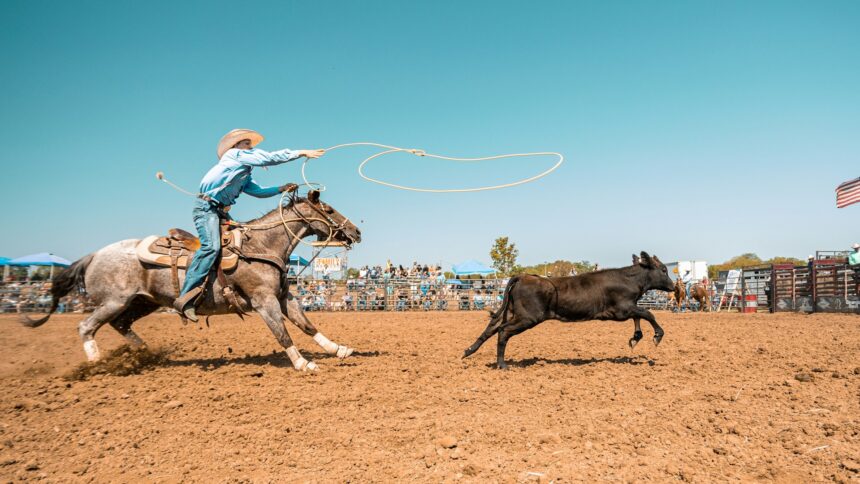
So when Guy Weadick went looking for riders to fill the first Stampede, backed by the four Calgary cattlemen and businessmen whose story sits in the A.E. Cross House and the Big Four, she was exactly the kind of competitor he wanted. She placed second in the cowgirls’ bucking horse riding and took home $500, which in 1912 was enough to start a life somewhere.
What she chose to do with the prize
Here the record turns in a direction the rodeo posters never followed. Within about a year of that ride, the St. Clairs had filed on a homestead west of Edmonton. The show circuit, with its trains and grandstands and applause, gave way to a quarter section, a well that had to be dug, fence that had to be strung, and winters that did not care who had ridden before a president. In 1917 the two of them became Canadian citizens, which is a paper decision, and a serious one, for people who could have gone back south at any time.
They did try the south again. In 1927 they moved to Texas, and the move did not hold. She came back to Alberta, the marriage ended in 1929 after twenty-one years, and in the 1930s she was ranching near Brooks with her second husband, an Alberta rancher named Tom Hillis. The road bent and doubled back, the way prairie roads do after a wet spring, and it kept bringing her to the same province.
None of this appears in the photographs from 1912, which show riders and stock and dust and crowds. Photographs are good at showing arrivals. They are poor at showing decisions, and the decision is the part of her life that matters most here.
Why a rodeo rider’s homestead belongs in Alberta’s story
The first Stampede was built as a farewell of sorts, a gathering of the old range skills at a moment when many people assumed the fence and the plough had finished them. What happened instead is that the event kept drawing people like Goldie St. Clair, and some of them looked around, filed on land, and began the slow work of making a district. The show brought them. The country kept them.
Alberta has always filled up this way, through people who came for a season, a contract or a prize and then found reasons to stay through a second winter, and a third. Her life is one clear, documented case of it, traced in the 2024 study from her citizenship in 1917 to her death in November 1956. She was sixty-six when she died after a car accident, a long way in years from the girl at Jamestown and not very far in spirit from the rider who climbed back on after Roan Devil.
The Stampede grounds this week will be full of riders who travelled a long way to compete, and most of them will load up and leave when the last go-round ends, as riders always have. The heritage of the event lives in the arena and the chutes. Some of it lives out in the country too, in land that was first broken by people who arrived with a saddle and an entry fee.
Somewhere west of Edmonton there is a quarter section where a champion bronc rider once stood at the edge of a field in the first cold of autumn, looking at a winter she had chosen.