

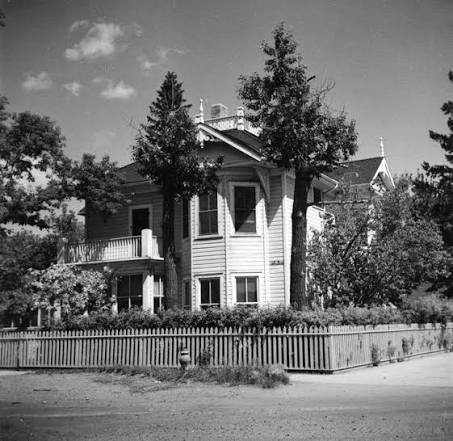
In 1912 four wealthy Calgary cattlemen, businessmen, and ranchers wrote a cheque for one hundred thousand dollars to underwrite a brand new event called the Calgary Stampede. They were Pat Burns, George Lane, Archibald McLean, and Alfred Ernest Cross. The four of them became known in Calgary lore as the Big Four. The house Alfred Cross built for his family in 1891 still stands on 8 Avenue SE in Inglewood and is among the city’s best-known pioneer residences.
Who A.E. Cross was
Alfred Ernest Cross arrived in Calgary in 1884 as a young veterinarian from Montreal. He bought his own ranch in the foothills south of Calgary in the 1880s. He founded the Calgary Brewing and Malting Company in 1892, which became one of the larger businesses in the city.
Cross built the family residence on 8 Avenue SE in Inglewood in 1891, immediately before he founded the brewery. The two storey wood frame house was built on a substantial Inglewood lot when Inglewood was still the working commercial centre of Calgary.
The Big Four moment
In 1912 American showman Guy Weadick proposed the first Calgary Stampede as a one-time event modeled on the rodeo and wild west exhibitions popular in the United States. He needed underwriting. The four wealthy Calgarians who fronted the money were:
- Pat Burns, the cattle and packing king.
- George Lane, the rancher and former Bar U manager.
- Archibald McLean, the rancher and politician.
- A.E. Cross, the brewer and rancher.
The four put up one hundred thousand dollars between them, an enormous sum at the time, to fund the event. The 1912 Stampede ran once before the First World War. It returned in 1919, became annual in 1923, and is now one of the largest western events in the world.
What the house represents
The Cross House is a surviving residence of a Big Four member, and it has been preserved in close to its original 1891 configuration.
The house was designated a Provincial Historic Resource on November 29, 1977, and is listed on the Canadian Register of Historic Places as Site ID 5133.
Why the Cross House links pioneer wealth to the Stampede
The Big Four story is told often enough in Calgary, but the connection between the original pioneer cattle wealth and the modern Stampede economy is usually framed as marketing rather than history. The Cross House is the physical proof that the connection is real and specific. The man who put up his share of the underwriting for the first Stampede built this house with his ranching and brewing money twenty-one years earlier. The financial path runs directly from one to the other.
That is a useful reminder of where the Stampede actually comes from. It was not a community festival that grew organically. It was a deliberate event funded by four wealthy Calgary businessmen who saw cultural and commercial value in branding the city as the western capital of the new prairie economy. They were right. The Stampede became the brand. The four men became the founding myth.
The house has been preserved as part of the broader Inglewood heritage cluster. Worth a slow walk past if you are interested in where Calgary’s commercial wealth actually came from. The bones of the early city are still here if you know where to look.
Related reading from the series. The Senator Lougheed Residence and the Calgary sandstone mansion that raised a political dynasty. Cochrane Ranche and how Alberta’s ranching industry got off the ground.