

If the Father Lacombe Chapel is the small humble first chapter of the St. Albert mission story, the Bishop’s Palace is the institutional chapter that came right after. Construction started in 1872 under Bishop Vital-Justin Grandin and the building took five years to finish. By 1877 the Diocese of St. Albert had a permanent headquarters on Mission Hill. The Catholic Church in what would become Alberta had moved from frontier outreach to formal institutional administration in a window of about fifteen years.
Why a Bishop needed a palace
The English word palace is a bit misleading. The Bishop’s Palace at St. Albert was not a luxury residence. It was the administrative office of a working diocese covering an area larger than several European countries combined. Bishop Grandin’s responsibilities in 1872 included the mission system, the schools the Oblates were starting to build, the diocesan accounting, the correspondence with Rome and with Montreal, the supervision of the small but growing clergy network in the region, and the ongoing relationship management with both the Hudson’s Bay Company and the Indigenous and Métis communities the mission worked with. All of that activity needed a building.
The construction period from 1872 to 1877
Building a substantial two storey wood frame structure on Mission Hill in the early 1870s was harder than it sounds.
- Lumber had to be milled locally, partly at the St. Albert sawmill that operated alongside the mission.
- Skilled labour was scarce and often had to be brought in from Manitoba and the United States.
- The mission economy ran on cash and barter at the same time, which complicated wage payment for any larger project.
- Construction stopped each winter and restarted in the spring.
The 1877 completion date represents five working seasons of effort. The building included sleeping quarters for the bishop and visiting clergy, a chapel, office space for the diocesan administration, a reception hall, and storage. It was the largest non-trade building anywhere in the area at the time.
Vital-Justin Grandin himself
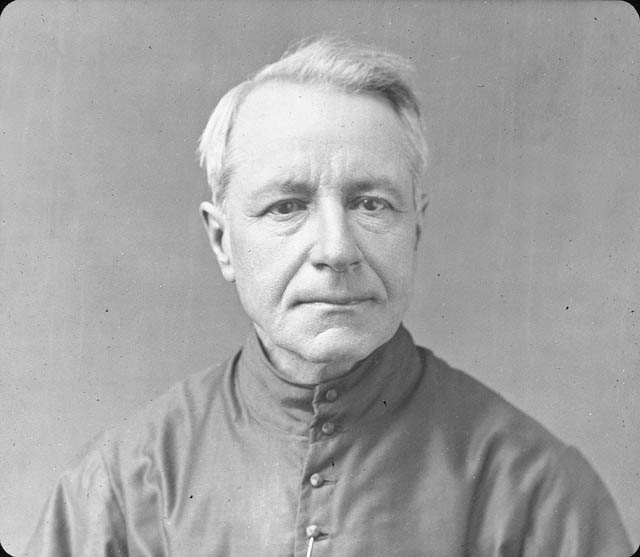
Grandin came to the western interior in 1857 and served as Bishop of St. Albert from 1871 until his death in 1902. He is one of the central institutional figures in early Alberta. The Bishop’s Palace was his physical base for most of that thirty-one year tenure. His correspondence, his administrative decisions about which missions to expand and which to close, his sometimes complicated positions on residential schools, and his diocesan reports all moved through this building.
The residential school history is part of the record. The Diocese of St. Albert was involved in the establishment of multiple residential schools in the late nineteenth and early twentieth centuries, and the long social and intergenerational consequences of that involvement are documented in the Truth and Reconciliation Commission reports and in ongoing community work. Any honest heritage profile of the Bishop’s Palace has to include that history.
What survives today
The original structure is the building you can still see on Mission Hill in St. Albert. It has been preserved as part of the broader Father Lacombe Centre complex and is managed today by the Musée Héritage Museum. The Alberta Register of Historic Places lists the building under ID 4997, with Provincial Historic Resource designation on February 15, 1977.
The building sits next to the Father Lacombe Chapel from 1861. The pair of structures, sixteen years apart in construction, give the visitor a clear architectural sense of how quickly the Roman Catholic mission infrastructure scaled up in this country between the first frontier chapel and the first institutional headquarters.
Why this building still anchors the hill
The buff opinion is straightforward. The Bishop’s Palace marks the moment when the Catholic Church in the country that became Alberta stopped being a small itinerant operation and started being an institution. That transition shaped the social history of the next century. Schools, hospitals, parishes, charitable organisations, social services. All of it grew from buildings like this one. You do not have to share the religion to recognise the historical weight. The institution shaped the place. Honest heritage interpretation acknowledges both the constructive and the harmful sides of that record.
Listed on the registry. The Bishop’s Palace appears on the Canadian Register of Historic Places as Site ID 4997 and was designated a Provincial Historic Resource on February 15, 1977. The building is part of the broader Musée Héritage Museum complex on Mission Hill.
Related reading from the series. Father Lacombe Chapel, the oldest standing building in Alberta. Rundle’s Mission and Alberta’s first Protestant inland outpost.