


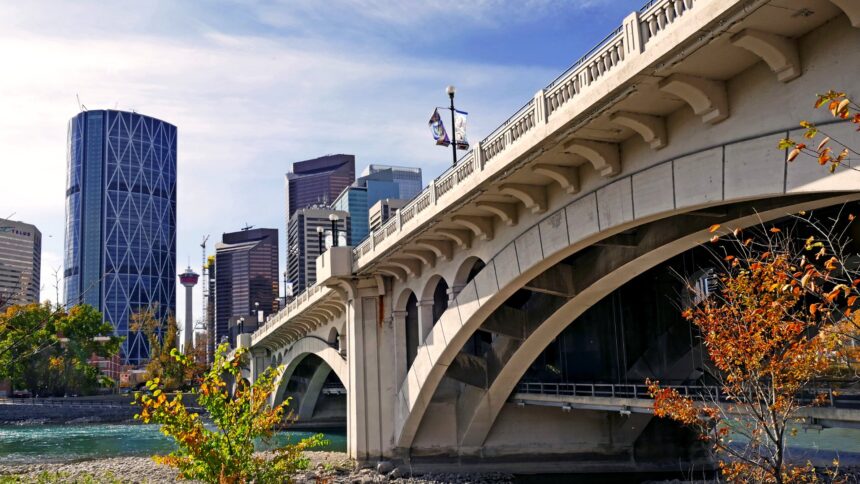
Each of the four original lions on Calgary’s Centre Street Bridge weighed 14 tons, or 12,600 kilograms, according to the City of Calgary’s heritage brochure. The four standing there now are copies, because the originals came down in 1999 after 84 years of freezing, thawing and traffic.
The man who carved the originals was a Scottish stonemason who sculpted in his spare time, by the same brochure. The Canadian Register of Historic Places spells his name Thomson, and a Calgary magazine spells it Thompson. The magazine says he worked through the winter of 1916 in a shed just east of the bridge, shaping concrete beasts after the bronze lions at the foot of the Nelson monument in London.
The bridge that carried them had cost $375,000.
Key facts
- The Centre Street Bridge over the Bow River in Calgary is 396 metres long, was built of reinforced concrete between 1915 and 1916, and has four arched spans, according to the Canadian Register of Historic Places.
- The City of Calgary heritage brochure on the Centre Street lions records that the bridge cost $375,000 and officially opened on December 18, 1916.
- The Canadian Register of Historic Places records that the Centre Street Bridge was protected as a Municipal Historic Resource on July 27, 1992.
- The City of Calgary public art page records that the original lions were removed in 1999 and that four replacement lions were cast for the renovated bridge.
The Paper Trail Gives Several Dates for One Bridge
The register puts construction at 1915 to 1916. The brochure gives an official opening on December 18, 1916. The city’s public art page says the lions were installed in 1916 with the bridge, while the magazine says they went up in 1917. A bridge may be finished, opened and ornamented on three separate days, so any of these can be right. The published accounts do not line the dates up, and a reader who tries is left to choose.
The carving rewards the trouble. The register reads the lions as symbols of the British Empire, modelled on those at Trafalgar Square, and lists buffalo heads for Western Canada beside the maple leaf, rose, shamrock and thistle. The lions sit in pairs on kiosks at each end of the bridge, two facing north and two facing south.
The Four Original Lions Are Hard to Account For
The city’s public art page says one fully restored original has stood at the Municipal Building entrance since 2003, and that two more are in storage because they are too fragile for the weather. It adds that in 2017 one remaining original was moved to Rotary Park, above the bridge, where it is left showing its cracks and repairs. The page does not say whether the Rotary Park lion is one of the two in storage. The magazine, writing earlier, says three of the four originals sat in a southeast city maintenance yard under tarps. The sources leave a reader unsure where the fourth lion stands.
The lion restored in 1999 came from the southwest tower, where the city says the concrete had fared best. The brochure says a local sculptor, Illyas Pagonis, restored it and made moulds for the four replacements. The magazine spells his first name Ilyas. One set of lions has collected two spellings of its restorer and two of its carver.
A Concrete Lion Needs a Dated Label
Calgary protected the bridge in 1992 and added the lions to its public art collection in 1993, which is a long time to hold a municipal asset without publishing one list of what it contains. The position here is plain. The city should issue a single inventory of the four originals, each with a location and a date, settle the spelling of the sculptor’s name and say which source it follows. That is an afternoon’s work for an archivist. Left undone, every new retelling picks a date and a spelling at random, and the next one inherits it.
On the bridge, two lions face north and two face south, each cast from a mould taken off the one original sound enough to copy.
Sources
- Canadian Register of Historic Places, Centre Street Bridge (accessed Oct 2, 2026)
- City of Calgary, Centre Street Lions public art page (accessed Oct 2, 2026)
- City of Calgary, Centre Street Lion heritage brochure (accessed Oct 2, 2026)
- Avenue Calgary, The Story of Calgary’s Centre Street Bridge Lions (accessed Oct 2, 2026)






.jpg)