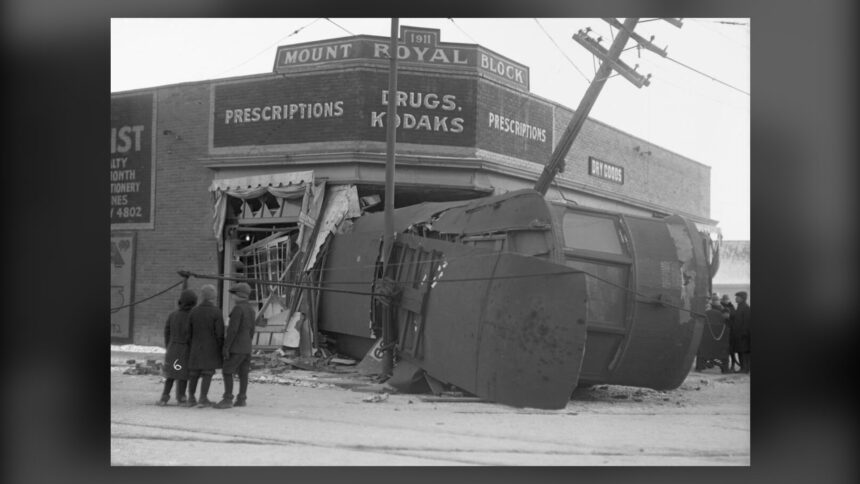
The photograph shows a streetcar that has stopped in the wrong place. Its nose is inside a brick drugstore, a corner of the building is gone, and the street in front is packed with people who came to look at something that wasn’t supposed to be possible. Nobody in the frame is doing anything useful. They’re standing in the street at 14th Street and 17th Avenue S.W. in Calgary, and the archive caption dates the picture to December 15, 1919.
The building in it was Crooks Drugs, on the southeast corner, and it is gone. The streetcar line that ran into it is gone too. What remains is the picture, which says more about what Calgary chooses to keep than about the crash.
Key facts
- Pharmacist Ivan H. Crooks established Crooks Drugs at 1428 17 Avenue SW in 1911, according to the University of Calgary Archives.
- Calgary’s streetcars began running in 1909, with 12 cars on 25.7 kilometres of track serving about 30,000 people, and the last ran in 1950, per the City of Calgary transit history.
- The pharmacy traded from the corner until 2007, and the building burned on February 24, 2008, according to a thread kept by the Calgary Heritage Initiative.
- One restored streetcar from the final years of service sits at Heritage Park, the City’s transit history says.
The city built its street railway in 1909 and ran it as a utility
Calgary opened its street railway in 1909 and ran it as a public utility. Twelve cars, a bit over 25 kilometres of track, a city of about 30,000 people.
What the record opened for this column doesn’t give is the cause of the 1919 crash or the toll, so neither is claimed here. The photograph is firm evidence that it happened. Anything past that needs the archive file, and that is where a careful reader should go next, starting with the 1966 transfer that shaped the Glenbow collection.
The drugstore outlasted the streetcar by nearly sixty years
Crooks Drugs opened in 1911, so the building was young in 1919. It was repaired and went on selling prescriptions, and the pharmacy kept trading from that corner until 2007. The streetcars were retired in 1950, so the drugstore served the neighbourhood for roughly 96 years and the cars ran for 41 (a calculation from those dates, not a published figure).
Then, on February 24, 2008, the old building caught fire. Firefighters couldn’t determine the cause, the brick walls were judged too unstable to leave standing, and the structure came down within hours. The one physical witness to the crash was lost in an afternoon.
Calgary kept the wreck and let the corner go
A disaster gets photographed. The 41 years of ordinary service on either side of it mostly didn’t. The picture has outlasted the building in it, and a city that keeps the wreck while letting the corner go has picked which half of the story to hold.
Almost nothing of the old network is marked on the ground today. One restored car survives. The building that stood in the photograph, the only thing a person could walk up to and touch, reached its late nineties and was pulled down in a single day, and none of the sources opened for this column describes a plaque, a survey or a salvaged brick. Calgary has done better with other buildings, and the 1885 Immigration Hall and Victoria School in the 1918 epidemic show both the loss and the saving in the same city.
The corner at 14th Street and 17th Avenue S.W. is still there, and the 1919 photograph is what the archive keeps of what stood on it.