

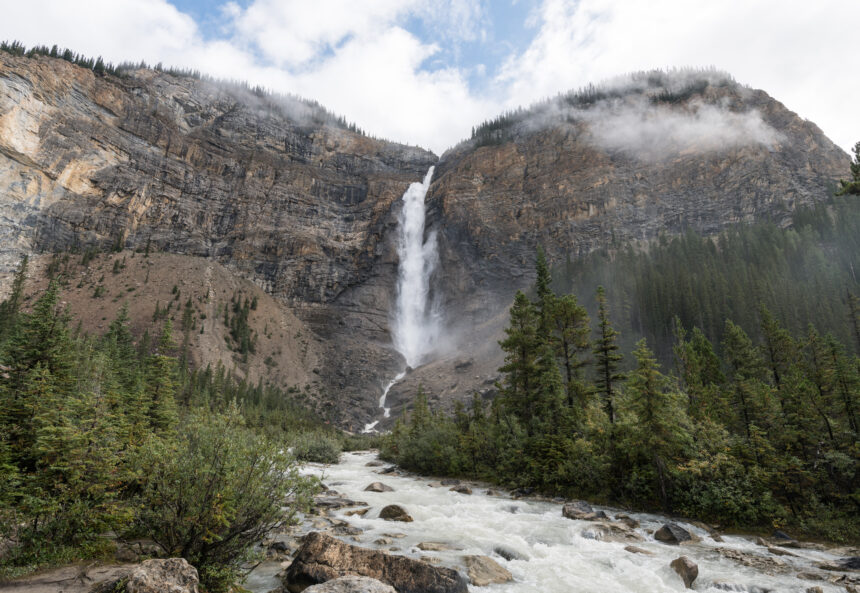
The name Takakkaw went onto the map on March 1, 1904, according to BC Geographical Names, and the waterfall has been the Rockies’ best-kept public secret ever since. It sits in Yoho National Park, across the provincial line from Banff, and drops 373 metres in total, with a main drop of 254 metres fed by meltwater from the Daly Glacier.
Most people never see it. The highway from Calgary to the BC interior crosses into Yoho not long after Lake Louise, and nearly everyone keeps driving. Takakkaw is a turnoff most drivers never take.
Key facts
- Takakkaw Falls is 373 metres in total height, with a main drop of 254 metres after a 1985 survey, and is fed by the Daly Glacier, as Britannica records.
- The Yoho Valley Road is open from late June to mid-October, and Parks Canada says the falls are reachable only by cars and small RVs because of very tight switchbacks.
- Parks Canada also warns that parking at Takakkaw Falls and Emerald Lake can fill quickly in July and August.
- The Canadian Pacific Railway built the original Emerald Lake guest lodge in 1902, according to the lodge’s own history.
- Yoho belongs to the Canadian Rocky Mountain Parks World Heritage Site.
The railway built Yoho and then stopped advertising it
What Yoho has is the railway’s fingerprints on everything. The village of Field exists because the Canadian Pacific Railway needed a division point at the foot of Kicking Horse Pass, and the Spiral Tunnels that tamed the old Big Hill grade are a short drive from the falls. On the shore of Emerald Lake the company put up a guest lodge in 1902, and it was still taking guests when CPR road improvements opened the place to cars by the mid-1920s.
The CPR built the mountain parks as destinations, then spent a century steering people toward Banff and Lake Louise. Yoho got the infrastructure and missed the fame. The result is a 1902 railway hotel with hand-hewn timber and stone fireplaces, twenty minutes from the most photographed lake in Canada, that many Lake Louise visitors have never heard of.
Nearby sit the Burgess Shale fossil beds, about half a billion years old and among the most important fossil sites anywhere. Parks Canada runs guided hikes to them in summer. In any other province that would anchor a whole tourism campaign. Here it gets a paragraph in the brochure.
Yoho stays out of the spotlight because of its road
The obvious explanation for Yoho’s low profile is marketing, and it’s only half right. The real limit is the road. Banff has a townsite, a gondola and four million visitors a year, and Yoho has a village of fewer than 200 people and switchbacks too tight for tour coaches. The park couldn’t take Banff’s crowds if it wanted them, so it never had to fight them off.
That makes it a useful counterexample. The usual Rockies story is too many cars and too few stalls, and Yoho is what the same mountains look like when the access is hard. The mountains didn’t change. The distribution of people did.
Go in the morning, before the parking fills
The falls are strongest in early summer, when snowmelt swells the glacier’s runoff, and the light turns gold by September. The road closes in mid-October and stays closed until the snow clears the switchbacks in late June. Go early, because Parks Canada’s own advice is that parking fills in July and August, and the morning sun hits the water straight on.
Walk in from the lot and stand in the spray. Then drive back to the Trans-Canada and merge into the line of brake lights heading for Lake Louise, and watch how many of them never took the turn. The same mountains hold more of that history. See the cosmic ray station on Sulphur Mountain, the climb to Lake Agnes and a century of skiing at Norquay.