

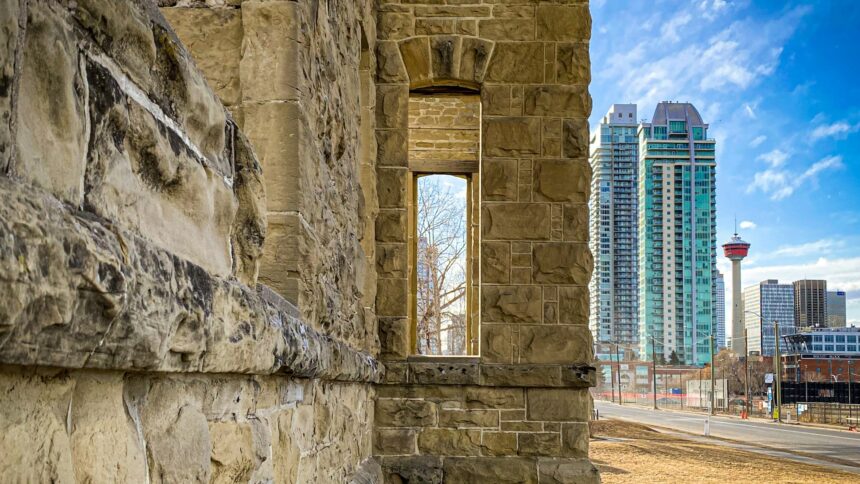
Walk up to Historic City Hall on Macleod Trail and lay your palm on any block you can reach. It is one of 15,522 pieces of Paskapoo sandstone in that building, and between 2016 and 2020 the City of Calgary repaired or replaced almost every one of them, working inside a wrapped scaffold through three winters so the masons could keep at it while the temperature outside did whatever an Alberta winter does.
The stone is on that corner because of a fire. Calgary’s sandstone era has a starting date and a closing date, and both sit plainly in the civic record. It began on November 7, 1886, when flames were found behind a feed and flour business on Atlantic Avenue, the street we now call Ninth, and it ended in 1915, when the last quarries around the city shut. Twenty-nine years. That is how long Calgary cut its own buildings out of its own ground.
The City’s account of that morning reads like a weather report from a bad November. Roughly 18 buildings on the commercial strip were lost. The town owned a chemical engine for exactly this kind of night, and it was locked away in a Canadian Pacific Railway freight shed because nobody in town government had the authority to settle what was owed on it, so the firefighters forced the shed and used the engine anyway. The blaze was finally held at George Murdoch’s tack shop, which the former mayor agreed to sacrifice as a firebreak and, by the City’s telling, helped tear down with his own hands. No one was killed.
Key facts
- The City of Calgary’s newsroom history of April 2, 2019 estimates losses from the fire of November 7, 1886 at $103,200, across roughly 18 buildings on Atlantic Avenue, now Ninth Avenue.
- According to the same City of Calgary history, over half of the city’s skilled trades by 1890 were stonecutters or masons.
- The City of Calgary’s sandstone quarries page counts about fifteen quarries in or near present city limits in the years before 1914 and records that the last of them closed in 1915.
- Calgary’s Historic City Hall rehabilitation ran from 2016 to August 2020 at a cost of $34.1 million and repaired 97% of the building’s 15,522 pieces of sandstone, using about 1,350 tonnes of newly quarried stone, according to the City of Calgary.
Why a town built of wood turned to stone after one night
The popular version says Calgary was timber on the Saturday and stone by the following spring, and the record is more patient than that. Two substantial sandstone buildings were already finished at 102 and 104 Eighth Avenue SE before the fire, the Canadian Pacific Railway had been quarrying stone west of town since the summer of 1885, and Joseph Butlin had opened a quarry on the Elbow River that same year. The fire did not invent the material. It hurried the town toward something it had already started to trust.
What followed was a decision taken by a whole community rather than a single clause. The City’s histories describe officials pressing for local stone on the big downtown buildings and builders going along, though none of the City pages reproduces a bylaw, so the honest reading is a town that made up its mind one block at a time. Wesley Fletcher Orr, mayor in the middle of the 1890s, ran a quarry. William Oliver worked the Bankview quarry from about 1900, and at its peak it kept roughly 40 men at work. The buildings those men supplied are still the ones people photograph, from the Tribune Block on Eighth Avenue to the Lougheed family’s sandstone mansion on 13th Avenue.
Then there is the count of the trade itself. By 1890, four years after the fire, stonecutters and masons made up more than half the skilled tradespeople in town, in a business that by the City’s own dating had only begun here in 1885. Even the number of quarries drifts depending on which City page you read. One says more than a dozen, another says about fifteen, and a 2019 City story on the restoration put it at no fewer than 19. The archive agrees on the shape of the thing and loses its grip on the details, which is what happens when nobody is paid to keep the details.
What Calgary lost when its quarries closed in 1915
The last pits closed in 1915. After that the stone went into repairs and the odd late commission, and the City’s page lists the Memorial Chapel at Grace Presbyterian Church, finished in 1962, as the final new construction in Calgary sandstone. A trade that had once outnumbered every other skilled craft in town simply wore away, the way a gravel road goes back to grass when the traffic stops.
That loss came due a century later, on City Hall itself. When the rehabilitation needed new stone, the City brought in about 2,400 replacement blocks from three quarries chosen to match the old stone’s grain and colour, because the ground that fed the original building was no longer being worked. The City also had to find carvers. It found three certified ones, and one of them, Tina Hart, told the City, “It’s a rare opportunity to do work like this.” She is right, and it should not be rare.
Nobody set out to lose the stonecutters. The quarries closed and the men aged out. The skill that built the downtown went unrecorded in any register that would have kept it teachable. That is neglect in its most ordinary form, a thing allowed to lapse because every season there was something more pressing, until the one building that most needed it had to borrow both the stone and the hands.
Go back to that block on Macleod Trail. Somewhere in the same wall, set course by course beside stone cut in the last good years of the quarry trade, are some 2,400 newer pieces, and on a November morning they all take the same wind.