

If you want a heritage story that explains how permanent Alberta communities actually get built, look at Fort Chipewyan. The post that became the modern Hamlet of Fort Chipewyan is not the first version of the fort. It is not even the second. It is the third location, built in 1803 across the lake from the original site, and it is the one that finally stuck. That sequence is worth knowing because it shows up everywhere in Alberta history once you start looking for it.
The first two sites
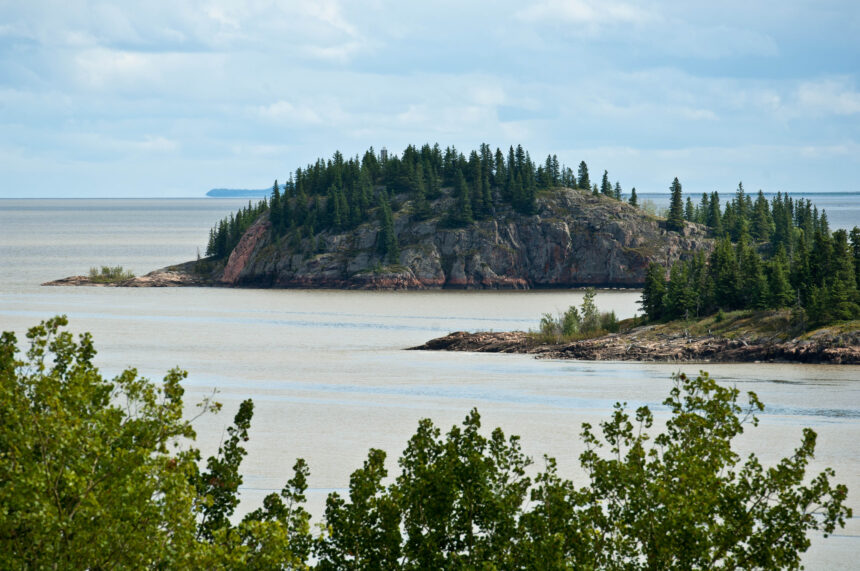
The original Fort Chipewyan, built in 1788 by Roderick Mackenzie, sat at Old Fort Point on the south shore of Lake Athabasca. It worked for a window of time. The country around it had productive fur catchments and the lake itself supported reliable fishing. A second iteration of the post was active in the late 1790s before the company made the call to move the whole operation across the lake.
Why the original Old Fort Point did not last
Three operational issues drove the relocation, judging from the surviving post journals.
- Fishing yields at the south shore began to decline as harvest pressure grew.
- The south shore landing was exposed in heavy weather coming off the lake.
- The fur catchment was reorganising as Indigenous trade patterns shifted, and the north shore was better positioned to serve the new patterns.
The company did what any operator with a working asset and a deteriorating site would do. It moved.
The 1803 move across the lake
In 1803 the North West Company built Fort Chipewyan III on the north shore at the location of the present community. The Alberta Register of Historic Places lists it under ID 11935 and granted it Provincial Historic Resource status on August 10, 1987. The third location had three things going for it. Better fishing access. Better shelter from prevailing wind. Better positioning for the supply canoes coming up the Athabasca. The site has not moved since.
Two centuries on the same shore
The 1803 site is also the spot where the Hudson’s Bay Company set up its own competing Fort Chipewyan within a few years, where the post continued to operate after the 1821 merger combined the two companies, and where the community of Fort Chipewyan kept growing through the nineteenth and twentieth centuries. Indigenous habitation in the area is much older than any of these forts. The modern Hamlet of Fort Chipewyan layers two and a half centuries of trade post history on top of much deeper Cree, Dene, and Métis presence in the country.
A heritage buff view of repeated rebuilds
Here is the pattern. Alberta communities are not built by proclamation. They are built by the third or fourth iteration of a site that finally pencils out. Same goes for ranches that moved more than once. Same goes for railway towns that grew and shrank with the route. Same goes for energy hubs that picked up and put down operations as the resource moved. Permanence in this province is earned by trial. Fort Chipewyan is the cleanest example of the rule. Three locations, one stuck, two hundred and twenty-three years of continuous habitation. The lesson is generous if you let it be. You do not need to get the location right on the first attempt. You need to keep paying attention until you get it right.
Listed on the registry. Fort Chipewyan III appears on the Canadian Register of Historic Places as Site ID 11935 and was designated a Provincial Historic Resource on August 10, 1987.
Related reading from the series. The original Fort Chipewyan and the founding of Alberta commerce. Fort Dunvegan, the only standing fur trade site in Alberta.