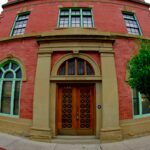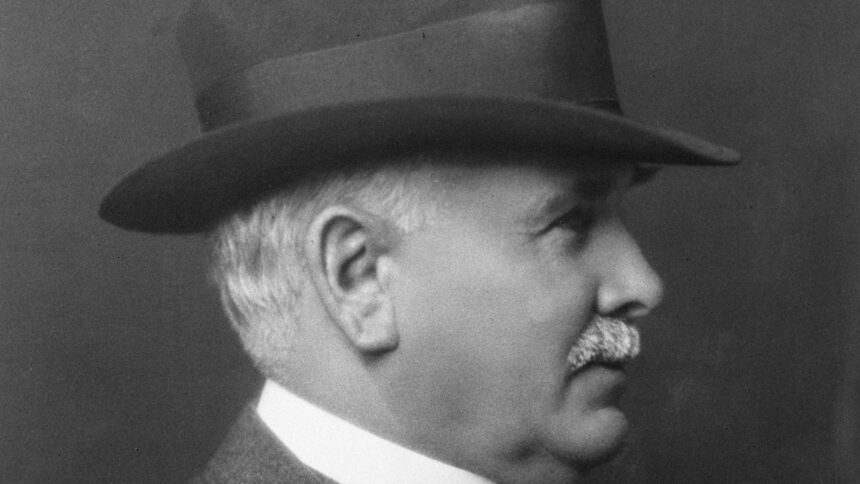
A wrought-iron canopy still stretches over the sidewalk at 237 8 Avenue SE in Calgary, and above it rises six storeys of terra cotta with “BURNS BUILDING” set in relief across the front. Inside the doors the Canadian Register of Historic Places lists original marble and tile among the features worth keeping. It is a handsome piece of commercial architecture, and it was built to sell meat.
Thanksgiving falls on Monday, October 12 this year, which makes it a fair week to look at where Calgary bought its roast. The ground floor was a Burns retail market. The offices stacked above it paid the mortgage.
Key facts
- The Burns Building was built between March 3, 1912 and January 1, 1913 to a design by architect William Stanley Bates, with Norton-Griffiths Steel Construction Company of Vancouver as builder, per the register.
- The Province of Alberta designated it a Provincial Historic Resource on July 20, 1987 under the Historical Resources Act.
- Patrick Burns bought out or started more than 100 retail meat shops in Alberta and British Columbia, according to the Dictionary of Canadian Biography.
- By 1914 Burns controlled more than 400,000 acres and more than 30,000 head of cattle, and his firm had bought or set up about 65 creameries and cheese factories between 1909 and 1919, the same biography says.
The meat market sat under the offices
The structure is reinforced concrete poured in the Kahn system, which let the Vancouver builders raise six storeys with a grid of windows across the front. The register calls the style Chicago, a downtown office idiom borrowed for a business that dealt in carcasses. That pairing is the detail worth keeping: a working shop with rentable floors above it is a plan a man who started in a slaughterhouse would understand at once.
A slaughterhouse on the Elbow became a hundred shops
Burns built his first slaughterhouse in 1890 on the east side of the Elbow River. He had already spent years buying cattle and feeding railway construction crews, and in 1897 he shipped cattle by rail to Vancouver and by sea to Skagway so they could be herded over the Chilkoot Pass to the Yukon gold fields. The same firm that sold the Sunday roast also supplied butter and cheese through those creameries. The building on 8 Avenue was finished the year the first Calgary Stampede ran, September 2 to 7, 1912, with Burns among the four men who put up the money and the organization.
One city council vote kept it standing
The building later sat on land wanted for the Calgary Centre for the Performing Arts, and a proposal to demolish it failed by a single vote of city council, as one account tells it. The province designated it in 1987, 75 years after it was finished (a calculation, not a published figure). That is a long wait for a building that was already in demolition range.
Calgary remembers the rancher and forgets the counting room
Calgary is good at remembering cattle. The Big Four are a fixture of Stampede history, and every July the city dresses for them. What the record shows on 8 Avenue is that a building tied to one of those four survived on the margin of one vote.
The money behind Calgary’s early fortunes was made in plain commercial blocks, in offices, market halls and warehouses where cheques were signed and invoices filed. Those buildings carry no hats or horses, so they draw no festivals, and they stand on land somebody always wants for something larger. A city that celebrates the herd and leaves the counting house to a one-vote margin is protecting the story and gambling with the evidence. Other Calgary buildings have had better luck with their paperwork, among them the Fire Hall No. 1 and the 1885 Immigration Hall.
On Thanksgiving Monday you can stand under the canopy, look up at the terra cotta and read the name in the stone.