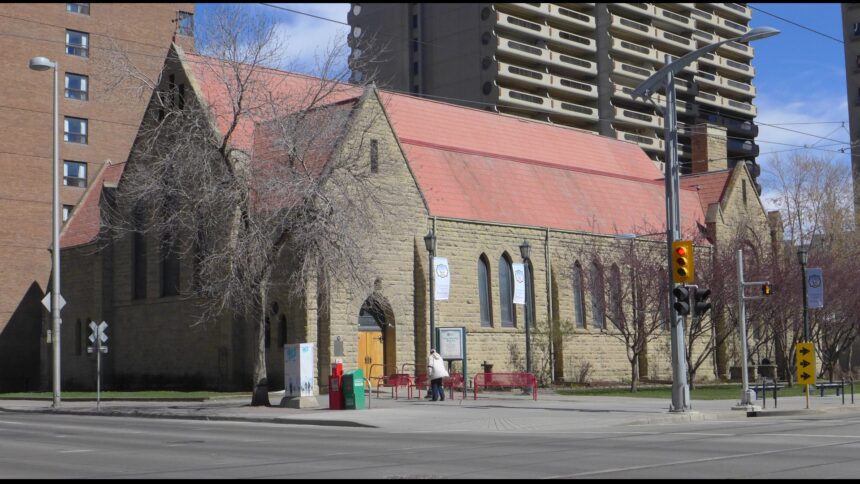
Three stained-glass windows in the Cathedral Church of the Redeemer on 7 Avenue Southwest are older than the building around them. They were made for a wooden church that opened for worship on August 3, 1884, and the register says McCausland and Company installed them in the stone building when it went up in 1905.
The wooden church was the first Anglican church in what is now the Diocese of Calgary, according to the cathedral’s history. Its windows moved across, and so did its standing, because the title it held was temporary and the title outlasted the timber.
Key facts
- The Cathedral Church of the Redeemer in Calgary was designed by Scottish-born architect John C. M. Keith, and its construction date is recorded as January 1, 1905, according to the Canadian Register of Historic Places.
- The Redeemer received provisional cathedral status on February 14, 1889, according to the cathedral’s published history.
- The Anglican Diocese of Calgary records that the Redeemer became a full cathedral in June 1949.
- The stone building measures 145 feet long and 70 feet wide and was completed on July 30, 1905, according to the cathedral’s published history.
Stone Replaced Wood in 1905
Keith, an architect in Victoria, British Columbia, was commissioned in 1903. The register calls his design an eclectic Gothic Revival with a German strain going back to the Romanesque. The parish built it of rusticated Paskapoo sandstone, which the register says came from the Oliver quarry, in the years when Calgary was putting up one sandstone landmark after another. The nave ceiling rises 45 feet.
The original roof cladding is a fish-scale pattern, which the register calls the first metal roofing used in Calgary. The diocese counts it among the oldest tin roofs in the city. Inside are a barrel-vaulted nave with a pine ceiling, double transepts with their own gabled roofs, oak woodwork, an organ dating to 1906 and windows by William Morris and Company of Merton Abbey. The oak rood screen was dedicated by the Prince of Wales in 1919.
The Title Waited Sixty Years
The wooden church was proclaimed a pro-cathedral on February 14, 1889, after the Diocese of Calgary was created, and the title went with the parish into the stone building. The register describes the pro-cathedral as a temporary designation. It stayed temporary until June 1949, which is 60 years by simple subtraction, and for 44 of them the stone building carried it.
The diocese’s explanation for the change is plain. By 1949 it was obvious that a large cathedral on a British or European scale was never going to be built in Calgary, so the church that already stood was confirmed.
The Records Disagree on the Dates
The register says that in 1905 it was determined Calgary would become the seat of a new Anglican diocese. The cathedral’s history places the provisional cathedral status in 1889, after the diocese was created. Both cannot be a complete account of the diocese’s founding, and the church’s own record is the more detailed one.
Other dates split as well. The register gives provincial designation as July 13, 1977, while the cathedral says it became a Registered Heritage Site in September 1974 under the Alberta Heritage Act, 1973. The Lady Chapel is dated 1935 in the register and 1936 in the cathedral’s history, where it is credited to Henry and Eleanor Tomkins. These could not be reconciled from the sources checked.
The register does call the church the Pro-Cathedral, but in the entry’s text it gives neither the 1889 nor the 1949 date, and a heritage entry without those dates has described the stone and left out the status. Sixty years of being officially provisional is the most distinctive fact about the building. The entry should carry both dates and cite the parish history that supports them.
Heritage writing tends to flatter old buildings. This one does not need it, because the record shows a congregation that built in stone in 1905 and waited another 44 years for the title.
Three windows from a wooden church of 1884 still hold the light in a sandstone wall.
Related from Alberta Tribune: The Hunt House and the Oldest Building Still Standing in Downtown Calgary · At 45, West Edmonton Mall Still Cannot Agree on Its Attraction Count · Rossdale Power Plant Still Carries Its Building Dates In White Bands